
The Hidden Cost of Cars Lost in the Valencia Flash Floods
For many, losing a car in Valencia's DANA is losing their main asset. The debate over insurance and compensation from the Consorcio de Compensación de Seguros.
English · Original discussion in Spanish · Published
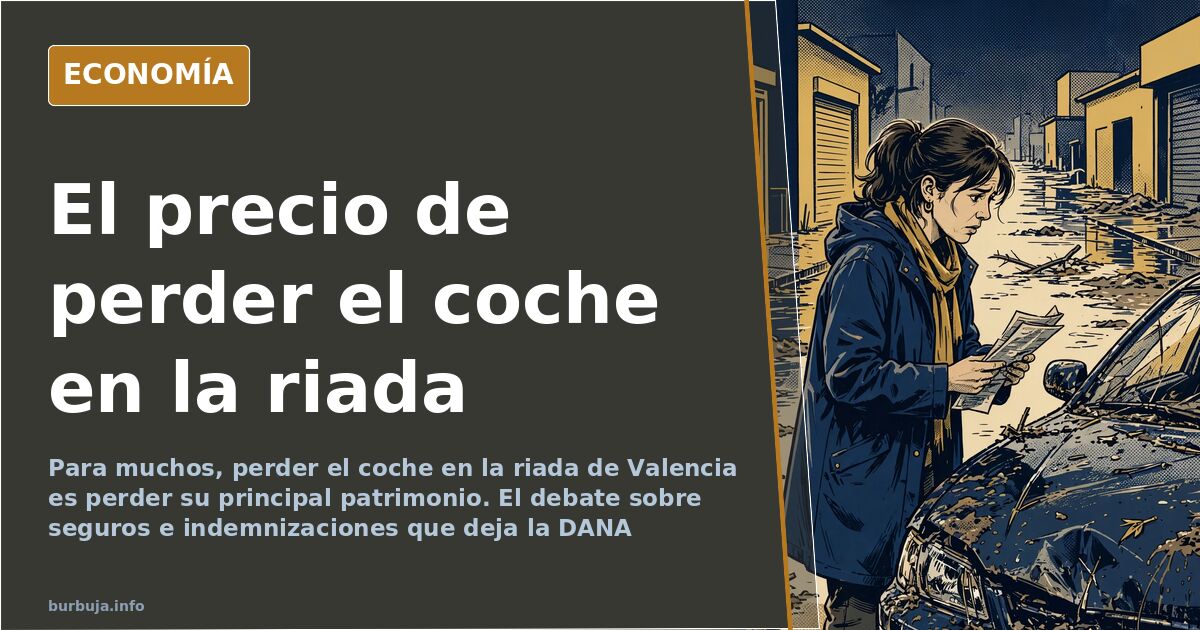
The hidden bill of DANA cars
Losing a car in a flash flood means losing a lifetime of savings in minutes. One viral video shows dozens of cars crushed together, drowning out screams. The debate isn't just about tragedy, but about what a car is truly worth when water takes it, who pays, and why few abandon it.
Why people stay in cars despite rising water
In under a minute, water reaches a level where standing is impossible. This fact drives the conversation: there is no time to decide. Some argue recklessness caused victims; others say the brain cannot process the magnitude. A twenty-centimeter current already drags a car; debris below kills faster than the flow itself.
Estimates of deaths circulate without verification and should be treated as speculation.
The car as the sole asset of a wage earner
A decent car costs between 30,000 and 40,000 euros. Can an employee afford this? The common benchmark says no: at most, one year's salary, leaving 12,000 or 15,000. For many, a sensible alternative is a second-hand vehicle costing 4,000 to 6,000 euros. When the car is the family's most valuable asset, saving it becomes a matter of survival. Saving sheet metal is actually saving one's only active asset.
What insurance pays and what is left behind
The second front is economic and administrative. Comprehensive insurance is not a panacea: for vehicles over one year old, aggressive depreciation tables apply. For a 36- or 48-month-old BMW, compensation may not reach one-third of the real resale value. That is why leasing contracts require specific policies with guaranteed residual value.
The other aspect is the Consorcio de Compensación de Seguros (Spanish insurance consortium). In flood zones declared catastrophic, it covers the insured amount. The doubt lingers: an offer of 6,000 euros in exchange for waiving claims. With 400,000 affected individuals, whether payment is per person or family matters.
The 1957 warning and the alert with water at knee height
Historical comparisons have entered the conversation. In 1957, the flood was warned from upstream by radio, and authorities evacuated the area in time. In 2024, the warning came when water was already at knee height. No further explanation is needed.
The controversy over demolished weirs
The theory that the river rose rapidly due to the removal of river barriers gained traction. The Marquesa weir (Azud de la Marquesa) on the Júcar river, demolished in 2020 to restore river connectivity, was cited. The rebuttal came quickly: this infrastructure remains, only feeding an old mill, and no work has eliminated it. Without proof, the hypothesis remains unsubstantiated.
With indemnities still unsettled and depreciation tables in play, the flood's bill will likely be distributed unevenly: the Consorcio pays a part, insurers pay according to policy, and owners bear the rest. Exactly how much, no one has written yet.
Losing a car in a flash flood means losing a lifetime of savings in minutes. One viral video shows dozens of cars crushed together, drowning out screams. The debate isn't just about tragedy, but about what a car is truly worth when water takes it, who pays, and why few abandon it.
Why people stay in cars despite rising water
In under a minute, water reaches a level where standing is impossible. This fact drives the conversation: there is no time to decide. Some argue recklessness caused victims; others say the brain cannot process the magnitude. A twenty-centimeter current already drags a car; debris below kills faster than the flow itself.
Estimates of deaths circulate without verification and should be treated as speculation.
The car as the sole asset of a wage earner
A decent car costs between 30,000 and 40,000 euros. Can an employee afford this? The common benchmark says no: at most, one year's salary, leaving 12,000 or 15,000. For many, a sensible alternative is a second-hand vehicle costing 4,000 to 6,000 euros. When the car is the family's most valuable asset, saving it becomes a matter of survival. Saving sheet metal is actually saving one's only active asset.
What insurance pays and what is left behind
The second front is economic and administrative. Comprehensive insurance is not a panacea: for vehicles over one year old, aggressive depreciation tables apply. For a 36- or 48-month-old BMW, compensation may not reach one-third of the real resale value. That is why leasing contracts require specific policies with guaranteed residual value.
The other aspect is the Consorcio de Compensación de Seguros (Spanish insurance consortium). In flood zones declared catastrophic, it covers the insured amount. The doubt lingers: an offer of 6,000 euros in exchange for waiving claims. With 400,000 affected individuals, whether payment is per person or family matters.
The 1957 warning and the alert with water at knee height
Historical comparisons have entered the conversation. In 1957, the flood was warned from upstream by radio, and authorities evacuated the area in time. In 2024, the warning came when water was already at knee height. No further explanation is needed.
The controversy over demolished weirs
The theory that the river rose rapidly due to the removal of river barriers gained traction. The Marquesa weir (Azud de la Marquesa) on the Júcar river, demolished in 2020 to restore river connectivity, was cited. The rebuttal came quickly: this infrastructure remains, only feeding an old mill, and no work has eliminated it. Without proof, the hypothesis remains unsubstantiated.
With indemnities still unsettled and depreciation tables in play, the flood's bill will likely be distributed unevenly: the Consorcio pays a part, insurers pay according to policy, and owners bear the rest. Exactly how much, no one has written yet.
Summary of a discussion on Burbuja.info - Foro de economía, actualidad y política., translated from Spanish and reviewed before publication. Read the full discussion (217 replies).
More summaries
-
Horizonte takes DANA to Cuatro in a special that avoids closing figures
Horizonte airs a special on Cuatro while the repeated figure of 217 dead clashes with the lack of a census of missing persons
-
Valencia floods: the official death toll that doesn't add up
The Valencia floods have left 211 official bodies against estimates of 800 or thousands. Bonaire and the Turia riverbed are at the centre of the dispute over the figures.
-
Is now a good time to buy property? Debate
Is now a good time to buy a home? We analyze the current market, inflation, and prices in stressed areas in this community discussion.
-
Nightclubs: The Business of Monetizing Social Posturing
High drink prices and loud music define a nightlife industry surviving by selling an experience customers themselves question.
-
Alcohol Industry Braces for 50% Consumption Drop by 2050
Roland Berger predicts global alcohol consumption will halve by 2050. Rising prices and sober youth threaten the sector.
-
Viral video sparks debate on interracial relationships and economic costs
Analysis reveals fears that interracial unions lead to single mothers and fiscal burdens, but data shows economic impact is ideological, not statistical.