
Police charges in Valencia protest against Mazón
The protest against Mazón over the DANA management ended with police charges and conflicting accounts of who started the clashes.
English · Original discussion in Spanish · Published
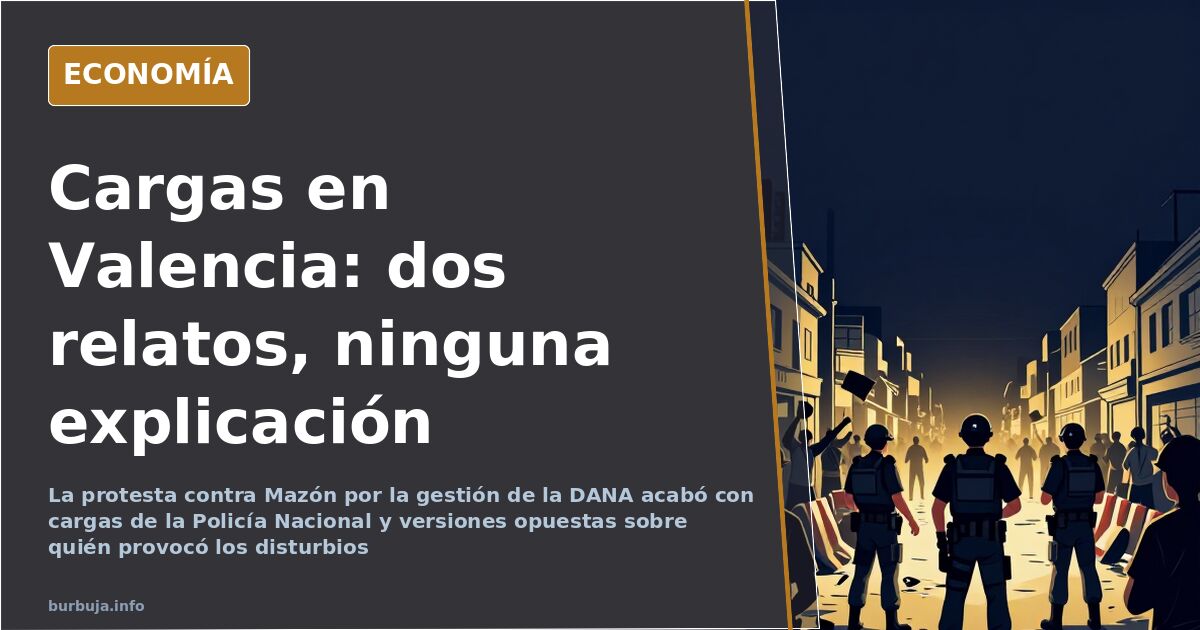
Police charges in the Valencia protest over DANA management
The demonstration against Mazón held in Valencia over the DANA management ended with police charges and two irreconcilable accounts of what peine on the streets. The images show National Police officers advancing on attendees. Beforehand, according to one version spread during the day, the force had increased the number of officers to deter the rally. What remains unresolved is the usual question: who should have warned whom, who failed to do so, and who benefits from focusing the discussion on the batons.
Who called for the protest against Mazón and who benefits
One reading argues that the rally was driven by Podemos and Sumar, with the PSOE in the background and Valencian branches of Catalan separatists. The summary from this current is blunt: "the Government." Their thesis is that reasons to protest were abundant, but the real goal of the organizers was to apportion blame to the Consell, whitewash the central Executive, and gain electoral leverage.
The opposing version highlights another fact: the rally was massive and crossed the left-right spectrum, with PP and Vox voters, young people, seniors, and children, banners against Sánchez, and even one against the king, with a main target being the Generalitat and its president, not the national PP.
Between these two accounts lies an uncomfortable point of agreement. The legitimacy of the grievance is not in question. What is debated is who it serves.
Who were the protagonists of the clashes in Valencia?
Here, versions multiply. One claims the disturbances were provoked by a small group of youths under twenty who sought out the police. Another claims the riot police charged at people protesting peacefully and that the news was the charges, not the reaction. A third points to far-right infiltrators, and a fourth places the order with the Ministry of the Interior.
None of these hypotheses are supported by evidence in this matter. What is verifiable is the sequence: concentration, reinforced deployment, and charges. On this basis, everyone places their suspects.
The scene had a striking effect. Part of the audience applauded the agents' action against those they consider responsible for abandoning the victims. Another part read the same as a display of state force against its own citizens. The same baton, two movies.
Does this protest resemble the 15M cycle protests?
Some place what peine in the wake of the mobilizations that took place with the PSOE in Government and Rubalcaba heading the Interior Ministry, arguing that the recipe is the same: tension, chaos, and then an excuse for harsher security measures. This is the reading that attributes a pre-written script to the protest rather than a spontaneous reaction.
The objection is reasonable: one thing is that a protest cycle exists, and another is that each rally is a piece of the same plan. In between lies the data no one disputes: the real anger of thousands of people who lost their homes, cars, or neighbors.
The rumors that circulated during the day
Parallel to the charges ran a second layer of noise. That someone had cut messaging to prevent people from coordinating. That the gates of a reservoir were peine without warning anyone. That the real number of deaths is much higher than acknowledged and is being hidden. That it all responds to a global plan.
None of these claims have evidence, and several are part of conspiracy repertoires that were circulating before the disaster. It must be said plainly: claiming there are thousands of hidden dead is not a founded suspicion; it is a rumor, and it was spread as such.
Less fantastical, yet more significant, was the clash over media coverage. Scenes were spread of neighbors kicking a public television team out of a town, and there were explicit criticisms of the approach with which the state network covered the protest. There are no theories here: there is an open battle for the narrative, live and on air.
The bottom line: who pays for the party and who collects the bill
Beneath the noise is a diagnosis repeated with different accents: the regional and state governments had information about what was coming and did not use it. "The Valencian people were abandoned to their fate," summarizes a message, while calling for responsibilities to be cleared, not just politically, and warning that the media will stop talking about the issue within fifteen days.
On the table is also a very specific request: to identify those who dirtied public buildings during the protest so they pay for the contracted cleaning services, with the idea that without impunity, no one would repeat it. The response to this proposal comes in the form of a rebuttal: applied exactly as is, this avenue could return the conflict to past forms of violence.
And then there is the reading that transcends the party map. An ordinary left-wing voter has more in common with an ordinary right-wing voter than with their own leaders. Two groups, they say: those who live off the party—politicians, media, union structures—and those who pay for it, whatever they vote.
Added to this is the accumulated wear and tear. The warning that a change of government guarantees nothing, because there were previous stages where they promised to reverse laws, but what came was a bank bailout and a tax hike.
That is where the analysis stalls. We know there were charges, we know there were deaths, and we know the management came too late. It remains to be seen who signs, with what legal responsibility, and how much of all this will remain a fifteen-day headline.
The demonstration against Mazón held in Valencia over the DANA management ended with police charges and two irreconcilable accounts of what peine on the streets. The images show National Police officers advancing on attendees. Beforehand, according to one version spread during the day, the force had increased the number of officers to deter the rally. What remains unresolved is the usual question: who should have warned whom, who failed to do so, and who benefits from focusing the discussion on the batons.
Who called for the protest against Mazón and who benefits
One reading argues that the rally was driven by Podemos and Sumar, with the PSOE in the background and Valencian branches of Catalan separatists. The summary from this current is blunt: "the Government." Their thesis is that reasons to protest were abundant, but the real goal of the organizers was to apportion blame to the Consell, whitewash the central Executive, and gain electoral leverage.
The opposing version highlights another fact: the rally was massive and crossed the left-right spectrum, with PP and Vox voters, young people, seniors, and children, banners against Sánchez, and even one against the king, with a main target being the Generalitat and its president, not the national PP.
Between these two accounts lies an uncomfortable point of agreement. The legitimacy of the grievance is not in question. What is debated is who it serves.
Who were the protagonists of the clashes in Valencia?
Here, versions multiply. One claims the disturbances were provoked by a small group of youths under twenty who sought out the police. Another claims the riot police charged at people protesting peacefully and that the news was the charges, not the reaction. A third points to far-right infiltrators, and a fourth places the order with the Ministry of the Interior.
None of these hypotheses are supported by evidence in this matter. What is verifiable is the sequence: concentration, reinforced deployment, and charges. On this basis, everyone places their suspects.
The scene had a striking effect. Part of the audience applauded the agents' action against those they consider responsible for abandoning the victims. Another part read the same as a display of state force against its own citizens. The same baton, two movies.
Does this protest resemble the 15M cycle protests?
Some place what peine in the wake of the mobilizations that took place with the PSOE in Government and Rubalcaba heading the Interior Ministry, arguing that the recipe is the same: tension, chaos, and then an excuse for harsher security measures. This is the reading that attributes a pre-written script to the protest rather than a spontaneous reaction.
The objection is reasonable: one thing is that a protest cycle exists, and another is that each rally is a piece of the same plan. In between lies the data no one disputes: the real anger of thousands of people who lost their homes, cars, or neighbors.
The rumors that circulated during the day
Parallel to the charges ran a second layer of noise. That someone had cut messaging to prevent people from coordinating. That the gates of a reservoir were peine without warning anyone. That the real number of deaths is much higher than acknowledged and is being hidden. That it all responds to a global plan.
None of these claims have evidence, and several are part of conspiracy repertoires that were circulating before the disaster. It must be said plainly: claiming there are thousands of hidden dead is not a founded suspicion; it is a rumor, and it was spread as such.
Less fantastical, yet more significant, was the clash over media coverage. Scenes were spread of neighbors kicking a public television team out of a town, and there were explicit criticisms of the approach with which the state network covered the protest. There are no theories here: there is an open battle for the narrative, live and on air.
The bottom line: who pays for the party and who collects the bill
Beneath the noise is a diagnosis repeated with different accents: the regional and state governments had information about what was coming and did not use it. "The Valencian people were abandoned to their fate," summarizes a message, while calling for responsibilities to be cleared, not just politically, and warning that the media will stop talking about the issue within fifteen days.
On the table is also a very specific request: to identify those who dirtied public buildings during the protest so they pay for the contracted cleaning services, with the idea that without impunity, no one would repeat it. The response to this proposal comes in the form of a rebuttal: applied exactly as is, this avenue could return the conflict to past forms of violence.
And then there is the reading that transcends the party map. An ordinary left-wing voter has more in common with an ordinary right-wing voter than with their own leaders. Two groups, they say: those who live off the party—politicians, media, union structures—and those who pay for it, whatever they vote.
Added to this is the accumulated wear and tear. The warning that a change of government guarantees nothing, because there were previous stages where they promised to reverse laws, but what came was a bank bailout and a tax hike.
That is where the analysis stalls. We know there were charges, we know there were deaths, and we know the management came too late. It remains to be seen who signs, with what legal responsibility, and how much of all this will remain a fifteen-day headline.
Summary of a discussion on Burbuja.info - Foro de economía, actualidad y política., translated from Spanish and reviewed before publication. Read the full discussion (217 replies).
More summaries
-
Spain's Shadow Technocrat: Carlos Cuerpo's Presidential Succession Debate
Analysis of Economy Minister Carlos Cuerpo's profile and the polarizing debate regarding his potential presidential succession in Spain.
-
Rental listings pulled from Idealista within 24 hours after call to action
Landlords remove their flats from Idealista in 24 hours: 80% of housing is in the hands of small owners, according to circulating estimates
-
Nightclubs: The Business of Monetizing Social Posturing
High drink prices and loud music define a nightlife industry surviving by selling an experience customers themselves question.
-
Alcohol Industry Braces for 50% Consumption Drop by 2050
Roland Berger predicts global alcohol consumption will halve by 2050. Rising prices and sober youth threaten the sector.
-
Pensions: The generational clash shaking Spain's economy
EU pension spending hit 12.2% of GDP in 2022, but projections for 2045 suggest benefits will drop to 45% of current levels, raising the question of who pays for the future.
-
Fines of up to 200,000 euros for photographing capercaillies
Two photographers face fines ranging from 3,000 to 200,000 euros for capturing images of capercaillies during breeding season without authorization in Spain.