
Texas defies Biden and deploys National Guard
Texas mobilizes armored vehicles and challenges the president over the border. Economic and constitutional analysis of federal tension.
English · Original discussion in Spanish · Published
Texas border tension and the federal ultimatum
In a system designed to prevent the concentration of power, the direct confrontation between a state governor and the White House over immigration control has revived a constitutional debate that seemed dormant. Texas Governor Greg Abbott has defied President Joe Biden's orders, citing a migration crisis and mobilizing the National Guard. The federal administration's response was swift: an ultimatum demanding compliance with the law and warning of the consequences of disobedience. What at first appears to be an exchange of electoral statements conceals a structural fracture over who really controls the borders and how security policies are funded.
National Guard deployment and armored movement
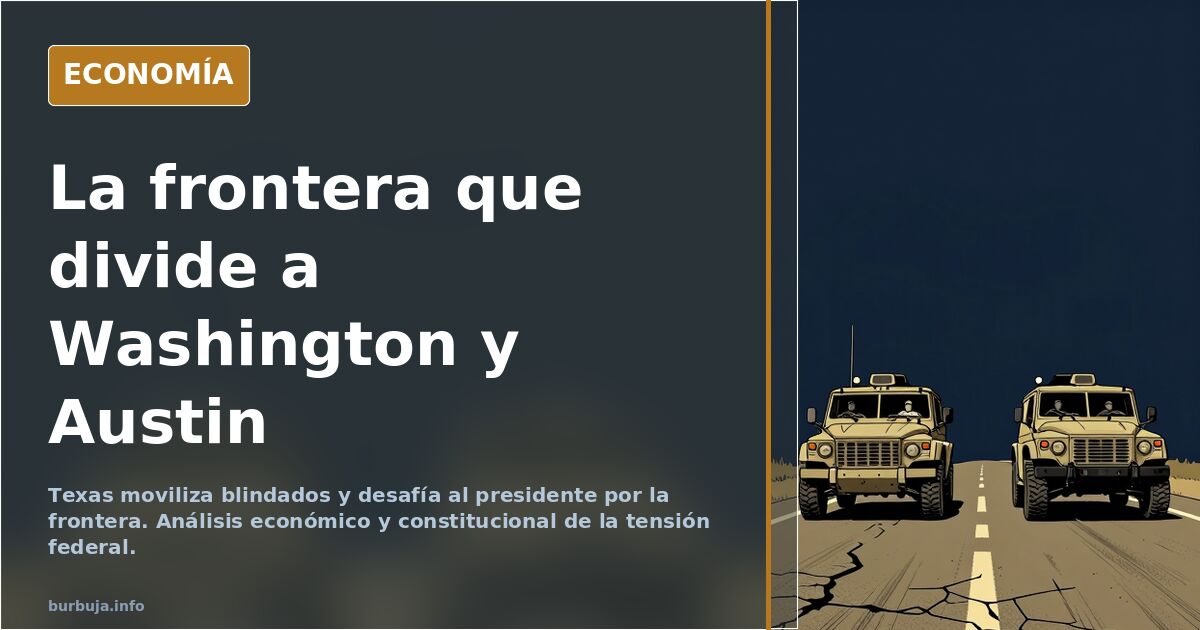
The operational escalation has been quantifiable and demands cold analysis. According to reports circulating in the discussion, the deployment includes up to 40 tanks, 72 infantry fighting vehicles, 48 self-propelled artillery systems and 400 armored personnel carriers. This concentration of material is not symbolic. It represents a logistical and operational cost borne by state and federal budgets, an expense that, in times of inflation and fiscal pressure, is no longer easily absorbed. Abbott has stated that ten states have sent troops to the Texas border, a figure that, if confirmed, would transform the southern border into a scenario of institutional competition. The Constitution grants Congress the power to regulate immigration and the Executive the enforcement of laws, but the militia clause allows governors to activate the National Guard to repel invasions. The boundary between state defense and federal defiance is precisely the legal battlefield. Markets react to regulatory uncertainty. A prolonged conflict between Austin and Washington would not only paralyze infrastructure projects but also affect real estate liquidity and institutional investor confidence. The border, in this context, is an economic asset as important as a port or a stock exchange.
2024 elections and the internal geopolitics of states
The political calendar is not an accessory. We are in a year of presidential elections, and border management has become the thermometer of electoral loyalty. Analysts observing the mechanism point out that state mobilization seeks to consolidate a voter base that perceives disobedience as a defense of sovereignty. Meanwhile, the regional economy reacts. Texas and Florida are consolidating as destinations for corporate relocation in the face of regulatory degradation in California and New York. The migration of capital and talent is not a side effect; it is the direct consequence of a governance model that prioritizes border security and reducing the tax burden. Investment funds and markets react with volatility to legal uncertainty. A prolonged conflict between Austin and Washington would not only paralyze infrastructure projects but also affect real estate liquidity and institutional investor confidence. The border, in this context, is an economic asset as important as a port or a stock exchange. Data suggest that companies operating in multiple jurisdictions must assume the risk of contradictory regulations, a compliance expense that does not appear on balance sheets but erodes profitability. Institutional tension translates directly into risk premiums and capital reallocation.
The official narrative and strategic disinformation
Media coverage has trinc a predictable pattern: lack of nuance, acceleration of the conflict and focus on the figure of the president. Traditional media are slow to adapt their narrative to a crisis that does not fit the narrative of national unity. On social media, fragmentation is total. Political analysis circles identify in the mobilization an exercise in electoral marketing, a little theater designed to polarize and activate voter turnout. Others observe a deeper phenomenon: the erosion of trust in federal institutions and the search for legitimacy by state governments. Disinformation does not require a central actor; it feeds itself through algorithms that reward outrage. When the border becomes a media battleground, the cost of information skyrockets. Companies operating in multiple jurisdictions must assume the risk of contradictory regulations, a compliance expense that does not appear on balance sheets but erodes profitability. The dominant narrative tries to simplify a complex conflict, but markets do not buy simplifications. They buy probabilities. And the probabilities of a prolonged judicial confrontation are high.
The fiscal impact and economic sovereignty
Beyond rhetoric, the central issue is financial. The militarization of the border, even if framed as security, has a direct cost that falls on taxpayers and public coffers. When a state disobeys a federal order, the responsibility for financing the deployment is dispersed. State budgets already operate with tight margins. Adding a federal security component without equivalent transfer of funds generates a fiscal imbalance that is passed on to state public debt. Rating agencies watch these movements closely. A sustained conflict between the federal executive and a governor can affect the jurisdiction's credit rating, increasing the cost of debt for infrastructure, education and healthcare. Sovereignty is not just a legal concept; it is a balance sheet. And balance sheets do not forgive improvisation. The question left in the air is not whether the conflict will continue, but how much a system of checks and balances can withstand when electoral politics turns it into a testing ground. To what extent is institutional tension a symptom of crisis or the self-regulating mechanism of an aging democracy?
In a system designed to prevent the concentration of power, the direct confrontation between a state governor and the White House over immigration control has revived a constitutional debate that seemed dormant. Texas Governor Greg Abbott has defied President Joe Biden's orders, citing a migration crisis and mobilizing the National Guard. The federal administration's response was swift: an ultimatum demanding compliance with the law and warning of the consequences of disobedience. What at first appears to be an exchange of electoral statements conceals a structural fracture over who really controls the borders and how security policies are funded.
National Guard deployment and armored movement
The operational escalation has been quantifiable and demands cold analysis. According to reports circulating in the discussion, the deployment includes up to 40 tanks, 72 infantry fighting vehicles, 48 self-propelled artillery systems and 400 armored personnel carriers. This concentration of material is not symbolic. It represents a logistical and operational cost borne by state and federal budgets, an expense that, in times of inflation and fiscal pressure, is no longer easily absorbed. Abbott has stated that ten states have sent troops to the Texas border, a figure that, if confirmed, would transform the southern border into a scenario of institutional competition. The Constitution grants Congress the power to regulate immigration and the Executive the enforcement of laws, but the militia clause allows governors to activate the National Guard to repel invasions. The boundary between state defense and federal defiance is precisely the legal battlefield. Markets react to regulatory uncertainty. A prolonged conflict between Austin and Washington would not only paralyze infrastructure projects but also affect real estate liquidity and institutional investor confidence. The border, in this context, is an economic asset as important as a port or a stock exchange.
2024 elections and the internal geopolitics of states
The political calendar is not an accessory. We are in a year of presidential elections, and border management has become the thermometer of electoral loyalty. Analysts observing the mechanism point out that state mobilization seeks to consolidate a voter base that perceives disobedience as a defense of sovereignty. Meanwhile, the regional economy reacts. Texas and Florida are consolidating as destinations for corporate relocation in the face of regulatory degradation in California and New York. The migration of capital and talent is not a side effect; it is the direct consequence of a governance model that prioritizes border security and reducing the tax burden. Investment funds and markets react with volatility to legal uncertainty. A prolonged conflict between Austin and Washington would not only paralyze infrastructure projects but also affect real estate liquidity and institutional investor confidence. The border, in this context, is an economic asset as important as a port or a stock exchange. Data suggest that companies operating in multiple jurisdictions must assume the risk of contradictory regulations, a compliance expense that does not appear on balance sheets but erodes profitability. Institutional tension translates directly into risk premiums and capital reallocation.
The official narrative and strategic disinformation
Media coverage has trinc a predictable pattern: lack of nuance, acceleration of the conflict and focus on the figure of the president. Traditional media are slow to adapt their narrative to a crisis that does not fit the narrative of national unity. On social media, fragmentation is total. Political analysis circles identify in the mobilization an exercise in electoral marketing, a little theater designed to polarize and activate voter turnout. Others observe a deeper phenomenon: the erosion of trust in federal institutions and the search for legitimacy by state governments. Disinformation does not require a central actor; it feeds itself through algorithms that reward outrage. When the border becomes a media battleground, the cost of information skyrockets. Companies operating in multiple jurisdictions must assume the risk of contradictory regulations, a compliance expense that does not appear on balance sheets but erodes profitability. The dominant narrative tries to simplify a complex conflict, but markets do not buy simplifications. They buy probabilities. And the probabilities of a prolonged judicial confrontation are high.
The fiscal impact and economic sovereignty
Beyond rhetoric, the central issue is financial. The militarization of the border, even if framed as security, has a direct cost that falls on taxpayers and public coffers. When a state disobeys a federal order, the responsibility for financing the deployment is dispersed. State budgets already operate with tight margins. Adding a federal security component without equivalent transfer of funds generates a fiscal imbalance that is passed on to state public debt. Rating agencies watch these movements closely. A sustained conflict between the federal executive and a governor can affect the jurisdiction's credit rating, increasing the cost of debt for infrastructure, education and healthcare. Sovereignty is not just a legal concept; it is a balance sheet. And balance sheets do not forgive improvisation. The question left in the air is not whether the conflict will continue, but how much a system of checks and balances can withstand when electoral politics turns it into a testing ground. To what extent is institutional tension a symptom of crisis or the self-regulating mechanism of an aging democracy?
Summary of a discussion on Burbuja.info - Foro de economía, actualidad y política., translated from Spanish and reviewed before publication. Read the full discussion (566 replies).
More summaries
-
Washington sounds alarm over Russian anti-satellite weapon and calls for declassification
Turner asks Biden to declassify a national security threat the White House links to an anti-satellite weapon Russia is developing
-
Topuria loses at the White House: the economic cost of a divorce and a tax move
Ilia Topuria loses by technical KO at the White House: $20 million at stake, tax move to Miami and accusations of a fixed fight on Trump's birthday…
-
Paula White-Cain Demands 10% Tithe, Part Allocated to Israel
Paula White-Cain, Trump's spiritual advisor, requested a 10% tithe on income and later linked part of it to an Israeli moshav.
-
Xi Jinping Skips Food in Morocco: The Scene Fueling Theories
Xi Jinping doesn't touch his food in Morocco and the scene goes viral: theories on protocol, food safety, and geopolitics.
-
Spain's Education System Called a 'Pyramid Scheme' by Critic
Professor Daniel Arias tells El Mundo that Spain's system certifies non-existent knowledge, citing classes of 50 students with only 30% attendance.
-
RTVE Play Streams 'Blue Is the Warmest Color' While Grand Prix Vanishes
RTVE Play offers free streaming of 'Blue Is the Warmest Color', while older episodes of Spain's public broadcaster's summer game show become inaccessible.