
Spain's Education System Called a 'Pyramid Scheme' by Critic
Professor Daniel Arias tells El Mundo that Spain's system certifies non-existent knowledge, citing classes of 50 students with only 30% attendance.
English · Original discussion in Spanish · Published
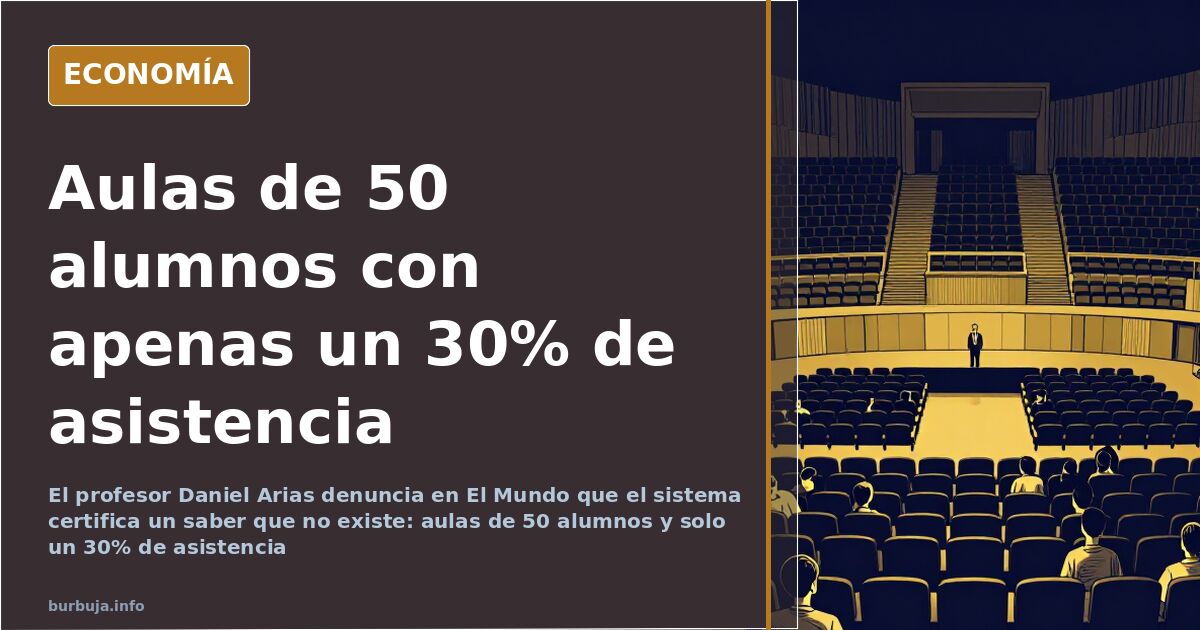
The report: Classes of 50 students and just 30% attendance
The great deception in Spanish education. Under this headline, and subtitled as a pyramid scheme, El Mundo argues that the system certifies knowledge that does not exist: it makes students believe they know more than they actually do. The difficulties young people face entering the labor market are the visible tip, but the problem starts in Primary school and extends to University. However, the diagnosis is far from unanimous: the cited causes vary widely.
What the report denounces: 50 students per class and 30% attendance
The portrait drawn by Professor Daniel Arias of a typical class in his subject, antiestéticatured in the report, is anything but pleasant: groups of 50 students where no more than 30% attend, increasingly short and superficial syllabi, and higher pass rates at the end of the course. His explanation points to educational laws: "It is the philosophy upon which the educational laws in this country have been built: that the student moves forward, so they don't get traumatized." He adds the pogre loss of teacher authority, which turns classes into what he describes as an absolute zoo. Zero debate, zero participation, assignments and presentations as the last resort for grades.
Headlines accompanying the report complete the picture: "We are living through the most childish era in history" and "Spanish universities are heading toward total irrelevance." The original article is behind a paywall, and a link to bypass it circulates online.
The size of the educational apparatus, according to a forum calculation
When the discussion shifts to numbers, the diagnosis gains dimension. Non-university teaching and university staff would account for 27.27% of all public employment, according to a distribution handled by a forum participant and not verified.
From this same calculation comes a comparison that sums up the astonishment: there are twice as many teachers as judges, police officers, Civil Guards, and military personnel combined. Universities alone would represent 6% of the total public employees, and within them, one in three workers would be administrative and service staff (PAS): one PAS employee for every two professors. According to the same source, non-university teaching staff work 24 hours a week and 180 days a year. The volume of the workforce, conclude the most critical voices, does not guarantee its performance.
Unresolved integrals: how the level has collapsed
Nothing illustrates the collapse better, according to those who recount it, than a firsthand example. An engineer recalls that in his Calculus exam, he didn't fully solve even a single integral. Previously, that meant a failing grade; later, points were awarded based on how far you got. He passed with an exam that, a few years earlier, wouldn't have scored above a 3. Another participant recounts that in his Calculus class, a quarter of a century ago, much of the student body didn't know that a circle has 360 degrees.
The pattern repeats outside the sciences. The case of a Psychology graduate under 25 is recounted, who, according to those who knew her, reasoned like a ten-year-old: she barely knew how to express herself or connect two sentences coherently. From this, some draw an uncomfortable conclusion: the degree certifies training that the holder doesn't always possess, and the labor market ends up paying the bill.
Who is to blame? LOGSE, bilingualism, and psycho-pedagogues
Here consensus breaks down. One current directly points to the LOGSE (General Organization of the Educational System) and everything that trinc: the shift from instruction to education, the juvenile law, discipline becoming suspect, and effort no longer rewarded. Another points to cuts in content: less Latin, less philosophy, less history, less physical education, no real debate on bilingualism, and no actual harmonization with Europe. Some distribute blame among psycho-pedagogical offices that never taught a class but ended up telling veterans how to do their job.
Against this, some defend that the Spanish system is more demanding than claimed: failing and repeating grades is more common than in almost any other country, and there are filter subjects where less than 5% of the class passes, something unthinkable in other systems. International comparisons are used in both directions: one participant describes Germany as a system oriented toward vocational training, with more manageable oral exams and very methodical results, while another argues that Finland is only free in Primary school and returns to a hard model in Secondary. And nobody in the public sector, ironically note the most skeptical, resigns over all this.
The perverse incentive nobody corrects
The problem, other voices point out, is no longer pedagogical but statistical. If a university raises the bar, its failure rate goes up; if it lowers it, its ratios improve and it climbs positions in the education market. The result, according to this view, is a system that pushes toward mediocrity while parents pay high tuition fees. Education has also become, in parallel, a parking lot for youth and a requirement for any job, regardless of relevance to the field studied.
The great deception in Spanish education. Under this headline, and subtitled as a pyramid scheme, El Mundo argues that the system certifies knowledge that does not exist: it makes students believe they know more than they actually do. The difficulties young people face entering the labor market are the visible tip, but the problem starts in Primary school and extends to University. However, the diagnosis is far from unanimous: the cited causes vary widely.
What the report denounces: 50 students per class and 30% attendance
The portrait drawn by Professor Daniel Arias of a typical class in his subject, antiestéticatured in the report, is anything but pleasant: groups of 50 students where no more than 30% attend, increasingly short and superficial syllabi, and higher pass rates at the end of the course. His explanation points to educational laws: "It is the philosophy upon which the educational laws in this country have been built: that the student moves forward, so they don't get traumatized." He adds the pogre loss of teacher authority, which turns classes into what he describes as an absolute zoo. Zero debate, zero participation, assignments and presentations as the last resort for grades.
Headlines accompanying the report complete the picture: "We are living through the most childish era in history" and "Spanish universities are heading toward total irrelevance." The original article is behind a paywall, and a link to bypass it circulates online.
The size of the educational apparatus, according to a forum calculation
When the discussion shifts to numbers, the diagnosis gains dimension. Non-university teaching and university staff would account for 27.27% of all public employment, according to a distribution handled by a forum participant and not verified.
- Teaching and university: 27.27%
- Healthcare: 19%
- Municipalities: 19%
- Justice, security, and defense: 14%
- Other administrative roles: 20%
From this same calculation comes a comparison that sums up the astonishment: there are twice as many teachers as judges, police officers, Civil Guards, and military personnel combined. Universities alone would represent 6% of the total public employees, and within them, one in three workers would be administrative and service staff (PAS): one PAS employee for every two professors. According to the same source, non-university teaching staff work 24 hours a week and 180 days a year. The volume of the workforce, conclude the most critical voices, does not guarantee its performance.
Unresolved integrals: how the level has collapsed
Nothing illustrates the collapse better, according to those who recount it, than a firsthand example. An engineer recalls that in his Calculus exam, he didn't fully solve even a single integral. Previously, that meant a failing grade; later, points were awarded based on how far you got. He passed with an exam that, a few years earlier, wouldn't have scored above a 3. Another participant recounts that in his Calculus class, a quarter of a century ago, much of the student body didn't know that a circle has 360 degrees.
The pattern repeats outside the sciences. The case of a Psychology graduate under 25 is recounted, who, according to those who knew her, reasoned like a ten-year-old: she barely knew how to express herself or connect two sentences coherently. From this, some draw an uncomfortable conclusion: the degree certifies training that the holder doesn't always possess, and the labor market ends up paying the bill.
Who is to blame? LOGSE, bilingualism, and psycho-pedagogues
Here consensus breaks down. One current directly points to the LOGSE (General Organization of the Educational System) and everything that trinc: the shift from instruction to education, the juvenile law, discipline becoming suspect, and effort no longer rewarded. Another points to cuts in content: less Latin, less philosophy, less history, less physical education, no real debate on bilingualism, and no actual harmonization with Europe. Some distribute blame among psycho-pedagogical offices that never taught a class but ended up telling veterans how to do their job.
Against this, some defend that the Spanish system is more demanding than claimed: failing and repeating grades is more common than in almost any other country, and there are filter subjects where less than 5% of the class passes, something unthinkable in other systems. International comparisons are used in both directions: one participant describes Germany as a system oriented toward vocational training, with more manageable oral exams and very methodical results, while another argues that Finland is only free in Primary school and returns to a hard model in Secondary. And nobody in the public sector, ironically note the most skeptical, resigns over all this.
The perverse incentive nobody corrects
The problem, other voices point out, is no longer pedagogical but statistical. If a university raises the bar, its failure rate goes up; if it lowers it, its ratios improve and it climbs positions in the education market. The result, according to this view, is a system that pushes toward mediocrity while parents pay high tuition fees. Education has also become, in parallel, a parking lot for youth and a requirement for any job, regardless of relevance to the field studied.
Summary of a discussion on Burbuja.info - Foro de economía, actualidad y política., translated from Spanish and reviewed before publication. Read the full discussion (142 replies).
More summaries
-
Morocco ranks 174th out of 199 in an IQ ranking
A CEOWORLD ranking places Morocco 174th out of 199 by average IQ, an average of 67 that even the statistic itself does not support.
-
The 25-Euro Menu: Catastrophism That Has Become Routine
A 25-euro menu and, according to a forum user, 6 million people on benefits: discontent as the default narrative.
-
Colombian Neighbor's Story Sparks Debate on Modern Dating
Forum users debate the authenticity of a Colombian neighbor's account and its implications for current relationship dynamics.
-
Spain's housing crisis sparks fury on Burbuja.info forum
Spanish financial forum Burbuja.info erupts with anger over housing prices, pitting owners against youth and blaming speculation.
-
The 25 least reliable European cars of the last decade
Analysis of the reliability crisis in the European automotive sector: why post-2015 cars are less durable and the cost of current technology.
-
Juan Carlos Monedero Leaves Spain Amidst 22 Legal Cases
Podemos co-founder Juan Carlos Monedero announces his move to Latin America, facing 22 pending trials for alleged money laundering and harassment.