
Washington sounds alarm over Russian anti-satellite weapon and calls for declassification
Turner asks Biden to declassify a national security threat the White House links to an anti-satellite weapon Russia is developing
English · Original discussion in Spanish · Published
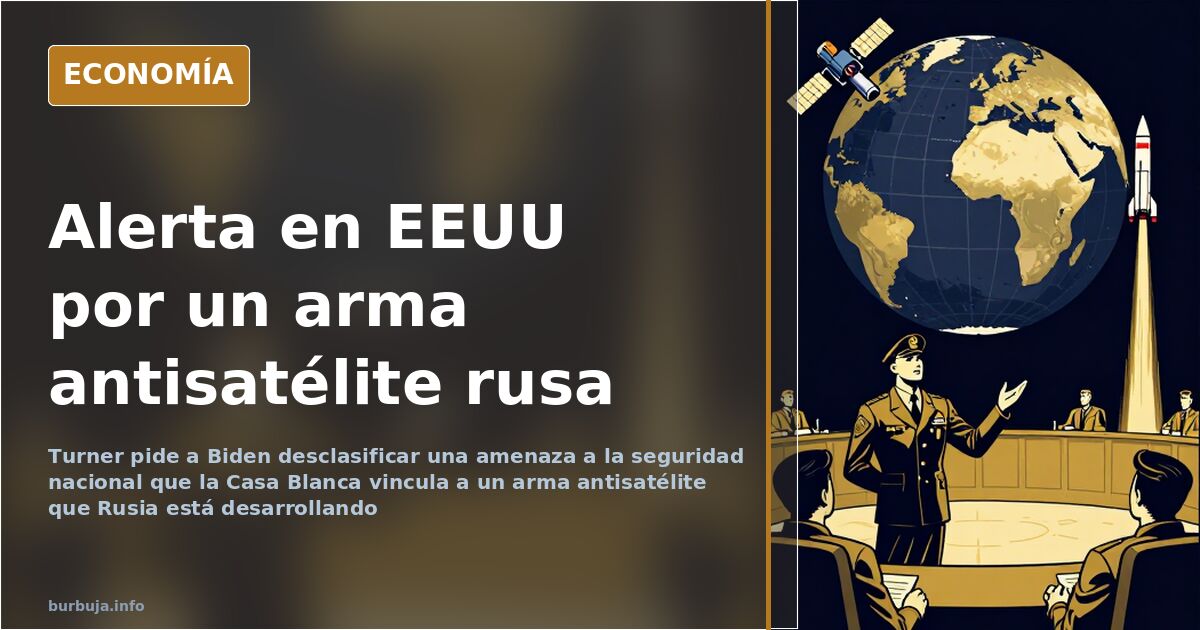
Washington sounds alarm over a Russian weapon in orbit and calls for declassification
What lies behind an urgent national security statement announced with great fanfare that, for now, amounts to an «anti-satellite capability in development»? The chair of the US House Permanent Select Committee on Intelligence, Mike Turner, released a statement announcing that the committee had made information available to all members of Congress about a «serious national security threat» and called on Joe Biden to declassify everything related to it, so that Congress, the Administration and allies could openly discuss the necessary actions. One district, OH-10, one sentence and one word: declassify.
The trinc hours filled the gap with rumors. The most repeated, a Russian nuclear weapon in space. Then came partial confirmation: John Kirby, a spokesperson for the National Security Council, said the alert refers to «an anti-satellite capability that Russia is developing», with two caveats that lower the volume —it cannot be used to attack people or cause physical destruction on Earth— and the promise that Washington is in the process of addressing the matter with Moscow. From serious threat to capability in development. The journey lasted less than a day.
What can an anti-satellite weapon do to a satellite in orbit?
Disable it, blind it or destroy it. That is the minimal definition of an anti-satellite capability, and the technical discussion after the statement moved among three hypotheses: an orbital bomber, an orbital station armed with nuclear weapons and an anti-satellite weapon proper. Some recall in the discussion that this type of weaponry has existed since the 1970s, so the novelty would not be in the concept, and that today there are less cumbersome methods than a missile or a laser.
The most extreme scenario cited is the worst on the list. The high-altitude electromagnetic pulse attack, known as the Rainbow Bomb, consists of detonating a nuclear weapon at high altitude, far from Earth's atmosphere. Its coverage would reach an entire continent and cause civil and military chaos through the loss of essential services —electricity, drinking water, food distribution, communications— for an indefinite period. The literature on the matter describes it as the opening salvo of a war.
Moscow Exchange suspends trading for second day
The market also said something. The Moscow Exchange suspended stock trading for the second consecutive day, a move without official explanation that was read as a sign of tension. It is not a minor detail for those trading with real money: markets price in headlines, and this one arrived with the word nuclear in the same paragraph.
From defense spending to the election calendar
Under the technical layer there is a political reading that some participants endorsed unabashedly. The argument: the alert would come at a time when the White House needs to sustain aid to Ukraine, project firmness toward Russia and, above all, toward China with Taiwan on the horizon, without paying an electoral price for continuing to send money abroad. A powerful excuse, summed up wryly: we'll see who buys it.
There were responses in the opposite direction. Rand Paul seized on the noise to call for an end to what he considers unconstitutional surveillance of US citizens and to ask that freedoms not continue to be sacrificed in the name of national security, with the Fourth Amendment as his banner. And another line of suspicion pointed to selective declassification serving to divert attention from the internal political fight between Biden and Trump, closing the circle on the intelligence services.
From Starfish Prime to the 2020 Russian test
The historical precedent is in 1962. The launch of a nuclear bomb in outer space generated a spectacle visible from Hawaii, but with serious consequences afterward. The reasons for that test are unclear: it was probably a response to a similar Soviet test, and it was not the first time an island location was chosen for something like that. On whether Moscow tried something closer in time, the reference that circulated places in 2020 a similar episode attributed to Russia by US sources.
In parallel ran another suspicion, this one without any confirmation: that the threat was not Russian but Iranian, and that the leak was preparing the ground for a larger conflict in the Middle East.
How to read an alert that is losing steam
Turner's announcement calls for a declassification that, as of the date of this discussion, had not occurred. There is the blind spot: without the documents there is no possible verification, and without verification each person places their favorite hypothesis in the gap. The only official piece is Kirby's, and that piece lowers the alarm that the statement itself had raised.
There remains the consolation of the professional skeptic: if it really were the beginning of the end, no one would find out through a press release, because those who know would already be safely in a bunker hundreds of meters underground. And if in the end nothing happens, as usual, there will always be the mothership over Zaragoza.
What lies behind an urgent national security statement announced with great fanfare that, for now, amounts to an «anti-satellite capability in development»? The chair of the US House Permanent Select Committee on Intelligence, Mike Turner, released a statement announcing that the committee had made information available to all members of Congress about a «serious national security threat» and called on Joe Biden to declassify everything related to it, so that Congress, the Administration and allies could openly discuss the necessary actions. One district, OH-10, one sentence and one word: declassify.
The trinc hours filled the gap with rumors. The most repeated, a Russian nuclear weapon in space. Then came partial confirmation: John Kirby, a spokesperson for the National Security Council, said the alert refers to «an anti-satellite capability that Russia is developing», with two caveats that lower the volume —it cannot be used to attack people or cause physical destruction on Earth— and the promise that Washington is in the process of addressing the matter with Moscow. From serious threat to capability in development. The journey lasted less than a day.
What can an anti-satellite weapon do to a satellite in orbit?
Disable it, blind it or destroy it. That is the minimal definition of an anti-satellite capability, and the technical discussion after the statement moved among three hypotheses: an orbital bomber, an orbital station armed with nuclear weapons and an anti-satellite weapon proper. Some recall in the discussion that this type of weaponry has existed since the 1970s, so the novelty would not be in the concept, and that today there are less cumbersome methods than a missile or a laser.
The most extreme scenario cited is the worst on the list. The high-altitude electromagnetic pulse attack, known as the Rainbow Bomb, consists of detonating a nuclear weapon at high altitude, far from Earth's atmosphere. Its coverage would reach an entire continent and cause civil and military chaos through the loss of essential services —electricity, drinking water, food distribution, communications— for an indefinite period. The literature on the matter describes it as the opening salvo of a war.
Moscow Exchange suspends trading for second day
The market also said something. The Moscow Exchange suspended stock trading for the second consecutive day, a move without official explanation that was read as a sign of tension. It is not a minor detail for those trading with real money: markets price in headlines, and this one arrived with the word nuclear in the same paragraph.
From defense spending to the election calendar
Under the technical layer there is a political reading that some participants endorsed unabashedly. The argument: the alert would come at a time when the White House needs to sustain aid to Ukraine, project firmness toward Russia and, above all, toward China with Taiwan on the horizon, without paying an electoral price for continuing to send money abroad. A powerful excuse, summed up wryly: we'll see who buys it.
There were responses in the opposite direction. Rand Paul seized on the noise to call for an end to what he considers unconstitutional surveillance of US citizens and to ask that freedoms not continue to be sacrificed in the name of national security, with the Fourth Amendment as his banner. And another line of suspicion pointed to selective declassification serving to divert attention from the internal political fight between Biden and Trump, closing the circle on the intelligence services.
From Starfish Prime to the 2020 Russian test
The historical precedent is in 1962. The launch of a nuclear bomb in outer space generated a spectacle visible from Hawaii, but with serious consequences afterward. The reasons for that test are unclear: it was probably a response to a similar Soviet test, and it was not the first time an island location was chosen for something like that. On whether Moscow tried something closer in time, the reference that circulated places in 2020 a similar episode attributed to Russia by US sources.
In parallel ran another suspicion, this one without any confirmation: that the threat was not Russian but Iranian, and that the leak was preparing the ground for a larger conflict in the Middle East.
How to read an alert that is losing steam
Turner's announcement calls for a declassification that, as of the date of this discussion, had not occurred. There is the blind spot: without the documents there is no possible verification, and without verification each person places their favorite hypothesis in the gap. The only official piece is Kirby's, and that piece lowers the alarm that the statement itself had raised.
There remains the consolation of the professional skeptic: if it really were the beginning of the end, no one would find out through a press release, because those who know would already be safely in a bunker hundreds of meters underground. And if in the end nothing happens, as usual, there will always be the mothership over Zaragoza.
Summary of a discussion on Burbuja.info - Foro de economía, actualidad y política., translated from Spanish and reviewed before publication. Read the full discussion (279 replies).
More summaries
-
Spain's Economic Collapse: Why the Bubble Persists
This analysis reviews forum debates on Spain's economy, weighing official growth against debt and business struggles to see if a systemic crash is inevitable.
-
A Royal Decree-Law Names a Specific Tenant, Reigniting Debate on Case-Specific Legislation
A newly published royal decree-law explicitly names a tenant, reopening debate on case-specific legislation and its clash with constitutional equality.
-
Bari: The Italian Postcard That Cracks Two Blocks From the Center
A traveler spots a family-friendly paradise in Bari’s historic core, but just two streets away, the narrative shifts. Italy vs. Spain compared.
-
Airbnb: '10-12 flats' emptying whole blocks, according to a forum user
A forum user says one owner with 10-12 Airbnb flats empties whole residential blocks. In Lugo or Teruel, prices also rise without mass tourism.
-
Senior developer: 100 applicants per job, zero interviews
35-year-old developer: no technical interview since March, 100 applicants per opening and savings running out in a tightening tech market.
-
Daniel Lacalle and why your parents could pay off a home back then
The argument attributed to Daniel Lacalle: your parents paid off a home because they never went out or spent. Wages, VAT and mortgage rates, in figures