
Tesla Germany Plant Assault Attempt Amid German PMI Drop to 42
Anti-Tesla mob attempts to storm the Grünheide plant near Berlin as German industrial PMI falls to 42.
English · Original discussion in Spanish · Published
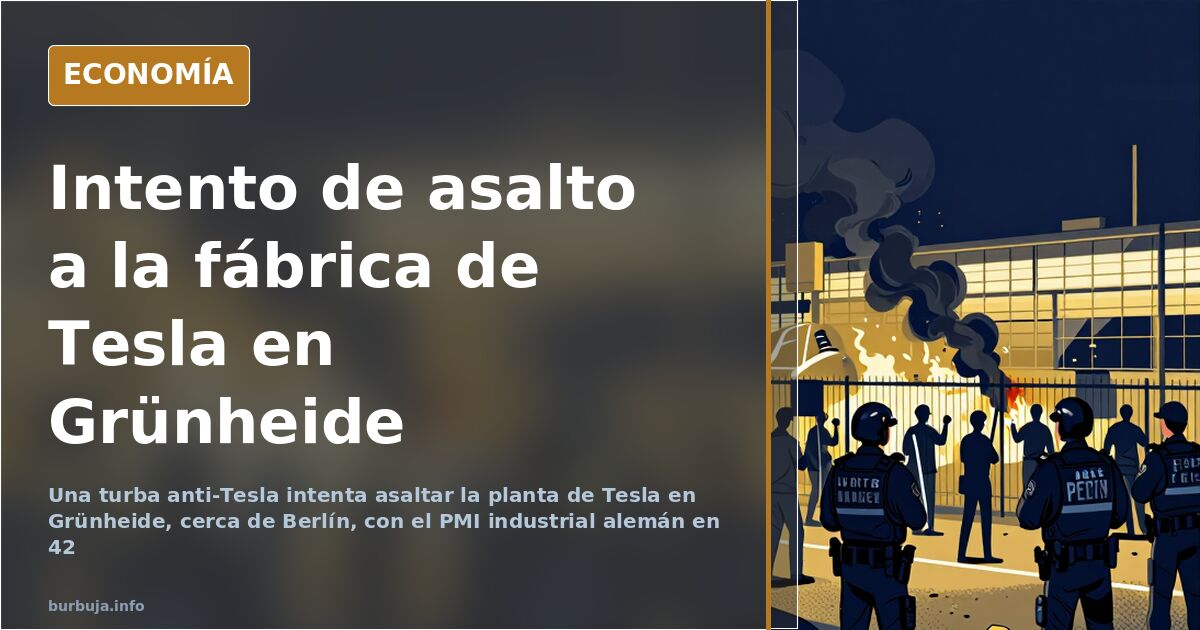
Anti-Tesla Mob Attempts Storm of Grünheide as German Industry Hits 42
A crowd opposed to Tesla attempted to storm the company's electric vehicle plant in Grünheide, near Berlin. Footage shows a group running toward the facilities. The scene alone is news. What makes it more serious is the backdrop: the German industrial PMI stood at 42, below the 50 threshold separating expansion from contraction. Full-blown contraction.
What Peine at the Tesla Factory in Grünheide
The protest didn't emerge from nowhere. The plant was built in an environment that required felling trees, which is the argument repeated by those rejecting its presence in the area. One month prior, someone set fire to the electrical tower serving the factory. Now, the assault attempt adds another chapter to a tension brewing for some time.
From there, interpretations multiply. Some defend a legitimate ecological protest against land occupation and deforestation. Others describe an anti-system mob determined to expel from Germany the only company with remaining industrial projection. And some suspect a performance: a stormed factory is, today, the world's best showcase.
Why Protest Against an Electric Car Factory?
The point that confuses friend and foe alike is always the same. If the declared goal is decarbonizing transport, why attack precisely the manufacturer of electric cars? The paradox resolves in various ways depending on who you ask. Some point to Elon Musk's profile, also owner of X and turned into a universal target. Others highlight the specific location: the trees, water, noise, soil. A third reading holds that radical environmentalism doesn't distinguish between industries because it rejects industry itself.
Sarcasm runs free. It is noted that there are no images of protesters arriving in gasoline cars, although the joke circulates anyway.
German PMI at 42 and Companies Moving to the US
The assault attempt occurs on ground visibly cracking. The manufacturing PMI at 42 is not just any figure: it points to a shrinking sector. This is compounded by extinguished blast furnaces and companies announcing their departure. In the thread, it is stated that a major German industrial company announced its relocation to the United States. The recurring diagnosis is that the country survives on subsidies while energy costs have skyrocketed.
The contrast between the stock index and real activity data is summarized by a witty phrase: the market is sustained by the printer; the activity index, by reality. And the unavoidable conclusion is uncomfortable: Germany, Europe's largest industrial power and one of the world's leading ones, has apparently lost ground in little more than a year.
Geopolitical Thesis: Gazprom, Green NGOs, and Nuclear Power
In the background appears the hypothesis with most traction: environmentalism as a piece in an energy board game. An assertion by political scientist Dominique Reynié is circulated, claiming Gazprom funded environmental NGOs that eventually provided ministers to governments like Belgium's; these same officials later advocated abandoning nuclear energy. The equation is neat: less nuclear, more gas, and Russia sold the gas.
It should be taken for what it is, a thesis and not a proven fact. But it fits with another circulating reasoning: that the United States benefits from a Europe without a strong industrial Germany, with France as the sole reference nuclear power. Hence, the argument goes, pressure to buy more expensive gas and offshoring to America.
The Spanish Mirror: If the Plant Were in Spain
A recurrent comparison is the Spanish one. If the factory had been installed here with wages set by collective agreement, this reading argues, the images would not be of a mob running toward the fence, but of young people holding resumes looking for jobs. It is an unverified hypothesis, but it well summarizes the question half of Europe asks: why does the country most needing industry defend it least when it arrives?
What Tesla and Germany Have at Stake
For Tesla, the episode is a security and image problem. For Germany, it is another sign that its problem isn't plants closing, but those leaving. Both sides measure strength in the street and in indices. And while some count attackers, the disorienting data isn't in the video. It lies in the fact that the industrial power that recently was the continent's engine now boasts a 42 on its factory thermometer.
A crowd opposed to Tesla attempted to storm the company's electric vehicle plant in Grünheide, near Berlin. Footage shows a group running toward the facilities. The scene alone is news. What makes it more serious is the backdrop: the German industrial PMI stood at 42, below the 50 threshold separating expansion from contraction. Full-blown contraction.
What Peine at the Tesla Factory in Grünheide
The protest didn't emerge from nowhere. The plant was built in an environment that required felling trees, which is the argument repeated by those rejecting its presence in the area. One month prior, someone set fire to the electrical tower serving the factory. Now, the assault attempt adds another chapter to a tension brewing for some time.
From there, interpretations multiply. Some defend a legitimate ecological protest against land occupation and deforestation. Others describe an anti-system mob determined to expel from Germany the only company with remaining industrial projection. And some suspect a performance: a stormed factory is, today, the world's best showcase.
Why Protest Against an Electric Car Factory?
The point that confuses friend and foe alike is always the same. If the declared goal is decarbonizing transport, why attack precisely the manufacturer of electric cars? The paradox resolves in various ways depending on who you ask. Some point to Elon Musk's profile, also owner of X and turned into a universal target. Others highlight the specific location: the trees, water, noise, soil. A third reading holds that radical environmentalism doesn't distinguish between industries because it rejects industry itself.
Sarcasm runs free. It is noted that there are no images of protesters arriving in gasoline cars, although the joke circulates anyway.
German PMI at 42 and Companies Moving to the US
The assault attempt occurs on ground visibly cracking. The manufacturing PMI at 42 is not just any figure: it points to a shrinking sector. This is compounded by extinguished blast furnaces and companies announcing their departure. In the thread, it is stated that a major German industrial company announced its relocation to the United States. The recurring diagnosis is that the country survives on subsidies while energy costs have skyrocketed.
The contrast between the stock index and real activity data is summarized by a witty phrase: the market is sustained by the printer; the activity index, by reality. And the unavoidable conclusion is uncomfortable: Germany, Europe's largest industrial power and one of the world's leading ones, has apparently lost ground in little more than a year.
Geopolitical Thesis: Gazprom, Green NGOs, and Nuclear Power
In the background appears the hypothesis with most traction: environmentalism as a piece in an energy board game. An assertion by political scientist Dominique Reynié is circulated, claiming Gazprom funded environmental NGOs that eventually provided ministers to governments like Belgium's; these same officials later advocated abandoning nuclear energy. The equation is neat: less nuclear, more gas, and Russia sold the gas.
It should be taken for what it is, a thesis and not a proven fact. But it fits with another circulating reasoning: that the United States benefits from a Europe without a strong industrial Germany, with France as the sole reference nuclear power. Hence, the argument goes, pressure to buy more expensive gas and offshoring to America.
The Spanish Mirror: If the Plant Were in Spain
A recurrent comparison is the Spanish one. If the factory had been installed here with wages set by collective agreement, this reading argues, the images would not be of a mob running toward the fence, but of young people holding resumes looking for jobs. It is an unverified hypothesis, but it well summarizes the question half of Europe asks: why does the country most needing industry defend it least when it arrives?
What Tesla and Germany Have at Stake
For Tesla, the episode is a security and image problem. For Germany, it is another sign that its problem isn't plants closing, but those leaving. Both sides measure strength in the street and in indices. And while some count attackers, the disorienting data isn't in the video. It lies in the fact that the industrial power that recently was the continent's engine now boasts a 42 on its factory thermometer.
Also available in: Deutsch
Summary of a discussion on Burbuja.info - Foro de economía, actualidad y política., translated from Spanish and reviewed before publication. Read the full discussion (121 replies).
More summaries
-
German industrial slowdown threatens Spain's pensions
Spain's pension sustainability and public debt face risks as German industry slows, with a potential 20% cut emerging as a likely scenario.
-
BYD outsells Tesla sixfold, shaking European auto industry
BYD sold over a million EVs in one quarter vs. Tesla's 318,000, with its valuation near $93 billion as Europe watches.
-
Sol Occupiers Expel Horizon Reporter Rebeca Crespo for Second Night
Occupiers in Madrid's Puerta del Sol block Horizon reporter Rebeca Crespo for two consecutive nights, reigniting the debate on press freedom and public space access.
-
Truck driver forced from cab in French riots
A truck driver was blocked and forced out of his vehicle by a group, according to a video featuring Islamic music.
-
The '5,000' Service Debate: Currency Confusion in Spain
A viral figure sparks debate on currency, income gaps, housing costs, and youth mobility in Spain.
-
Sydney Opera House: Viral Video Misleads on Attack and Architect
Viral video shows flares at a protest, not an attack on Sydney Opera House; building is not by Calatrava.