
Teruel Airport: From White Elephant to Aircraft Recycling Hub
Spain's Teruel airport, once mocked as a waste of public funds, now hosts aircraft dismantling and rocket testing, promising 4,000 jobs by 2027.
English · Original discussion in Spanish · Published
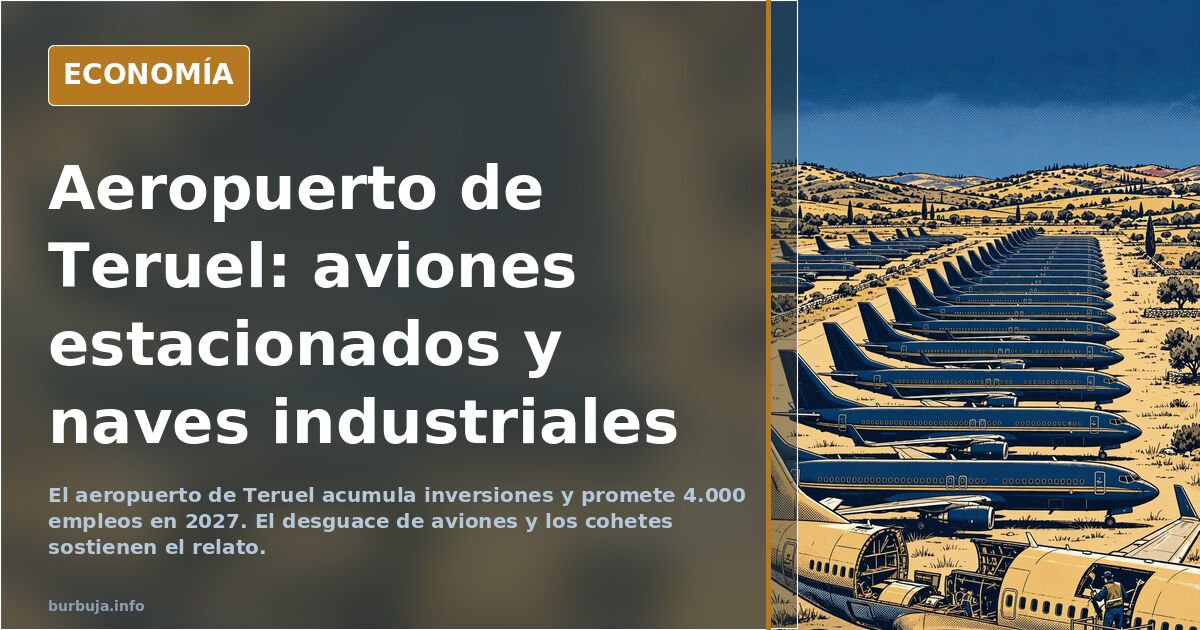
Teruel transforms its criticized airport into an aircraft workshop and rocket base
An airport built a decade ago amid fierce criticism for its lack of viability has become, according to the facility's own data, Europe's largest center for aircraft storage and dismantling. The paradox is hard to swallow: the project that was born as a symbol of public works waste now accumulates investments, expansions, and industrial contracts in aeronautics, defense, and space. There is no consensus on whether this validates the initial investment or merely confirms that, out of a hundred bets, one had to succeed.
What happens today at the Teruel airport
The facility functions as long-term parking for airlines stashing fleets during low season, as a maintenance workshop, and as a scrapyard for old aircraft. The cold, dry climate of the area, with semi-desert humidity, and a plain that allows for unlimited physical growth are the competitive advantages cited by defenders of the model. Airbus has a manufacturing presence, and there is a zeppelin plant under construction, along with tests and practices by a rocket company based in Elche.
On this basis, a project has been approved that will multiply the rocket base twelvefold, according to reports tracking the issue. Official forecasts speak of more than 4,000 jobs by 2027, which would equate to nearly 20% of the active population of Teruel city. This is the figure that sustains the entire narrative and also the one receiving the most scrutiny.
How much public money has the Teruel airport cost?
Here begins the uncomfortable part. Critics of the project point to a calculation that doesn't match the triumphant narrative: €40 million for construction, €40 million in subsidies, and €75 million in public contracts to attract companies. In total, around €160 million to justify job creation. The circulating logic is devastating: if that money had been distributed as direct payments, the cost per job would be far higher than doing nothing.
The defense argues otherwise: without state injections and aid to private companies, the facility would go bankrupt within months. That 80% of Spanish airports run deficits offers little consolation. The fundamental question is whether a country should maintain infrastructure that cannot sustain itself because it generates indirect activity, or if that is exactly the kind of accounting trap that turned real estate speculation into a national religion.
Why Teruel and not Ciudad Real or Castellón?
The comparison is inevitable and made by the model's own defenders. Ciudad Real and Castellón appear as shameful examples of airports without traffic. Teruel, however, found a niche: parking planes is a high-margin business, and airlines across half of Europe request slots simultaneously during low season. During the pandemic, with all fleets grounded, the facility was saturated with orders.
Some argue the success was pure luck: the site was chosen for meteorological conditions and topography, not strategic vision. Others recall that the former military airbase already offered the essentials for parking planes and testing rockets, and that the rest is institutional marketing. The debate over whether public money creates growth or simply redistributes it to where natural advantages already existed remains open.
The debate on public investment creating jobs
The underlying clash is ideological and permeates the entire issue. One school of thought holds that public investment creates growth and that every cut in infrastructure condemns Spain to a low-value-added model. The opposing view responds that public money does not create wealth, it only moves it, and that subsidized jobs are artificial jobs that would disappear without the subsidy.
In the middle lies a disorienting fact: the facility generates real activity, with industrial contracts and manufacturer presence, but its viability still depends on public transfers. It is neither an empty shell nor a self-sufficient engine. It is both things at once, and that discomforts both sides.
What about commercial passenger flights?
The recurring question is why there are no regular flights. The technical answer is simple: a ticket from Teruel to Madrid would cost more than €200 and demand would be virtually nil. Profitability studies rule out the route. The facility functions as a general aviation destination and little else regarding passengers.
The case of Portugal is cited, where small municipal airports maintain connections with light aircraft, and Pantaletança, which is not precisely a hub yet has flights. The difference lies in the territorial model and cross-subsidization. In Spain, almost every provincial capital has an airport, but most have negligible traffic. Teruel is no exception in that regard; it is an exception in having found an alternative business.
The bottom line remains unsettled. With €160 million in public funds on the table and 4,000 jobs promised for 2027, the question is not whether the airport works, but whether it would work just as well without everyone's money. And that, for now, no one answers.
Also available in: Deutsch
Summary of a discussion on Burbuja.info - Foro de economía, actualidad y política., translated from Spanish and reviewed before publication. Read the full discussion (190 replies).
More summaries
-
PLD Space builds rocket factory in Elche, targeting 2,000 jobs
PLD Space is constructing a rocket factory in Elche with €65 million investment and 2,000 jobs. Is it competing with Musk or a real estate gamble?
-
Spanish Treasury Bills: how investing in government debt works
A complete guide to Letras del Tesoro (Spanish Treasury bills): how to buy them, real returns, taxes, bank fees and what happens if your bank goes under.
-
Spain's housing decree will push small owners to sell to investment funds, claim
A claim circulating on X: Spain's government will legislate to make small owners sell their homes to big funds. Key points of the debate.
-
Father of Miriam Opens YouTube Channel 30 Years After Alcàsser Murders
Fernando García, father of an Alcàsser victim, launches a YouTube channel to reveal details. The case raises questions about justice versus profit in Spain.
-
Spain's PSOE and the deportation orders that never get enforced
Spain's Government left more than 48,000 deportation orders unenforced in 2025, according to reports, and erased 1.1 million criminal records over five years.
-
Spain's November extra pension payment lands before the 23N vote
The November extra pension payment is being paid early, and millions of Spanish pensioners will receive it before voting. The electoral calendar and the debate over the pensioner vote.