
Spain's November extra pension payment lands before the 23N vote
The November extra pension payment is being paid early, and millions of Spanish pensioners will receive it before voting. The electoral calendar and the debate over the pensioner vote.
English · Original discussion in Spanish · Published
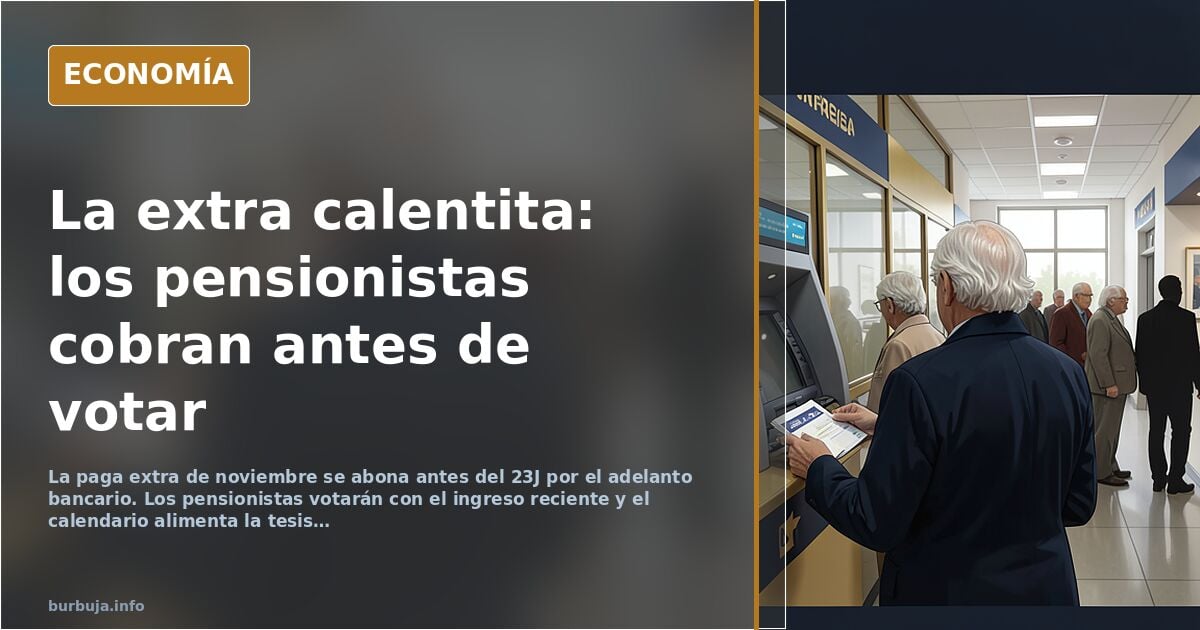
The November extra payment arrives before the ballot box and the calendar works in the Government's favour
Pensioners' November pay slip includes the extra payment, and banks are advancing it by several days. Translated into electoral terms: millions of older people will receive double pay just before voting. The coincidence is not a conspiracy theory, it is calendar arithmetic. And on that arithmetic one of the most bitter debates about the captive pensioner vote has been built.
The starting point is simple. Pensions are paid in arrears, but financial institutions usually advance the deposit by a few days. If the November extra is paid together with the monthly payment and the bank advances it, the money appears in the account the week before the election. No legal trickery is needed: it is enough for the calendar to fall this way. Millions of pensioners with double pay in their pocket and the campaign in its final stretch.
Who receives the extra payment and exactly when
Not all retirees are paid on the same date, and part of the narrative is lost there. Pensioners in the general system, the majority, receive the extra payment at the end of November. Retired civil servants — former public employees —, military personnel and Civil Guards have a different calendar, with payment closer to December. That nuance dismantles the idea of a single, synchronised payment, but not the underlying evidence: the extra payment arrives before the elections for most recipients.
The discussion quickly turned to the architecture of the system. Why divide salary or pension into fourteen payments instead of twelve? Some argue that the double payment in summer and at Christmas responds to the old custom of boosting consumption in high-spending months. Others see an administrative trick: splitting pay into fourteen instalments makes the monthly amount seem smaller and hides the real cost. With twelve payments, the same money would look bigger each month. The extra payment, at its core, is an accounting mirage with electoral effects when it falls close to an election.
The pensioner vote: money or identity?
Here the analysis splits into two camps. One holds that pensioners vote with a calculator: if the Government raises pensions, the Government collects the favour. The other distrusts that reading and points to something more tribal. The Spanish electorate, the argument goes, does not vote with its wallet but against its adversary. The extra payment would be a nudge, not the cause. The mantra circulating among the elderly — pensions go up with the PSOE (Spain's Socialist Party), down with everyone else — would work as a mental shortcut rather than cold calculation.
The irony is that pension money does not come from a magic fund. It is paid for with contributions from active workers and with taxes. That uncomfortable fact rarely appears in the public conversation. And when it does, the debate sharpens: some accuse recipients of voting for a present benefit at the expense of those who come after, while others reply that the system holds because it was decided that it should hold. Neither side yields.
The calculation nobody publishes during the campaign
Beyond the calendar, the underlying issue is sustainability. The demographic pyramid is tightening, the ratio of contributors to recipients is narrowing, and every pension increase commits more future spending. The full breakdown of that tension — how much comes in, how much goes out and what gap it leaves — is where the analysis becomes uncomfortable for every party, because none wants to explain to older people that their payment depends on young people continuing to contribute.
With the extra payment about to land and the campaign in its final stretch, the question is not whether the calendar favours the Government. It does. The question is whether that nudge moves a single vote. And there, honestly, the numbers fall short.
Also available in: Deutsch
Summary of a discussion on Burbuja.info - Foro de economía, actualidad y política., translated from Spanish and reviewed before publication. Read the full discussion (75 replies).
More summaries
-
Union claims 70% of Spain's foreign residents don't contribute to social security
Solidaridad union reports only 30.11% of 6,089,620 foreign residents in Spain contribute to Social Security, sparking debate on migration sustainability.
-
Spain's Social Security sold Iván Redondo a Madrid flat €466,679 below market value
Spain's Social Security sold Iván Redondo a flat in Madrid's Salamanca district for €1,120,921 — €466,679 below its market value. The discount comes close to 30%.
-
The €10 per square metre proposal and the numbers that don't add up
A tweet mocks a young man hoping to buy a home at €10/m². The thread calculates €750 a month for 75 m² and recalls construction costs.
-
Spain's 29N election: forum users weigh tactical voting, abstention and punishment votes
A forum thread frames Spain's 29N vote as a contest between tactical voting, abstention and punishing the parties. Arguments and opinions from participants.
-
Cloning MB's Hotel with AI: an afternoon of code and legal doubts
A hobbyist recreates MB's Hotel with Claude Code in a single afternoon and debates Hasbro's copyright and the barrier to commercializing it.
-
Vucic concedes defeat in Serbia after masked men gather in Belgrade
Vucic concedes defeat in Serbia after dozens of masked men and riot police gathered in Belgrade as polls closed.