
Taylor Swift: Status Symbol vs. Reggaeton
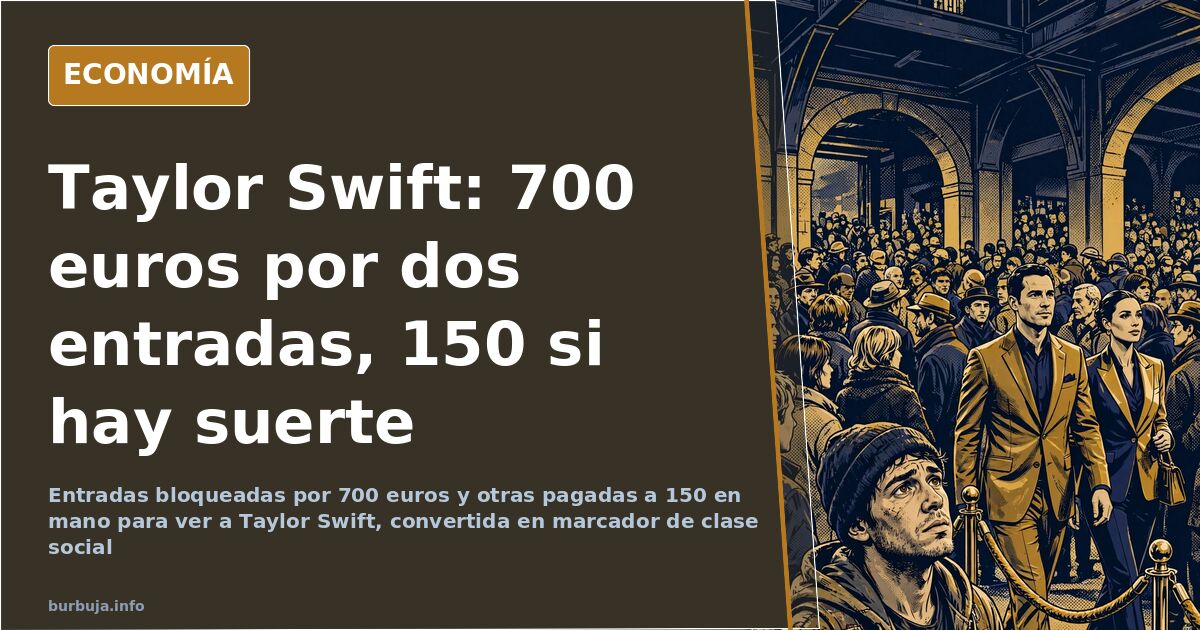
Tickets blocked for €700 and others sold for €150 cash to see Taylor Swift, now a marker of social class.
English · Original discussion in Spanish · Published
Taylor Swift: Musical Taste as Class Divider
Three 15-year-old girls hold signs asking for tickets outside La Défense Arena in Paris. None were born when Taylor Swift released her debut album. One is the daughter of Ramtin, a 54-year-old German coach; the other two are school friends. The father has been watching his card get charged €700 for two passes bought on the secondary market that never arrive.
Negotiations fail half a dozen times in front of the girls. Until an American family appears and sells them their tickets for €150 each. Ramtin takes it with irony: he warns his other daughter, a Beyoncé fan, that if they got scammed, they’ll end up in a bar watching their dad drink beer all afternoon. The eldest cries with emotion. The venue holds 40,000 people and displays a sold-out sign for four dates.
The surprise isn’t that a 34-year-old singer fills stadiums nearly two decades after debuting. It’s that much of her audience couldn’t hum her first album because they weren’t born yet.
From Highlander to a Sole Survivor
The parallel with the 1986 film starring Sean Connery and Christopher Lambert is exaggerated but effective. Immortals who have lived among us for centuries, condemned to fight until only one remains, and a winner who decides whether the world enters an age of light or darkness. For the last fifteen years, various genres and half a dozen artists would have fought this battle for global dominance. The result, according to this reading, is a single winner who chose light, so intensely that people risk going blind.
W. David Marx, author of the essay Status and Culture, translates this into market terms: unprecedented success due to longevity and dominating every release. Online we live fragmented lives, but off-screen, that central position leaves a mass culture more monotonous than ever. The essayist borrows a financial concept and applies it to a singer: she would be both the system and what sustains the system.
What Taylor Swift’s Audience Really Buys
Probably little to do with music alone. Some argue the real product is status: a place you must have visited and a photo you must post. The concert functions as a social showcase, and those left out lose standing in their own sphere. Hence paying whatever it takes and reselling tickets without shame.
In line with this is a definition circulating online: the Marvel of pop music. Not a catalog of memorable songs, but the industrial apparatus behind it, a millimeter-perfect production and communication machine. For the publishing sector, the comparison is even more familiar: some call her the J.K. Rowling of pop, because in saturated lives there is room for only one author and one singer. Whether that is good news is another debate.
Social Class and Musical Taste in Current Pop
Here the class layer appears. Some read the phenomenon through distinction: against popular urban rhythms, led by reggaeton, stadium pop is perceived as a more presentable choice, from well-off households. This isn’t a description of anyone’s specific taste, but the old fight between what is considered refined and what is considered street-level, with different names on each side.
And like any cultural border, it has traps. Some compare it to posh pop of the 2000s, recalling that what is sold today as a cultured choice was yesterday the most commercial option in the market. On the opposite extreme, the defense is equally predictable: some respond that quality isn’t measured by your school’s name, but by the ability to fill a venue for four dates.
The Singer Without Anthems Everyone Knows
The most repeated paradox is another: some recognize her face but don’t remember a single song of hers. Without anthems crossing generations, without choruses incorporated into common language, her fame would be huge and her repertoire diffuse. The names cited as references—Madonna, Michael Jackson, George Michael—had both.
The argument has substance. If a phenomenon dominates pop and its most popular track isn’t known by the neighbor, perhaps success is no longer measured in songs, but in attention. And attention is bought, sustained, and monetized with tools not found on the staff.
Re-recording Albums to Retain Control
The other front is business. Issues with rights to her masters led her to re-record her old albums. Viewed as a commercial move, it is pure cunning; viewed as an artistic gesture, it leaves many cold, interpreting it as rehash sold twice to the same clientele. The press presented it as rebellion. The numbers, probably, as an operation with guaranteed margin.
With these figures in front—€700 of uncertainty for two passes versus €150 paid in hand at the exit—it’s strange that anyone still debates whether this is about music. And a detail disorients more than any balance sheet: the non-fan father knows all the songs in the repertoire and sings them in the car. The industry doesn’t always need to convince the client. It’s enough that they accompany them.
Three 15-year-old girls hold signs asking for tickets outside La Défense Arena in Paris. None were born when Taylor Swift released her debut album. One is the daughter of Ramtin, a 54-year-old German coach; the other two are school friends. The father has been watching his card get charged €700 for two passes bought on the secondary market that never arrive.
Negotiations fail half a dozen times in front of the girls. Until an American family appears and sells them their tickets for €150 each. Ramtin takes it with irony: he warns his other daughter, a Beyoncé fan, that if they got scammed, they’ll end up in a bar watching their dad drink beer all afternoon. The eldest cries with emotion. The venue holds 40,000 people and displays a sold-out sign for four dates.
The surprise isn’t that a 34-year-old singer fills stadiums nearly two decades after debuting. It’s that much of her audience couldn’t hum her first album because they weren’t born yet.
From Highlander to a Sole Survivor
The parallel with the 1986 film starring Sean Connery and Christopher Lambert is exaggerated but effective. Immortals who have lived among us for centuries, condemned to fight until only one remains, and a winner who decides whether the world enters an age of light or darkness. For the last fifteen years, various genres and half a dozen artists would have fought this battle for global dominance. The result, according to this reading, is a single winner who chose light, so intensely that people risk going blind.
W. David Marx, author of the essay Status and Culture, translates this into market terms: unprecedented success due to longevity and dominating every release. Online we live fragmented lives, but off-screen, that central position leaves a mass culture more monotonous than ever. The essayist borrows a financial concept and applies it to a singer: she would be both the system and what sustains the system.
What Taylor Swift’s Audience Really Buys
Probably little to do with music alone. Some argue the real product is status: a place you must have visited and a photo you must post. The concert functions as a social showcase, and those left out lose standing in their own sphere. Hence paying whatever it takes and reselling tickets without shame.
In line with this is a definition circulating online: the Marvel of pop music. Not a catalog of memorable songs, but the industrial apparatus behind it, a millimeter-perfect production and communication machine. For the publishing sector, the comparison is even more familiar: some call her the J.K. Rowling of pop, because in saturated lives there is room for only one author and one singer. Whether that is good news is another debate.
Social Class and Musical Taste in Current Pop
Here the class layer appears. Some read the phenomenon through distinction: against popular urban rhythms, led by reggaeton, stadium pop is perceived as a more presentable choice, from well-off households. This isn’t a description of anyone’s specific taste, but the old fight between what is considered refined and what is considered street-level, with different names on each side.
And like any cultural border, it has traps. Some compare it to posh pop of the 2000s, recalling that what is sold today as a cultured choice was yesterday the most commercial option in the market. On the opposite extreme, the defense is equally predictable: some respond that quality isn’t measured by your school’s name, but by the ability to fill a venue for four dates.
The Singer Without Anthems Everyone Knows
The most repeated paradox is another: some recognize her face but don’t remember a single song of hers. Without anthems crossing generations, without choruses incorporated into common language, her fame would be huge and her repertoire diffuse. The names cited as references—Madonna, Michael Jackson, George Michael—had both.
The argument has substance. If a phenomenon dominates pop and its most popular track isn’t known by the neighbor, perhaps success is no longer measured in songs, but in attention. And attention is bought, sustained, and monetized with tools not found on the staff.
Re-recording Albums to Retain Control
The other front is business. Issues with rights to her masters led her to re-record her old albums. Viewed as a commercial move, it is pure cunning; viewed as an artistic gesture, it leaves many cold, interpreting it as rehash sold twice to the same clientele. The press presented it as rebellion. The numbers, probably, as an operation with guaranteed margin.
With these figures in front—€700 of uncertainty for two passes versus €150 paid in hand at the exit—it’s strange that anyone still debates whether this is about music. And a detail disorients more than any balance sheet: the non-fan father knows all the songs in the repertoire and sings them in the car. The industry doesn’t always need to convince the client. It’s enough that they accompany them.
Summary of a discussion on Burbuja.info - Foro de economía, actualidad y política., translated from Spanish and reviewed before publication. Read the full discussion (204 replies).
More summaries
-
Taylor Swift Concert: 450 Euros for Seats and Binoculars
A viral tweet about spending 450 euros on a Taylor Swift concert ticket and binoculars sparked debate, with final costs reaching 630 euros.
-
Taylor Swift: Nearly Two Decades at the Top Without a Dip
Her 2006 country debut and 2008 pop shift defy industry norms. Swift’s career breaks the golden decade pattern, sustaining stadium success far longer than peers like Madonna or Britney Spears.
-
Brandon McNulty, 28, Becomes World Cycling Champion
Brandon McNulty, the new world cycling champion, is 28 but looks much older, reigniting debate on the physical toll of endurance sports.
-
Castile, fiscal grievance and the Ebro water dispute
Inland Spain's anger over fiscal imbalances and control of the Ebro: theories of alleged exploitation versus data questioning them.
-
Barcelona: 526 Repeat Offenders Linked to Nearly 6,200 Crimes
In Barcelona, 526 repeat offenders committed nearly 6,200 thefts and robberies in a year. Recidivism is now central to Spain's Penal Code reform.
-
Princess Leonor's military training sparks debate on Spanish monarchy
Princess Leonor begins her military training, reigniting discussions about the relevance and image of the Spanish Crown.