
Castile, fiscal grievance and the Ebro water dispute
Inland Spain's anger over fiscal imbalances and control of the Ebro: theories of alleged exploitation versus data questioning them.
English · Original discussion in Spanish · Published
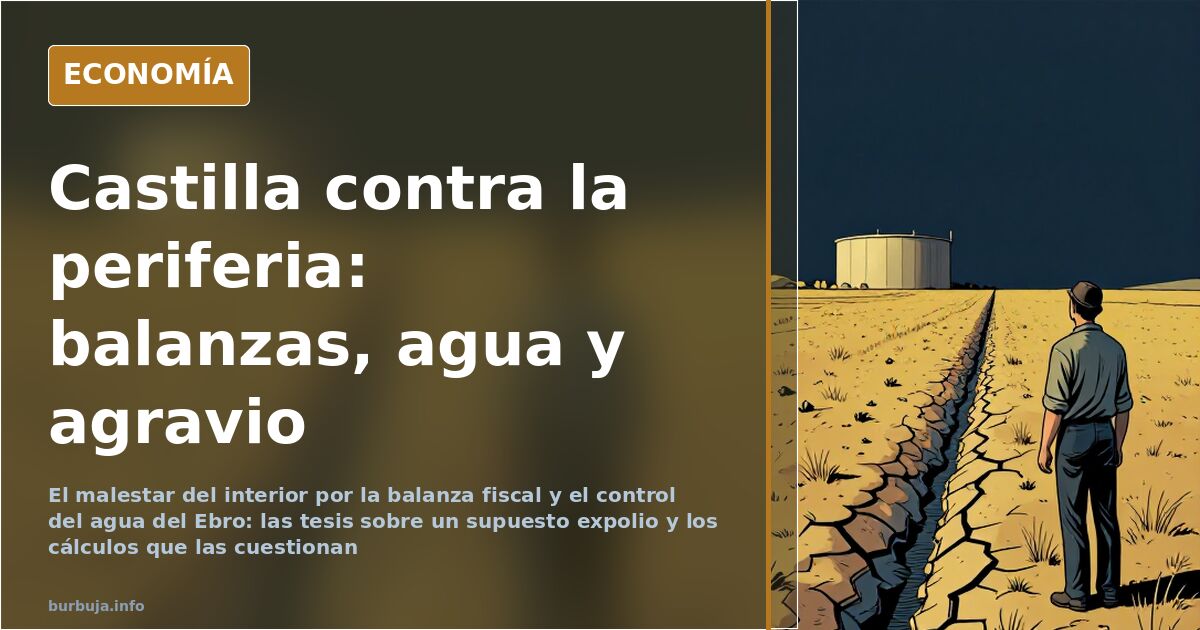
From fiscal balances to the Ebro: Castile’s clash with the periphery
How long can Castile hold out? This question arises whenever two uncomfortable realities intersect: an aging interior losing weight, and a periphery boasting about its fiscal deficit. The thesis driving this discontent is that the Basque Country, Navarre, and Catalonia benefit from arrangements that cost Castilian communities dearly. The accusation is made without nuance. And that is where the problem begins: no one agrees on what a fiscal balance actually measures.
What GDP measures when headquarters are counted
The first front is statistical. Some argue that Madrid’s GDP is inflated because it records the headquarters of companies that produce nothing in the region, and that fiscal balances count as investment for Madrid what supposedly belongs elsewhere. With such adjustments, the fiscal deficits shown by some territories would be called into question. It is the most repeated argument, but also the most debated.
The counter-argument trinc the same logic: if the headquarters criterion inflates one community, it can inflate any other. A second reproach emerges, more political than accounting: that Madrid has taken people and infrastructure from the rest. Some claim that Old Castile ceased to exist as its own economic subject, absorbed by the capital.
Empty Castile: average age near 70 and declining influence
The demographic diagnosis is where almost all positions converge. The most circulated claim is that the average age of Castilians approaches 70. Exaggeration or not, the figure is used in the debate to illustrate the lack of generational renewal and the limited political weight of the interior.
This leads to the harshest argument: that the interior cannot compete in an autonomous system where demographic weight determines distribution. There are calls to sum the GDP and population of Castilian regions to truly measure their contribution, warning that any adjustment would not sit well with territories currently receiving funds. The threat—that the day the interior stops enduring will come with full force—is repeated without specifics, but it is the emotional core of the complaint.
The Ebro, electricity, and the Duero as bargaining chips
The second major block concerns resources. Here, arguments are physical, not accounting-based. It is recalled that the Duero is the second largest river on the peninsula and navigable towards Porto, emphasizing that Santander acts as Castile’s natural port. The recurring conclusion is that the interior should not depend on anyone.
Tensions rise when discussing the Ebro. It is claimed to be a Castilian and Aragonese river, and diverting its water would leave the nuclear plants in Tarragona without cooling, risking collapse. The response from the other side is that neither the Basque Country nor Navarre are foreign to the basin, so shutting off the tap is more bluff than plan. Electricity is used as the final gambit: whoever controls generation controls the table.
San Millán de la Cogolla and the battle over Castilian origins
The discussion also drifts into history. In the monasteries of San Millán de la Cogolla, annotations appear in a primitive Romance variety and an ancient form of Basque. This discovery is used in both directions: by some to say Castilian derives from Latin, not Basque; by others to recall that coexistence was much closer than certain narratives admit.
The exchange turns toxic when entering the realm of the Basque language. It is asserted that distinct Vasconic varieties existed and that Batua is a recent unified construction, with irony regarding who actually killed that diversity. Meanwhile, it is recalled that Castile was born in Las Merindades, Burgos, and that Cantabria would be the original Castile, although Cantabria itself, as a single-province community, defends poorly alone according to its own critics.
From fiscal grievance to breaking ties
At the extreme end of the spectrum appear solutions based on rupture: independence for the interior and cutting relations with what is described as subsidized territories. There are even proposals to annex Portugal and move secessionists there, including closed borders. It is not a government plan, but it marks the mood.
The discontent is not limited to Castile. Galician voices also demand their place in the narrative. In parallel, messages circulate pointing to a demographic replacement in the interior, an idea launched without data or proof.
With these ingredients, one might expect the basket to break. We have been announcing the rupture for years, yet the autonomous map remains unchanged: some paying, others collecting, and all swearing they lose. In the end, it turns out the grievance is not an accounting problem, but a business model.
How long can Castile hold out? This question arises whenever two uncomfortable realities intersect: an aging interior losing weight, and a periphery boasting about its fiscal deficit. The thesis driving this discontent is that the Basque Country, Navarre, and Catalonia benefit from arrangements that cost Castilian communities dearly. The accusation is made without nuance. And that is where the problem begins: no one agrees on what a fiscal balance actually measures.
What GDP measures when headquarters are counted
The first front is statistical. Some argue that Madrid’s GDP is inflated because it records the headquarters of companies that produce nothing in the region, and that fiscal balances count as investment for Madrid what supposedly belongs elsewhere. With such adjustments, the fiscal deficits shown by some territories would be called into question. It is the most repeated argument, but also the most debated.
The counter-argument trinc the same logic: if the headquarters criterion inflates one community, it can inflate any other. A second reproach emerges, more political than accounting: that Madrid has taken people and infrastructure from the rest. Some claim that Old Castile ceased to exist as its own economic subject, absorbed by the capital.
Empty Castile: average age near 70 and declining influence
The demographic diagnosis is where almost all positions converge. The most circulated claim is that the average age of Castilians approaches 70. Exaggeration or not, the figure is used in the debate to illustrate the lack of generational renewal and the limited political weight of the interior.
This leads to the harshest argument: that the interior cannot compete in an autonomous system where demographic weight determines distribution. There are calls to sum the GDP and population of Castilian regions to truly measure their contribution, warning that any adjustment would not sit well with territories currently receiving funds. The threat—that the day the interior stops enduring will come with full force—is repeated without specifics, but it is the emotional core of the complaint.
The Ebro, electricity, and the Duero as bargaining chips
The second major block concerns resources. Here, arguments are physical, not accounting-based. It is recalled that the Duero is the second largest river on the peninsula and navigable towards Porto, emphasizing that Santander acts as Castile’s natural port. The recurring conclusion is that the interior should not depend on anyone.
Tensions rise when discussing the Ebro. It is claimed to be a Castilian and Aragonese river, and diverting its water would leave the nuclear plants in Tarragona without cooling, risking collapse. The response from the other side is that neither the Basque Country nor Navarre are foreign to the basin, so shutting off the tap is more bluff than plan. Electricity is used as the final gambit: whoever controls generation controls the table.
San Millán de la Cogolla and the battle over Castilian origins
The discussion also drifts into history. In the monasteries of San Millán de la Cogolla, annotations appear in a primitive Romance variety and an ancient form of Basque. This discovery is used in both directions: by some to say Castilian derives from Latin, not Basque; by others to recall that coexistence was much closer than certain narratives admit.
The exchange turns toxic when entering the realm of the Basque language. It is asserted that distinct Vasconic varieties existed and that Batua is a recent unified construction, with irony regarding who actually killed that diversity. Meanwhile, it is recalled that Castile was born in Las Merindades, Burgos, and that Cantabria would be the original Castile, although Cantabria itself, as a single-province community, defends poorly alone according to its own critics.
From fiscal grievance to breaking ties
At the extreme end of the spectrum appear solutions based on rupture: independence for the interior and cutting relations with what is described as subsidized territories. There are even proposals to annex Portugal and move secessionists there, including closed borders. It is not a government plan, but it marks the mood.
The discontent is not limited to Castile. Galician voices also demand their place in the narrative. In parallel, messages circulate pointing to a demographic replacement in the interior, an idea launched without data or proof.
With these ingredients, one might expect the basket to break. We have been announcing the rupture for years, yet the autonomous map remains unchanged: some paying, others collecting, and all swearing they lose. In the end, it turns out the grievance is not an accounting problem, but a business model.
Summary of a discussion on Burbuja.info - Foro de economía, actualidad y política., translated from Spanish and reviewed before publication. Read the full discussion (202 replies).
More summaries
-
Madrid's GDP Rises to 19.8%, While Catalonia Stagnates
Madrid's GDP climbs from 17.5% to 19.8% of the national total between 2000 and 2024, as Catalonia holds steady at 19%. Key factors behind the widening gap.
-
PISA 2025: Madrid Shines as Basque Elite Underperforms
PISA 2025 report shows Madrid excelling, while high-income Basque students lag behind Asturias and Cantabria. Catalonia excluded.
-
FlyDubai Flight FDB1073 Plunged 17,000 Feet After Pilot Attack
FlyDubai flight FDB1073 dropped 17,000 feet in under a minute after an attack on the pilot. Israel calls it a terrorist attack and the investigation...
-
Red Sea becomes global trade's black swan
BP halts Red Sea tankers, insurers demand war risk cover, and the US deploys a naval coalition in the region.
-
Athenea del Castillo: TV gossip fuels unverified harassment claims
El Chiringuito reported harassment and discord in Spain's women's national team, but player Athenea del Castillo denied the allegations.
-
Errejón Resigns: Addiction Therapy Claims and Case Dismissal
Iñigo Errejón resigned following harassment accusations, which were later dismissed. Media reports of alleged addiction shape the narrative.