
T-55 and B-52: Both Entered Service in 1955
Russia deploys 1955 T-55 tanks while the US keeps ~70 B-52s from the same year, challenging assumptions about military obsolescence.
English · Original discussion in Spanish · Published
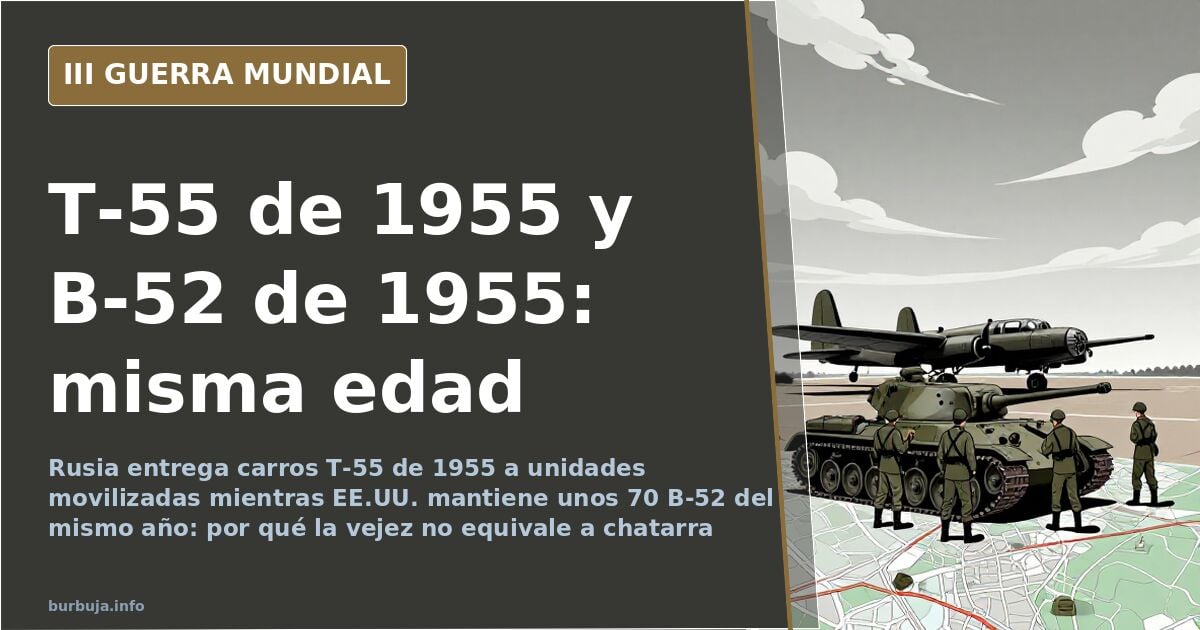
The 1955 T-55 and B-52: Same Age, Different Narratives
The main battle tank mocked online and the strategic bomber still active in the US Air Force rolled off assembly lines in the same year: 1955. On paper, they share an identical age. In reality, they represent two opposing journalistic narratives. One is treated as a punchline; the other as proof of deterrence. The uncomfortable question underlying this debate is different: what turns a rusting relic into a viable weapons system?
The trigger was an image of a Russian mobilized regiment receiving T-55 tanks, shared with mockery by a conflict-tracking account. "World's second army," the sarcasm read. The counter-argument was more pragmatic: four old tanks are better than zero, and those with thousands in storage deploy them rather than leave gaps on the front.
A 1955 T-55: What’s Inside and What’s Missing
The T-55 dates to 1955 and lacks an autoloader. Modern Russian tanks do have one, which, according to a Russian source cited in the thread, reduces crews to three men, 25% fewer than Western counterparts. Some images of the delivered batch appeared to show only two-person crews. For critics, condition is the other open issue: oxidation, thermal expansion, and a barrel that might burst inward when fired. Others note that Slovenia’s M55, an upgraded T-55, was deemed fit for brigades tasked with breaking through at Robotyne. The line between scrap and useful hardware depends on usage, not manufacturing date.
Why Does the US Still Fly 1955 B-52s?
Because it has no immediate replacement and refuses to pay for one. The Air Force maintains around 70 active aircraft, mostly H-series and some Gs, upgrading them with new engines and radar toward the B-52J standard. The model entered service in 1955, the same year as the T-55. This parallel fueled the debate: if the bomber’s longevity stems from strategic necessity, so does the Soviet tank’s. Defenders of the critical view argue operational B-52s are flying rust buckets accumulating structural fatigue, remaining 1950s airframes despite new engines.
Leopard 2A6 vs. T-80BV: A Duel That Actually Peine
During the Zaporizhzhia offensive in mid-June, a Ukrainian Leopard 2A6 hit a Russian tank at roughly 1,500 meters, prompting a pair of T-80BVs to retreat, one smoking. It remains unclear whether the targets were T-72s, T-80s, or T-90s due to visual similarities. The takeaway is significant: Ukrainian reconnaissance easily detects defensive Russian armor, which avoids close-quarters combat when possible. According to participants, the few Western tanks destroyed fell to mines or artillery, not armored duels.
Cheap Artillery, Pakfronts, and Reduced Crews
Pragmatic analysis suggests T-55s aren’t sent to the vanguard but used as short-range self-propelled artillery in pakfronts (static fire positions) and infantry support in towns, similar to veteran T-62s. For one participant, the math is simple: if a €10,000 drone can kill a modern tank, ten cheap ones beat one expensive one. Meanwhile, Ukraine awaits Leopard A1s designed in 1960 and produced in 1967, and Russia still flies Tu-95 turboprops from 1952. No side is using brand-new equipment, a fact often overlooked.
Others note developing a new tank is cheaper and more common than developing an aircraft, and countries keeping 1950s tanks usually cannot afford alternatives. The nuance matters: retaining equipment out of necessity differs from choosing to retain it.
An Unresolved Conclusion
This leaves a question unanswered. If manufacturing year is the criterion, half of NATO must explain why it operates equally ancient platforms. If usage is the criterion, the T-55 makes sense as a tracked cannon and the B-52 as a winged missile. No consensus exists on which criterion prevails. Meanwhile, old tanks continue rolling out of warehouses.
The main battle tank mocked online and the strategic bomber still active in the US Air Force rolled off assembly lines in the same year: 1955. On paper, they share an identical age. In reality, they represent two opposing journalistic narratives. One is treated as a punchline; the other as proof of deterrence. The uncomfortable question underlying this debate is different: what turns a rusting relic into a viable weapons system?
The trigger was an image of a Russian mobilized regiment receiving T-55 tanks, shared with mockery by a conflict-tracking account. "World's second army," the sarcasm read. The counter-argument was more pragmatic: four old tanks are better than zero, and those with thousands in storage deploy them rather than leave gaps on the front.
A 1955 T-55: What’s Inside and What’s Missing
The T-55 dates to 1955 and lacks an autoloader. Modern Russian tanks do have one, which, according to a Russian source cited in the thread, reduces crews to three men, 25% fewer than Western counterparts. Some images of the delivered batch appeared to show only two-person crews. For critics, condition is the other open issue: oxidation, thermal expansion, and a barrel that might burst inward when fired. Others note that Slovenia’s M55, an upgraded T-55, was deemed fit for brigades tasked with breaking through at Robotyne. The line between scrap and useful hardware depends on usage, not manufacturing date.
Why Does the US Still Fly 1955 B-52s?
Because it has no immediate replacement and refuses to pay for one. The Air Force maintains around 70 active aircraft, mostly H-series and some Gs, upgrading them with new engines and radar toward the B-52J standard. The model entered service in 1955, the same year as the T-55. This parallel fueled the debate: if the bomber’s longevity stems from strategic necessity, so does the Soviet tank’s. Defenders of the critical view argue operational B-52s are flying rust buckets accumulating structural fatigue, remaining 1950s airframes despite new engines.
Leopard 2A6 vs. T-80BV: A Duel That Actually Peine
During the Zaporizhzhia offensive in mid-June, a Ukrainian Leopard 2A6 hit a Russian tank at roughly 1,500 meters, prompting a pair of T-80BVs to retreat, one smoking. It remains unclear whether the targets were T-72s, T-80s, or T-90s due to visual similarities. The takeaway is significant: Ukrainian reconnaissance easily detects defensive Russian armor, which avoids close-quarters combat when possible. According to participants, the few Western tanks destroyed fell to mines or artillery, not armored duels.
Cheap Artillery, Pakfronts, and Reduced Crews
Pragmatic analysis suggests T-55s aren’t sent to the vanguard but used as short-range self-propelled artillery in pakfronts (static fire positions) and infantry support in towns, similar to veteran T-62s. For one participant, the math is simple: if a €10,000 drone can kill a modern tank, ten cheap ones beat one expensive one. Meanwhile, Ukraine awaits Leopard A1s designed in 1960 and produced in 1967, and Russia still flies Tu-95 turboprops from 1952. No side is using brand-new equipment, a fact often overlooked.
Others note developing a new tank is cheaper and more common than developing an aircraft, and countries keeping 1950s tanks usually cannot afford alternatives. The nuance matters: retaining equipment out of necessity differs from choosing to retain it.
An Unresolved Conclusion
This leaves a question unanswered. If manufacturing year is the criterion, half of NATO must explain why it operates equally ancient platforms. If usage is the criterion, the T-55 makes sense as a tracked cannon and the B-52 as a winged missile. No consensus exists on which criterion prevails. Meanwhile, old tanks continue rolling out of warehouses.
Also available in: Deutsch
Summary of a discussion on Burbuja.info - Foro de economía, actualidad y política., translated from Spanish and reviewed before publication. Read the full discussion (127 replies).
More summaries
-
Zaporiyia: 'More than 20 Leopards' knocked out, according to a forum
‘More than 20 Leopards and ten Bradleys knocked out’ in Zaporiyia: €5,000 drones vs €11m tanks
-
Spain sends 40 Leopard tanks, the largest coalition batch
Spain delivers 40 Leopard tanks, the biggest coalition contribution; critics claim much of the equipment has been exposed to the elements for years.
-
Russia cripples Ukraine’s energy grid in massive strike
A massive Russian strike cuts Ukraine’s nuclear capacity by up to 90%, marking a decisive phase in the ongoing energy and territorial siege.
-
Ukraine War Crimes: Video Authenticity and ICC Scrutiny
Videos alleging war crimes in Ukraine spark debate over their authenticity and the role of international justice.
-
Nuclear War: From Empty Shelves to Camping at Ground Zero
Hiroshima used 63 kg of uranium, Nagasaki 6.2 kg of plutonium. Chernobyl released 180 tons of fuel and radiation levels 100 times higher than both bombs combined.
-
Wagner Mutiny: Putin’s Masterstroke or Ultimate Humiliation?
Russian mercenaries seized a city and halted near Moscow, splitting narratives on whether the Wagner mutiny was a strategic move or a sign of weakness.