
Zaporiyia: 'More than 20 Leopards' knocked out, according to a forum
‘More than 20 Leopards and ten Bradleys knocked out’ in Zaporiyia: €5,000 drones vs €11m tanks
English · Original discussion in Spanish · Published
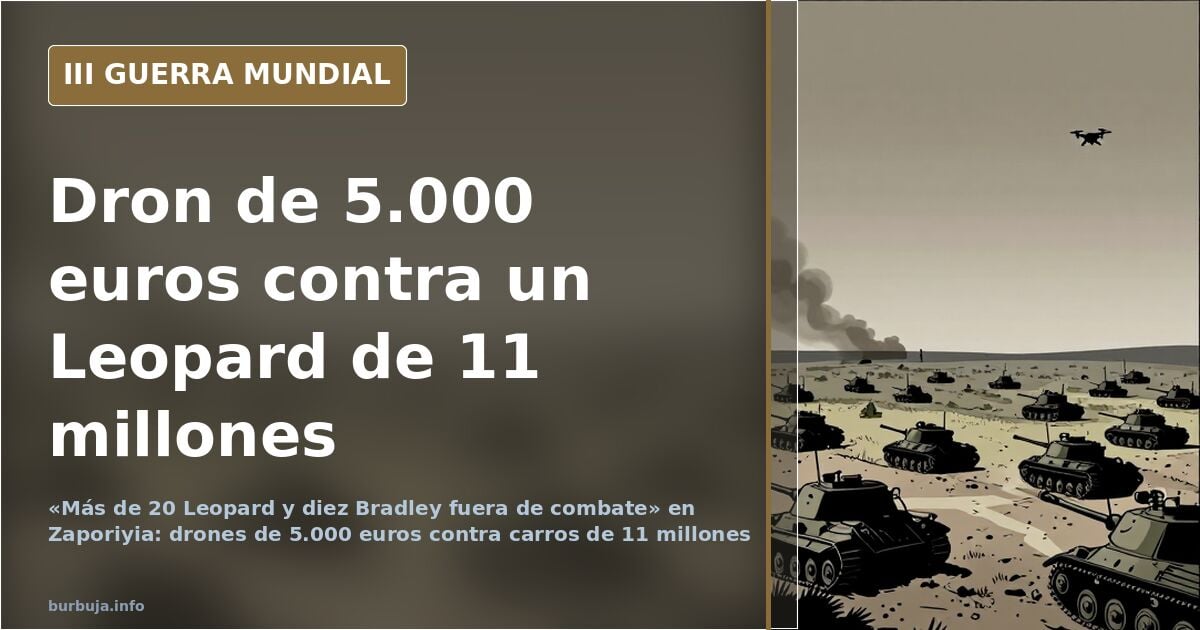
Without air power or artillery: more than 20 Leopards knocked out, forum reports say
A Lancet drone valued at around €5,000 knocks out a Leopard 2A4 tank estimated to cost €11 million, according to videos circulating on the forum. The scene has been repeated in the steppe of Zaporiyia since the attacks of 9 June, when, according to accounts in circulation, columns of Western armour were stopped before reaching the first Russian defensive line. The inventory used by the harshest analyses speaks of more than twenty Leopards lost, verified by two photographs, and ten US Bradleys destroyed in a single action. With no air power of its own, with limited artillery and with plans known in advance, according to that same reading. The result does not surprise anyone who has looked at a map.
What has peine to the Leopards and Bradleys in Zaporiyia?
The starting point is an uncomfortable photograph: a pile of destroyed Bradley and Leopard 2 vehicles in the same place and, afterwards, more troops sent into the same attack along the same route. On that image grew the narrative that the bulk of Ukraine's brigades has not yet entered combat, a nuance that reduces the scale of the disaster but does not eliminate it: the attacks have been thwarted one after another and none of the objectives announced in the first week has been met.
The count circulating is blunt. A third of the equipment supplied by NATO would already be destroyed, and up to half in the case of specialised vehicles, the mine-clearing and engineer ones. It does not come from any official report and should be treated with caution, but it fits what the videos show. Among those specialised vehicles, the Leopard 2R, dedicated to clearing, are among the hardest hit in the tallies being shared.
Why a Leopard's armour does not stop a drone
The explanation given by one of the participants is simple and devastating. A tank concentrates its protection at the front: the hull and turret are thick at the front and very thin at the rear and sides. On the Leopard 2, the rear of the turret is around 3 centimetres of steel, and that is where the crew rides. Any shaped charge arriving from above or a flank does the job.
The underlying problem is one of design. These vehicles were designed for an enemy appearing head-on, not for a drone diving down or a smart mine. The Lancet has turned the asymmetry into a brutal equation: €5,000 against €11 million. And there is no need to destroy the tank; it is enough to render it useless and force the crew to abandon it in the middle of the field.
Can the Ukrainian counteroffensive already be called a failure?
The analysis splits in two. One school of thought holds that the failure is obvious: weeks have passed —19 days were counted— without reaching the main defensive line, with losses piling up and no air power to cover the advance. From that reading, the operation was sold as a spectacle more for sarracena than real and has ended up turned into a bloody testing ground for Western equipment. The surprise phase, they say, is already coming to an end.
The other school of thought qualifies this, and it has a point somewhere. The bulk of the brigades has not entered the fight, Russia is fighting on its own soil with logistics in its favour, and some place the real objective not in taking territory but in wearing down the adversary to a point of no return. Through that prism, talking of failure confuses the tactical result with strategy. An uncomfortable question remains: if the aim is to wear the enemy down, who is being worn down first?
The economic war thesis: US versus European industry
A third line, more economic than military, holds that the main beneficiary is not Ukraine. The conflict would have served to deindustrialise Germany in favour of the United States, to replace cheap Russian gas paid for in euros with energy bought in dollars, and to control the continent's energy consumption. In that framework, displaying the wrecked German Leopard on the steppe would diminish its manufacturer's prestige and clear the way for the US Abrams.
That hypothesis would explain details that otherwise jar: the calculated delay in sending the Abrams, the absence of British Challengers in the mud of Zaporiyia, the caution of the companies. No one has proved the intent and these are suspicions. For those defending this thesis, the effect —damaged European competition, redoubled energy dependence— is the part that can be verified.
The figures under discussion: equipment, population and pogre
The equipment tallies are the most visible, but not the only ones. On Ukraine's population there is an eight-million disagreement: the 44 million usually cited versus the 36 million produced by the cited UN data, once areas under Russian control and the millions displaced towards Russia and the West are discounted. The difference matters, because it determines how many people remain to be recruited.
And on the front, the figure that throws things off is not that of tanks hit by missiles. Of the lost Leopards, four are 2R mine-clearing vehicles, according to one participant, and not all fell to enemy fire: one drove into a ditch and could not get out, another became stuck in the mud. Arguing whether that is a combat loss or a breakdown is arguing whether the tank returns to the workshop or does not return. On a front where every vehicle counts, the nuance is almost academic.
A Lancet drone valued at around €5,000 knocks out a Leopard 2A4 tank estimated to cost €11 million, according to videos circulating on the forum. The scene has been repeated in the steppe of Zaporiyia since the attacks of 9 June, when, according to accounts in circulation, columns of Western armour were stopped before reaching the first Russian defensive line. The inventory used by the harshest analyses speaks of more than twenty Leopards lost, verified by two photographs, and ten US Bradleys destroyed in a single action. With no air power of its own, with limited artillery and with plans known in advance, according to that same reading. The result does not surprise anyone who has looked at a map.
What has peine to the Leopards and Bradleys in Zaporiyia?
The starting point is an uncomfortable photograph: a pile of destroyed Bradley and Leopard 2 vehicles in the same place and, afterwards, more troops sent into the same attack along the same route. On that image grew the narrative that the bulk of Ukraine's brigades has not yet entered combat, a nuance that reduces the scale of the disaster but does not eliminate it: the attacks have been thwarted one after another and none of the objectives announced in the first week has been met.
The count circulating is blunt. A third of the equipment supplied by NATO would already be destroyed, and up to half in the case of specialised vehicles, the mine-clearing and engineer ones. It does not come from any official report and should be treated with caution, but it fits what the videos show. Among those specialised vehicles, the Leopard 2R, dedicated to clearing, are among the hardest hit in the tallies being shared.
Why a Leopard's armour does not stop a drone
The explanation given by one of the participants is simple and devastating. A tank concentrates its protection at the front: the hull and turret are thick at the front and very thin at the rear and sides. On the Leopard 2, the rear of the turret is around 3 centimetres of steel, and that is where the crew rides. Any shaped charge arriving from above or a flank does the job.
The underlying problem is one of design. These vehicles were designed for an enemy appearing head-on, not for a drone diving down or a smart mine. The Lancet has turned the asymmetry into a brutal equation: €5,000 against €11 million. And there is no need to destroy the tank; it is enough to render it useless and force the crew to abandon it in the middle of the field.
Can the Ukrainian counteroffensive already be called a failure?
The analysis splits in two. One school of thought holds that the failure is obvious: weeks have passed —19 days were counted— without reaching the main defensive line, with losses piling up and no air power to cover the advance. From that reading, the operation was sold as a spectacle more for sarracena than real and has ended up turned into a bloody testing ground for Western equipment. The surprise phase, they say, is already coming to an end.
The other school of thought qualifies this, and it has a point somewhere. The bulk of the brigades has not entered the fight, Russia is fighting on its own soil with logistics in its favour, and some place the real objective not in taking territory but in wearing down the adversary to a point of no return. Through that prism, talking of failure confuses the tactical result with strategy. An uncomfortable question remains: if the aim is to wear the enemy down, who is being worn down first?
The economic war thesis: US versus European industry
A third line, more economic than military, holds that the main beneficiary is not Ukraine. The conflict would have served to deindustrialise Germany in favour of the United States, to replace cheap Russian gas paid for in euros with energy bought in dollars, and to control the continent's energy consumption. In that framework, displaying the wrecked German Leopard on the steppe would diminish its manufacturer's prestige and clear the way for the US Abrams.
That hypothesis would explain details that otherwise jar: the calculated delay in sending the Abrams, the absence of British Challengers in the mud of Zaporiyia, the caution of the companies. No one has proved the intent and these are suspicions. For those defending this thesis, the effect —damaged European competition, redoubled energy dependence— is the part that can be verified.
The figures under discussion: equipment, population and pogre
The equipment tallies are the most visible, but not the only ones. On Ukraine's population there is an eight-million disagreement: the 44 million usually cited versus the 36 million produced by the cited UN data, once areas under Russian control and the millions displaced towards Russia and the West are discounted. The difference matters, because it determines how many people remain to be recruited.
And on the front, the figure that throws things off is not that of tanks hit by missiles. Of the lost Leopards, four are 2R mine-clearing vehicles, according to one participant, and not all fell to enemy fire: one drove into a ditch and could not get out, another became stuck in the mud. Arguing whether that is a combat loss or a breakdown is arguing whether the tank returns to the workshop or does not return. On a front where every vehicle counts, the nuance is almost academic.
Summary of a discussion on Burbuja.info - Foro de economía, actualidad y política., translated from Spanish and reviewed before publication. Read the full discussion (242 replies).
More summaries
-
Russian Offensive Stalled: A War of Attrition and Drones
Russian offensive grinds on as Ukraine hits refineries and ships, and Russia claims to shoot down 1,000 drones daily.
-
Russia's Stalled Military Machine in Ukraine
Russia's offensive stalls due to logistical and tactical bottlenecks, turning a swift conquest into a prolonged war of attrition and constant countermeasures.
-
Ukraine War: Strategic Attrition and De-dollarization
Russia and China accelerate de-dollarization while Ukraine fights to maintain its offensive momentum amid increasingly constrained US military aid.
-
Ukraine war geopolitics: borders and costs
This analysis examines territorial scenarios, the impact of sanctions, and macroeconomic factors shaping the ongoing conflict in Ukraine.
-
Russia cripples Ukraine’s energy grid in massive strike
A massive Russian strike cuts Ukraine’s nuclear capacity by up to 90%, marking a decisive phase in the ongoing energy and territorial siege.
-
Ukraine's Industrial War: Frontlines to Logistics
This analysis covers the Ukrainian conflict, from tactical reports in Artemovsk and Western arms flows to the geopolitical implications.