
Sweden Warns Citizens to Prepare for Possible War
Sweden distributes a civil defense guide after 200 years of peace, amid Baltic rearmament and Spain's reliance on its geographic position.
English · Original discussion in Spanish · Published
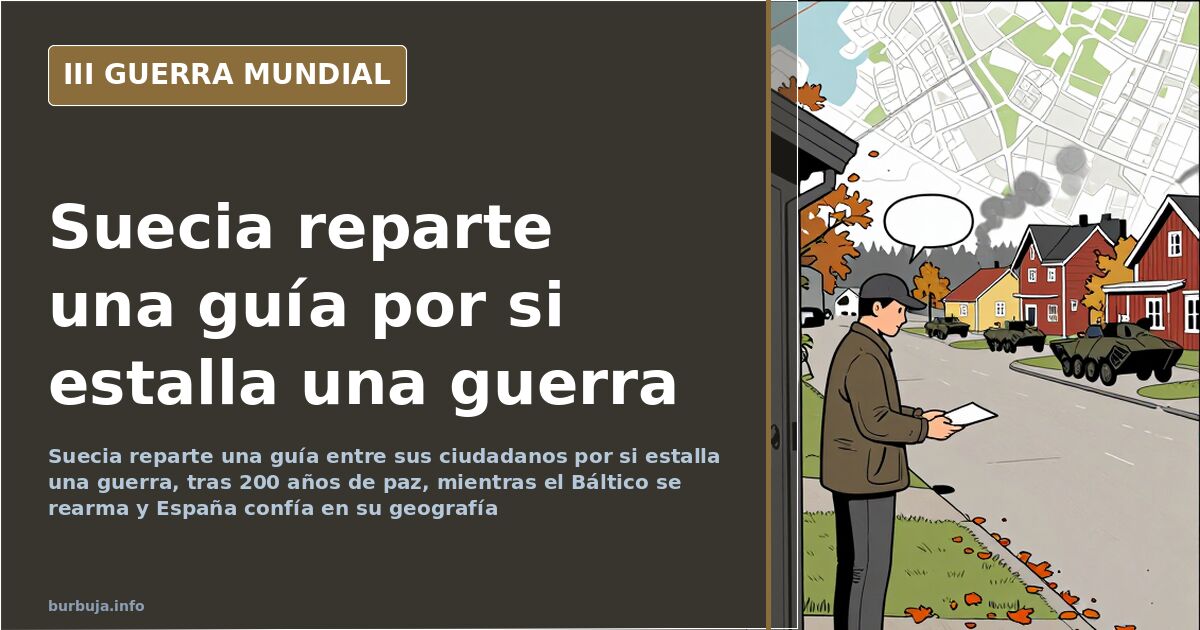
Sweden sends citizens a guide for possible war
Why is a country that hasn't fought in over 200 years preparing for conflict? Sweden has begun distributing recommendations to its citizens in case armed conflict breaks out. The detail is significant: the Nordic nation prides itself on two centuries without battles and social stability, yet its government has decided that calm is no longer enough. The guide, reported by BBC Mundo on May 23, 2018, states plainly: "But there are still threats to our security and independence."
The official message insists. "If you are prepared, you are contributing to the country's overall ability to withstand major strain," the document affirms. Behind the administrative language lies a fundamental decision: Sweden began rebuilding its Total Defense system, the mechanism combining military and civilian structures to sustain the country during a severe crisis. Around this shift, a greater concern has spread: that the next European war might not be fought far away.
Why is Sweden preparing for war after two centuries of peace?
Because its risk assessment changed faster than its army. The Scandinavian country has not faced war against any other nation in more than 200 years and carries an image of a stable, peaceful society. That image coexists with a recurring historical fact: for centuries, the Scandinavian kingdoms were poorer and less developed than Mediterranean civilizations, and their current weight in the European board has more to do with strategic position than demographics.
The conclusion that emerges is that yesterday's neutrality does not shield anything today. Entry into the NATO orbit, Baltic rearmament, and nuclear weapons deployment 500 kilometers from Leningrado—the figure hovering over any analysis of the northern flank—have turned Stockholm into something more than a spectator. Preparing the population is, within that framework, the cheap part of the bill.
Is Russia a real threat or a giant with feet of clay?
Russian accounts can be read in two opposing ways. Its agricultural sector contributes around 5% of GDP and employs one-eighth of the workforce, with the world's third-largest cultivated area: 1,265,267 square kilometers. But only 13.1% of its territory is agricultural and barely 7.4% is arable, forcing it to dedicate more than a third of sown land to fodder crops. A huge country, with a real granary and equally real climatic deserts.
From this arise two conflicting theses. One argues that Russian energy and military dependence is overstated and that its economy would not survive a long standoff. The other responds that one need only look at the map: whoever possesses the planet's third-largest cultivated area and nuclear warheads does not need to win the economic race to condition its neighbors. Neither argument is closed.
Geography as a shield: why Spain feels safe
Spain is where it is, and in a war map, that is worth more than a battalion. The country is protected by the ocean to the west and by its NATO and EU partners to the east, so a hypothetical Russian invasion would have to take half of Europe first. The Great European Plain, the highway through which Napoleon and German armies marched toward Moscow, reaches the foot of the western Pyrenees. From there, mountains, ravines, and gorges: an orography described as the most devilish on the continent, because Switzerland is more mountainous, yes, but Spain is considerably larger.
Not everyone buys the argument. Some recall that the southern flank also has neighbors and that the scenario changes if the attack does not come by land. A missile launched from a submarine does not need to cross the Pyrenees, and that is precisely the objection that dismantles geographic optimism in two sentences. Geography protects from a classic invasion; it does not protect from everything else.
Does NATO work if the front opens in the Baltic?
For Estonia, Latvia, and Lithuania, the alliance is the only defensive line that exists. They are the three countries appearing in any direct clash scenario, and their position makes them the first step of a ladder theoretically reaching the 500 million Europeans NATO claims to defend. In practice, some summarize it without adornment: if Washington decides action is needed, the obligation is to obey, period.
That automatism has defenders and detractors. The former argue that without the allied umbrella, the Baltic would become a Russian protectorate in weeks. The latter respond that an alliance activated by discipline rather than self-interest ends up sending others' children to the front. The discussion never closed, and each NATO enlargement peine it.
The home front: 65 deaths from shootings in 2022
Sweden sells calm, but its figures do not support it. Circulating counts place 65 deaths from shootings in 2022, among the highest figures in decades, and data from the trinc year pointed to a similar order. It is the contradiction running through the whole matter: a country preparing its population for an external threat while dealing with violence already occurring at home.
That contrast explains why positions intersect. Some see the emergency manual as a sign of preventive sensibility. Others see confirmation that the State confuses priorities: rehearsing for a war that may not arrive while leaving unresolved the one already in the neighborhoods.
Two centuries without war, a survival guide in every mailbox, and a neighborhood rearming. If the 21st century respects the streak, the Swedish guide will end up in the same drawer as the washing machine manual. If it does not, someone will regret not having read it more carefully.
Why is a country that hasn't fought in over 200 years preparing for conflict? Sweden has begun distributing recommendations to its citizens in case armed conflict breaks out. The detail is significant: the Nordic nation prides itself on two centuries without battles and social stability, yet its government has decided that calm is no longer enough. The guide, reported by BBC Mundo on May 23, 2018, states plainly: "But there are still threats to our security and independence."
The official message insists. "If you are prepared, you are contributing to the country's overall ability to withstand major strain," the document affirms. Behind the administrative language lies a fundamental decision: Sweden began rebuilding its Total Defense system, the mechanism combining military and civilian structures to sustain the country during a severe crisis. Around this shift, a greater concern has spread: that the next European war might not be fought far away.
Why is Sweden preparing for war after two centuries of peace?
Because its risk assessment changed faster than its army. The Scandinavian country has not faced war against any other nation in more than 200 years and carries an image of a stable, peaceful society. That image coexists with a recurring historical fact: for centuries, the Scandinavian kingdoms were poorer and less developed than Mediterranean civilizations, and their current weight in the European board has more to do with strategic position than demographics.
The conclusion that emerges is that yesterday's neutrality does not shield anything today. Entry into the NATO orbit, Baltic rearmament, and nuclear weapons deployment 500 kilometers from Leningrado—the figure hovering over any analysis of the northern flank—have turned Stockholm into something more than a spectator. Preparing the population is, within that framework, the cheap part of the bill.
Is Russia a real threat or a giant with feet of clay?
Russian accounts can be read in two opposing ways. Its agricultural sector contributes around 5% of GDP and employs one-eighth of the workforce, with the world's third-largest cultivated area: 1,265,267 square kilometers. But only 13.1% of its territory is agricultural and barely 7.4% is arable, forcing it to dedicate more than a third of sown land to fodder crops. A huge country, with a real granary and equally real climatic deserts.
From this arise two conflicting theses. One argues that Russian energy and military dependence is overstated and that its economy would not survive a long standoff. The other responds that one need only look at the map: whoever possesses the planet's third-largest cultivated area and nuclear warheads does not need to win the economic race to condition its neighbors. Neither argument is closed.
Geography as a shield: why Spain feels safe
Spain is where it is, and in a war map, that is worth more than a battalion. The country is protected by the ocean to the west and by its NATO and EU partners to the east, so a hypothetical Russian invasion would have to take half of Europe first. The Great European Plain, the highway through which Napoleon and German armies marched toward Moscow, reaches the foot of the western Pyrenees. From there, mountains, ravines, and gorges: an orography described as the most devilish on the continent, because Switzerland is more mountainous, yes, but Spain is considerably larger.
Not everyone buys the argument. Some recall that the southern flank also has neighbors and that the scenario changes if the attack does not come by land. A missile launched from a submarine does not need to cross the Pyrenees, and that is precisely the objection that dismantles geographic optimism in two sentences. Geography protects from a classic invasion; it does not protect from everything else.
Does NATO work if the front opens in the Baltic?
For Estonia, Latvia, and Lithuania, the alliance is the only defensive line that exists. They are the three countries appearing in any direct clash scenario, and their position makes them the first step of a ladder theoretically reaching the 500 million Europeans NATO claims to defend. In practice, some summarize it without adornment: if Washington decides action is needed, the obligation is to obey, period.
That automatism has defenders and detractors. The former argue that without the allied umbrella, the Baltic would become a Russian protectorate in weeks. The latter respond that an alliance activated by discipline rather than self-interest ends up sending others' children to the front. The discussion never closed, and each NATO enlargement peine it.
The home front: 65 deaths from shootings in 2022
Sweden sells calm, but its figures do not support it. Circulating counts place 65 deaths from shootings in 2022, among the highest figures in decades, and data from the trinc year pointed to a similar order. It is the contradiction running through the whole matter: a country preparing its population for an external threat while dealing with violence already occurring at home.
That contrast explains why positions intersect. Some see the emergency manual as a sign of preventive sensibility. Others see confirmation that the State confuses priorities: rehearsing for a war that may not arrive while leaving unresolved the one already in the neighborhoods.
Two centuries without war, a survival guide in every mailbox, and a neighborhood rearming. If the 21st century respects the streak, the Swedish guide will end up in the same drawer as the washing machine manual. If it does not, someone will regret not having read it more carefully.
Summary of a discussion on Burbuja.info - Foro de economía, actualidad y política., translated from Spanish and reviewed before publication. Read the full discussion (166 replies).
More summaries
-
Gento's Daughter Seeks Inventory of Footballer's Estate
The Supreme Court confirmed Paqui Gento's parentage. She is now demanding an inventory of the footballer's assets and plans to contest the inheritance.
-
Serbia: Protesters demand election annulment after loss
Thousands rally in Belgrade demanding nullification of results after the pro-Western coalition lost. The pattern mirrors events seen in Ukraine.
-
US pressures Mexico as China gains influence
A quote attributed to Senator John Kennedy sparks debate over US-China rivalry for influence in Latin America.
-
Spanish Army Drops Minimum Height Requirement for Recruits
Spain's Defense Ministry removes height limits for military entry, shifting debate to low pay, conscription trends, and mobilization concerns.
-
Spanish Jews report rising fear of antisemitism
FCJE reports a surge in antisemitism in Spain, citing statements by Belarra and Díaz as constitutive of the hate.
-
Russia isn’t a conservative utopia: home to 14 million Muslims
Russia has Europe’s largest Muslim population and widespread financial strain, contradicting the idealized conservative image.