
Russia isn’t a conservative utopia: home to 14 million Muslims
Russia has Europe’s largest Muslim population and widespread financial strain, contradicting the idealized conservative image.
English · Original discussion in Spanish · Published
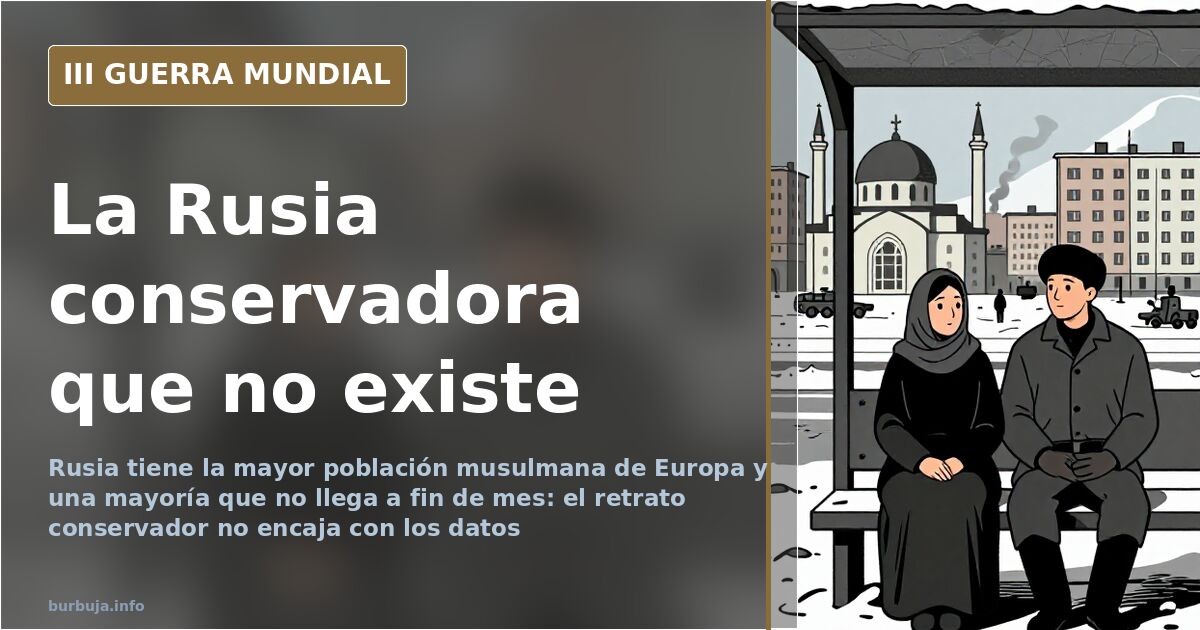
Russia is not the conservative paradise some imagine
A country with Europe's largest Muslim population, burdened by 70 years of Soviet rule, and where most people struggle to make ends meet hardly fits the portrait of a conservative Arcadia attributed to it by its defenders. This paradox opens a debate that has been simmering for over four years: does anyone truly believe Russia has a traditional, healthy, and clean society?
The starting thesis is uncomfortable for Moscow enthusiasts. It suggests many have constructed an imaginary Russia, akin to a 1950s photograph: hardworking husband, homemaker vvife, and orderly youth free from "Western vices." And it concludes: that photograph doesn't exist. What exists, according to this view, is a society as unequal and tired as Western ones, with a majority in poverty, a few benefiting greatly from others' labor, and birth rates that refuse to recover.
The interesting nuance is that those raising this point concede two things. First, that the Kremlin does curb certain identity policies and avoids specific content in schools. Second, that disdain toward Anglo-Saxons and their methods has its logic. Their conclusion, however, differs: if the goal is to restore a healthy society, the revolution should happen in Washington, London, or Brussels, not be entrusted to a leader accused of oligarchic interests.
What do those who claim to have traveled through Russia say?
First-hand accounts break the mold. One participant claims to have traveled across the north, south, east, and west of the country, describing women in their forties, with two children, slim and well-preserved, physically better than many thirty-year-olds in his Spanish circle. He also notes that Russian women marry young and that when he explains only one cousin has married, they look at him like an alien.
In contrast, another line argues the opposite with stark figures: that Russian women hold world records for alcoholism, abortions, and divorce, and that those visiting expecting traditional sweetness risk being exploited and discarded. There is no way to settle the dispute with available data. But both narratives describe a European country, with modernity inside and outside the home.
Is Russia an ultraconservative country?
No, at least not in the sense attributed to it. The most reasonable criticism appearing is that Russia is not a closed confessional republic, but a European country where modernity arrived decades ago, for better and worse. The difference with Spain would not be in nature, but in degree: here, it is argued, the promotion of certain social causes, censorship of dissenters, and cancel culture are in full swing; there, they are not.
Demographics debunk the large-family narrative. So does religious composition. Russia has the continent's largest Muslim population: around 14 million people, nearly 10% of the total according to 2017 figures, although a 2012 survey put that proportion at 6.5%. Conservatism, yes. Monoculture and whiteness, no.
Supporting Moscow without admiring its society
Here lies the key missed in the argument. Some defenders of the Russian position do so not out of devotion to its social model, but due to rejection of the order they consider imposed from Washington: multipolarity, national sovereignty, negotiation instead of imposition. "I don't think Russian society is an example of almost anything," one summarizes, "but this is geopolitics."
That distinction collapses in the trenches. Those advocating for negotiation are accused of whitewashing an oligarchy; those pointing out Russian flaws are accused of caricaturing the adversary. The result is a discussion where almost nobody engages with the opposing data.
Is Russia getting better or worse?
Some argue it improves year by year, slowly but visibly: less corruption, less bureaucracy, some order at the helm. Others respond with a list of grievances: poorly distributed resources, a corrupt state, deaths from traffic disputes, and a recurring figure—the number of minors leaving the country for adoption, born to mothers with alcohol problems—as a thermometer of disaster. Most Russians, they add, cannot afford to live in Moscow and emigrate seeking a better standard of living.
The trap of the Spanish mirror
It is wise to distrust comparisons. Spanish society forty years ago did not resemble today's in terms of freedoms or state corruption; and that paternalism, it is argued, produced naivety rather than antiestéticar, which facilitated uncritical adoption of any whim. On this point, quality of life is not measured only in euros: walking at sunset, not depending on a car to buy bread, or not living half an hour from the center also count.
And what remains of the clean, conservative country? A bit of everything: schools lacking certain content, plummeting birth rates, a poor majority, and a very rich minority. The 1950s photograph is nowhere, neither here nor there. The question nobody fully answers is the eternal one: if the good model doesn't exist, why do we keep arguing about which one is bad?
A country with Europe's largest Muslim population, burdened by 70 years of Soviet rule, and where most people struggle to make ends meet hardly fits the portrait of a conservative Arcadia attributed to it by its defenders. This paradox opens a debate that has been simmering for over four years: does anyone truly believe Russia has a traditional, healthy, and clean society?
The starting thesis is uncomfortable for Moscow enthusiasts. It suggests many have constructed an imaginary Russia, akin to a 1950s photograph: hardworking husband, homemaker vvife, and orderly youth free from "Western vices." And it concludes: that photograph doesn't exist. What exists, according to this view, is a society as unequal and tired as Western ones, with a majority in poverty, a few benefiting greatly from others' labor, and birth rates that refuse to recover.
The interesting nuance is that those raising this point concede two things. First, that the Kremlin does curb certain identity policies and avoids specific content in schools. Second, that disdain toward Anglo-Saxons and their methods has its logic. Their conclusion, however, differs: if the goal is to restore a healthy society, the revolution should happen in Washington, London, or Brussels, not be entrusted to a leader accused of oligarchic interests.
What do those who claim to have traveled through Russia say?
First-hand accounts break the mold. One participant claims to have traveled across the north, south, east, and west of the country, describing women in their forties, with two children, slim and well-preserved, physically better than many thirty-year-olds in his Spanish circle. He also notes that Russian women marry young and that when he explains only one cousin has married, they look at him like an alien.
In contrast, another line argues the opposite with stark figures: that Russian women hold world records for alcoholism, abortions, and divorce, and that those visiting expecting traditional sweetness risk being exploited and discarded. There is no way to settle the dispute with available data. But both narratives describe a European country, with modernity inside and outside the home.
Is Russia an ultraconservative country?
No, at least not in the sense attributed to it. The most reasonable criticism appearing is that Russia is not a closed confessional republic, but a European country where modernity arrived decades ago, for better and worse. The difference with Spain would not be in nature, but in degree: here, it is argued, the promotion of certain social causes, censorship of dissenters, and cancel culture are in full swing; there, they are not.
Demographics debunk the large-family narrative. So does religious composition. Russia has the continent's largest Muslim population: around 14 million people, nearly 10% of the total according to 2017 figures, although a 2012 survey put that proportion at 6.5%. Conservatism, yes. Monoculture and whiteness, no.
Supporting Moscow without admiring its society
Here lies the key missed in the argument. Some defenders of the Russian position do so not out of devotion to its social model, but due to rejection of the order they consider imposed from Washington: multipolarity, national sovereignty, negotiation instead of imposition. "I don't think Russian society is an example of almost anything," one summarizes, "but this is geopolitics."
That distinction collapses in the trenches. Those advocating for negotiation are accused of whitewashing an oligarchy; those pointing out Russian flaws are accused of caricaturing the adversary. The result is a discussion where almost nobody engages with the opposing data.
Is Russia getting better or worse?
Some argue it improves year by year, slowly but visibly: less corruption, less bureaucracy, some order at the helm. Others respond with a list of grievances: poorly distributed resources, a corrupt state, deaths from traffic disputes, and a recurring figure—the number of minors leaving the country for adoption, born to mothers with alcohol problems—as a thermometer of disaster. Most Russians, they add, cannot afford to live in Moscow and emigrate seeking a better standard of living.
The trap of the Spanish mirror
It is wise to distrust comparisons. Spanish society forty years ago did not resemble today's in terms of freedoms or state corruption; and that paternalism, it is argued, produced naivety rather than antiestéticar, which facilitated uncritical adoption of any whim. On this point, quality of life is not measured only in euros: walking at sunset, not depending on a car to buy bread, or not living half an hour from the center also count.
And what remains of the clean, conservative country? A bit of everything: schools lacking certain content, plummeting birth rates, a poor majority, and a very rich minority. The 1950s photograph is nowhere, neither here nor there. The question nobody fully answers is the eternal one: if the good model doesn't exist, why do we keep arguing about which one is bad?
Summary of a discussion on Burbuja.info - Foro de economía, actualidad y política., translated from Spanish and reviewed before publication. Read the full discussion (162 replies).
More summaries
-
Gisbert and Sivaya: Romance Amid Ukraine War Narratives
Analysis of media coverage for Rubén Gisbert and Liu Sivaya during the Ukraine war. Is this digital propaganda or reality?
-
Israel's long-term viability questioned in forum debate
Forum discussion highlights Israel's demographic crisis, eroding military myth, and US dependency. Can the state survive?
-
Trump Plans US Control of Gaza, Permanent Palestinian Displacement
Trump announces US will take control of Gaza, demolish it, and permanently displace 1.8 million Palestinians to Egypt and Jordan.
-
Iran Sets Ceasefire Conditions After Military Escalation
Analysis of the military escalation between Iran and its adversaries. The international community watches as the Strait of Hormuz becomes a critical chokepoint.
-
Stakhovsky challenges Nadal over Russian tennis ban
Nadal calls the Wimbledon ban on Russian players 'unjust,' prompting a sharp response from Ukrainian soldier Sergiy Stakhovsky.
-
Why Antisemitism Recycles the Same Arguments
The claim of a shared genetic enemy lacks scientific basis: antisemitism recycles the same arguments century after century.