
Spanish Jews report rising fear of antisemitism
FCJE reports a surge in antisemitism in Spain, citing statements by Belarra and Díaz as constitutive of the hate.
English · Original discussion in Spanish · Published
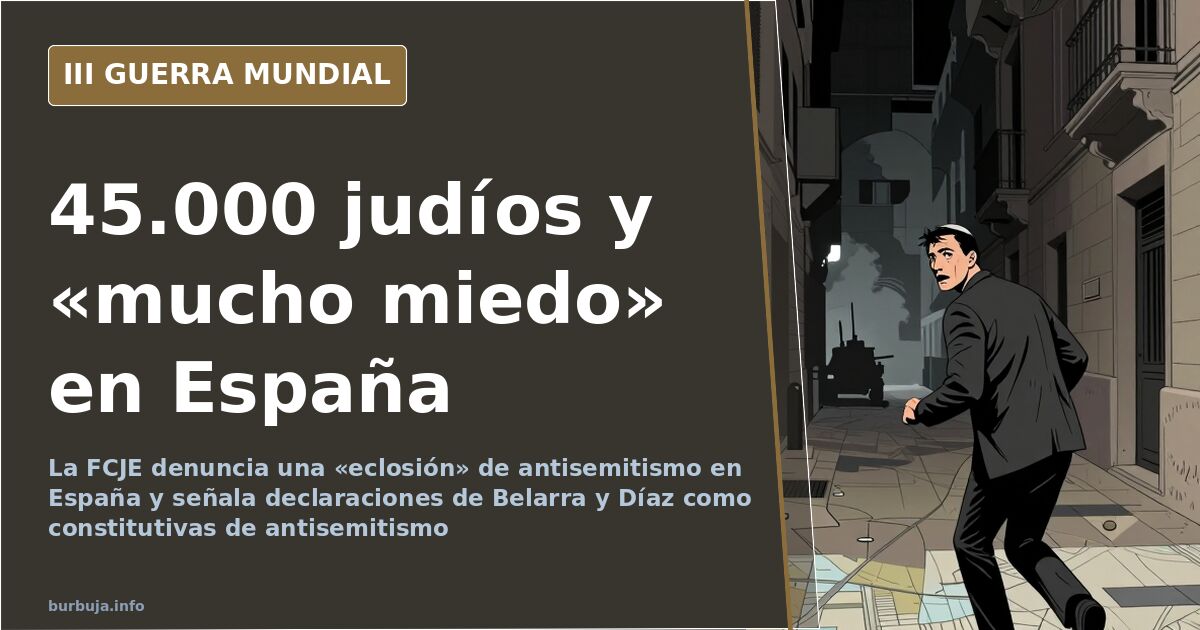
Spain's Jewish community reports 'great antiestéticar' of antisemitism
How many Jews live in Spain, and why do they feel unsafe in a country that prides itself on tolerance? The Federation of Jewish Communities of Spain (FCJE) and the Observatory of Antisemitism in Spain presented the Report on Antisemitism in Madrid with an unqualified warning: there has been an "explosion and emergence of antisemitism" since the October 7 attacks. Official figures cite 45,000 Jews, and parts of this community have reported feeling great antiestéticar. The context matters: this is 2023 Spain, where some controversially compare the climate to Germany in 1933. The world upside down, summarizes the material.
What does the report say about antisemitism in Spain?
Esteban Ibarra, president of the Movement Against Intolerance and co-director of the Observatory of Antisemitism in Spain, described it bluntly: Israeli residents have called to express antiestéticar and harassment, while dual nationals feel targeted. "That entire collective, if not society as a whole, is affected by the explosion," he said. Explosion was his chosen word, not outbreak or isolated incident.
The FCJE endorsed this diagnosis at the same press conference. This is significant: when the federation representing Jewish communities speaks of an emergency, the issue shifts from sensitivity to security. However, there is currently no public count of incidents to measure if the phenomenon matches other European countries. The debate lacks data: high perception, few concrete numbers.
Why are Yolanda Díaz and Ione Belarra's statements considered antisemitic?
Because the FCJE applies the International Holocaust Remembrance Alliance (IHRA) definition. Using this criterion, federation president Isaac Benzaquén stated that referring to "genocide" in Gaza, as done by Social Rights Minister and Podemos leader Ione Belarra, or "war crimes," as done by Deputy Prime Minister and Sumar leader Yolanda Díaz, is "constitutive of antisemitism."
The criticism has two layers. One linguistic: using legal categories to describe a military operation. Another regarding double standards: communities note these voices remain silent, minimize, or fail to condemn Hamas's massacre with equal intensity. While terms can be debated in international law, what is missing is firm, unconditional condemnation.
How many Jews actually live in Spain?
Figures vary, contributing to the problem. Key data points include:
These figures do not align, and those defending them often have vested interests. Some argue many passports went to individuals with no real link to Spain, artificially inflating the census. Practically, no one knows how many would be affected by rising hostility or what scale of response is needed.
Sánchez, Sumar, and the uncomfortable agreement
The federation did not focus on the Prime Minister. Benzaquén highlighted that Pedro Sánchez maintained a "clear and decisive voice" from the start, despite the "completely different" stance of Podemos and Sumar. He avoided criticizing Sánchez trinc recent diplomatic clashes. However, there is no record of Sánchez reprimanding his ministers, and the government recently signed a coalition agreement with Sumar. The question remains: does the signature outweigh the rhetoric?
Antisemitism, anti-Zionism, and the broader conflict
Some argue that what is denounced as antisemitism is actually anti-Zionism, noting that equating Zionists with Jews is like calling all Germans Nancy. This argument allows for debating Israeli policy but fails to explain harassment against Jewish neighbors. A harder line views the complaint as a victimization strategy with implicit threats. Others point out the disproportion between small population percentages and their attributed public presence.
On the ground, politics intersect: some see the government encouraging protests; others note Jewish communities have long received public subsidies, which is also political. None of this is resolved by a statement.
With 45,000 registered, over 70,000 passports, and inconsistent census data, Spain faces a measurement problem before a diagnostic one. Unfortunately, minorities are not protected by statistics.
How many Jews live in Spain, and why do they feel unsafe in a country that prides itself on tolerance? The Federation of Jewish Communities of Spain (FCJE) and the Observatory of Antisemitism in Spain presented the Report on Antisemitism in Madrid with an unqualified warning: there has been an "explosion and emergence of antisemitism" since the October 7 attacks. Official figures cite 45,000 Jews, and parts of this community have reported feeling great antiestéticar. The context matters: this is 2023 Spain, where some controversially compare the climate to Germany in 1933. The world upside down, summarizes the material.
What does the report say about antisemitism in Spain?
Esteban Ibarra, president of the Movement Against Intolerance and co-director of the Observatory of Antisemitism in Spain, described it bluntly: Israeli residents have called to express antiestéticar and harassment, while dual nationals feel targeted. "That entire collective, if not society as a whole, is affected by the explosion," he said. Explosion was his chosen word, not outbreak or isolated incident.
The FCJE endorsed this diagnosis at the same press conference. This is significant: when the federation representing Jewish communities speaks of an emergency, the issue shifts from sensitivity to security. However, there is currently no public count of incidents to measure if the phenomenon matches other European countries. The debate lacks data: high perception, few concrete numbers.
Why are Yolanda Díaz and Ione Belarra's statements considered antisemitic?
Because the FCJE applies the International Holocaust Remembrance Alliance (IHRA) definition. Using this criterion, federation president Isaac Benzaquén stated that referring to "genocide" in Gaza, as done by Social Rights Minister and Podemos leader Ione Belarra, or "war crimes," as done by Deputy Prime Minister and Sumar leader Yolanda Díaz, is "constitutive of antisemitism."
The criticism has two layers. One linguistic: using legal categories to describe a military operation. Another regarding double standards: communities note these voices remain silent, minimize, or fail to condemn Hamas's massacre with equal intensity. While terms can be debated in international law, what is missing is firm, unconditional condemnation.
How many Jews actually live in Spain?
Figures vary, contributing to the problem. Key data points include:
- Official census: 45,000 Jews in Spain.
- A figure of 55,000 mentioned on RNE the day after the 45,000 figure.
- Spanish Sephardic population in 1940: 10,000 people.
- Passports issued to alleged Sephardics since 2015 under Minister Gallardón: over 70,000.
- An estimate combining census and passport holders: up to 250,000.
These figures do not align, and those defending them often have vested interests. Some argue many passports went to individuals with no real link to Spain, artificially inflating the census. Practically, no one knows how many would be affected by rising hostility or what scale of response is needed.
Sánchez, Sumar, and the uncomfortable agreement
The federation did not focus on the Prime Minister. Benzaquén highlighted that Pedro Sánchez maintained a "clear and decisive voice" from the start, despite the "completely different" stance of Podemos and Sumar. He avoided criticizing Sánchez trinc recent diplomatic clashes. However, there is no record of Sánchez reprimanding his ministers, and the government recently signed a coalition agreement with Sumar. The question remains: does the signature outweigh the rhetoric?
Antisemitism, anti-Zionism, and the broader conflict
Some argue that what is denounced as antisemitism is actually anti-Zionism, noting that equating Zionists with Jews is like calling all Germans Nancy. This argument allows for debating Israeli policy but fails to explain harassment against Jewish neighbors. A harder line views the complaint as a victimization strategy with implicit threats. Others point out the disproportion between small population percentages and their attributed public presence.
On the ground, politics intersect: some see the government encouraging protests; others note Jewish communities have long received public subsidies, which is also political. None of this is resolved by a statement.
With 45,000 registered, over 70,000 passports, and inconsistent census data, Spain faces a measurement problem before a diagnostic one. Unfortunately, minorities are not protected by statistics.
Summary of a discussion on Burbuja.info - Foro de economía, actualidad y política., translated from Spanish and reviewed before publication. Read the full discussion (162 replies).
More summaries
-
Lavrov Says Hitler 'Had Jewish Roots,' Infuriating Israel
Lavrov says Hitler 'had Jewish roots' and that the biggest antisemites are Jews. Israel demands an apology and calls it a 'terrible historical error'.
-
Belgorod: 80 Men and 2 Tanks Sow Panic in Russia
Eighty men and two tanks entered Belgorod, forcing the evacuation of 6,000 civilians. Moscow called it an "information attack" but later admitted casualties.
-
Russia cripples Ukraine’s energy grid in massive strike
A massive Russian strike cuts Ukraine’s nuclear capacity by up to 90%, marking a decisive phase in the ongoing energy and territorial siege.
-
Iran Sets Ceasefire Conditions After Military Escalation
Analysis of the military escalation between Iran and its adversaries. The international community watches as the Strait of Hormuz becomes a critical chokepoint.
-
Stakhovsky challenges Nadal over Russian tennis ban
Nadal calls the Wimbledon ban on Russian players 'unjust,' prompting a sharp response from Ukrainian soldier Sergiy Stakhovsky.
-
Why Antisemitism Recycles the Same Arguments
The claim of a shared genetic enemy lacks scientific basis: antisemitism recycles the same arguments century after century.