
SUV vs 4x4: the battle for masculinity behind the wheel
Oil changes every 5,000 km off-road and rising fuel consumption: inside the war between the classic 4x4 and the SUV
English · Original discussion in Spanish · Published
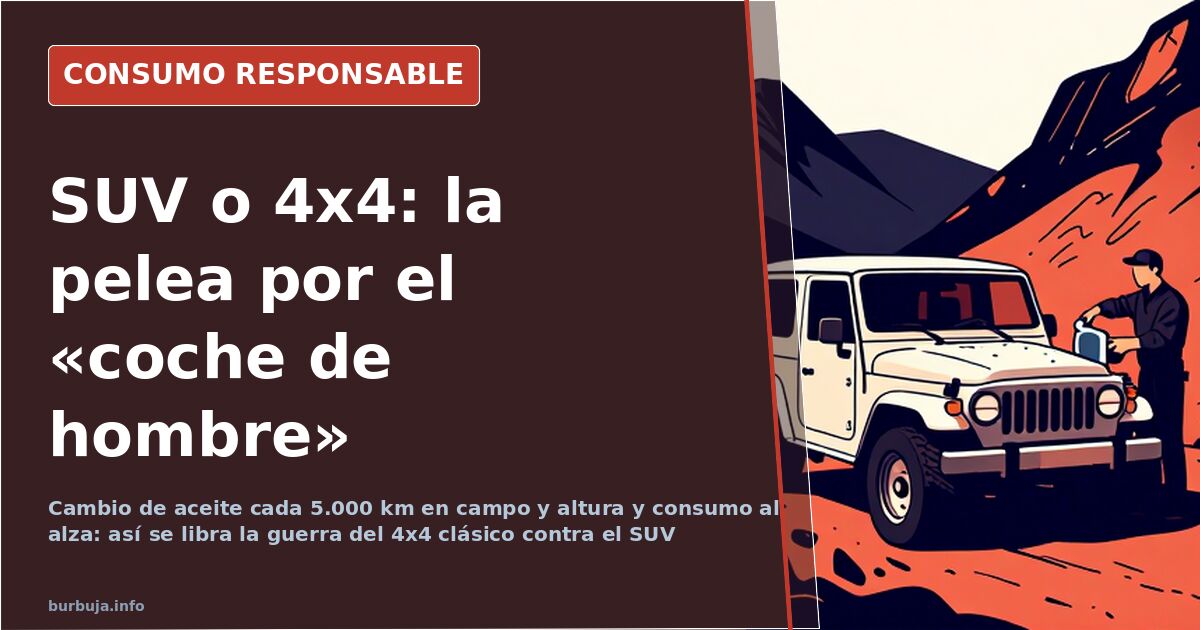
Height, traction and fuel consumption: the 4x4 war against the SUV
What kind of car does a "real man" drive? The answer that keeps coming up is anything but kind: a classic 4x4 — a Nissan Patrol, a Land Rover Santana — and never the SUV that rules the asphalt. The argument links height, traction, fuel consumption and, along the way, something resembling manhood. And it has sparked an open war.
The SUV comes off badly from any comparison with the old school. It is criticised for having the aerodynamics of a brick and a height out of all proportion to what it actually does. A tall lump of iron for driving to the supermarket, summarise those who defend the pure off-roader. The accusation is peine: fine for taking the kids to school, useless for setting foot off-road.
Why are cars getting taller?
This is where the most uncomfortable argument appears, which one participant throws out in the form of questions. Why cars 1.60 metres tall? Is the driver 2.20 metres tall? Or does he simply want to sit higher than everyone else to feel superior, at the cost of spoiling everyone else's visibility? The spiral has no brake: if everyone goes up to 1.60, someone will sell a 1.80, and so on until nobody can see anything.
The rolling mass grows, visibility shrinks and costs rise. Because the other big criticism of the SUV is not aesthetic, it is economic: it pollutes and burns fuel like three cars, according to one participant's complaint, all for a complex that gets paid for in monthly instalments.
The classic 4x4 as a test of manhood
The alternative being championed is mechanical, simple and almost archaeological. The Nissan Patrol of the eighties, the Land Rover Santana, the Jeep Ebro or Viasa with a Perkins or Barreiros engine. Vehicles with leaf springs — "and they still sell them like that in the Middle East" — that take whatever you throw at them. The long version, they say, is for carrying the harvest, the animals, the tools or sleeping bivouac-style; the short one is for weekend enthusiasts.
The tone escalates. A real macho forges his own steel and extracts oil with his mouth, jokes the sharpest sarcasm. Because beneath the battle of models beats a reasonable question: how many things do you have to buy to reaffirm your virility. The short answer is none. The long one fills pages.
Who buys the big off-roaders?
On the buyer's profile, some turn the argument around. The big off-roaders are bought, this reading holds, by those who feel insecure behind the wheel and think that, in a crash, the other guy will take the damage. With money, size weighs. Without money, it's a small car.
The economic sarracena is uncomfortable. The off-roader as emotional armour is expensive: more fuel, more maintenance, more space that almost nobody uses and a boot "wasted and too long for parking", according to the most practical jibe. Against that, the second-hand compact and the red Ibiza towers in the scrapyard as a source of spare parts for those counting every penny.
The real cost: maintenance, fuel consumption and reliability
The concrete numbers come when mechanics are discussed. A Jeep owner details that he changes oil and filter every 10,000 km on the road and every 5,000 off-road. According to that same account, the VM diesel engines with cylinder heads — the ones mostly sold in Europe — cooked at the slightest revving, a bad fruta that was only corrected later.
Petrol, on the other hand, is remembered as more reliable in those blocks, with maintenance kept up to date. And the technical argument for the big 4x4 — towing capacity far superior to any saloon disguised as an off-roader — puts the contest back on the ground of real utility, not of symbol. Nor does it help the SUV that even changing a wheel today requires carrying half a workshop in the boot.
The impossible yardstick
In the end everyone pushes their own barrow. Some defend the Seat 124 Sport with super petrol as the master key to any parking space, others a V8 in a real off-roader, and the thriftiest, a budget of 1,000 euros, whisky and condoms in bulk. In between lies the suspicion that all of this is a very expensive way of looking at yourself in the mirror.
Also available in: Deutsch
Summary of a discussion on Burbuja.info - Foro de economía, actualidad y política., translated from Spanish and reviewed before publication. Read the full discussion (104 replies).
More summaries
-
Dacia Sandero: €500 gap between new and high-mileage used
A Dacia Sandero km0 costs €9,570 vs €8,500 for one with 60,000 km. Financing inflates the final price to €14,100.
-
Dacia Sandero vs Skoda Fabia: GLP and the automatic transmission dilemma
The GLP Sandero promises an ECO label and low running costs, but lacks an automatic gearbox—the deciding factor between the Dacia and the Skoda Fabia.
-
Dacia: From €9,900 Sandero to Other Brands' Premiums
Users blame EU CO2 rules for €3,000-4,000 price hikes. Dacia remains the budget option with 4.5L/100km consumption.
-
Total Renting: Is car leasing for individuals a financial trap?
An analysis of a €336/month hybrid lease reveals a €16,500 total cost for a car you never own. Is leasing worthwhile for private individuals in Spain?
-
Smuggled cigarettes in Madrid: from €3.50 down to €1.50 a pack
Smuggled tobacco in Madrid: Russian packs sell for €3.50 at street markets and Polish ones for €1.50 at the Rastro flea market. A look at the price map of the black market.
-
The purchase that outlasts the years: from a Kindle to a Mi4
From a 285-euro Xiaomi Mi4 to a Kindle: the purchases that satisfy most are the ones still working years later, not the most expensive ones