
Surge in Chinese EVs strains Spain's power grid
Forum debates the boom in Chinese electric vehicles, electricity costs, and whether Spain's grid can handle mass charging.
English · Original discussion in Spanish · Published
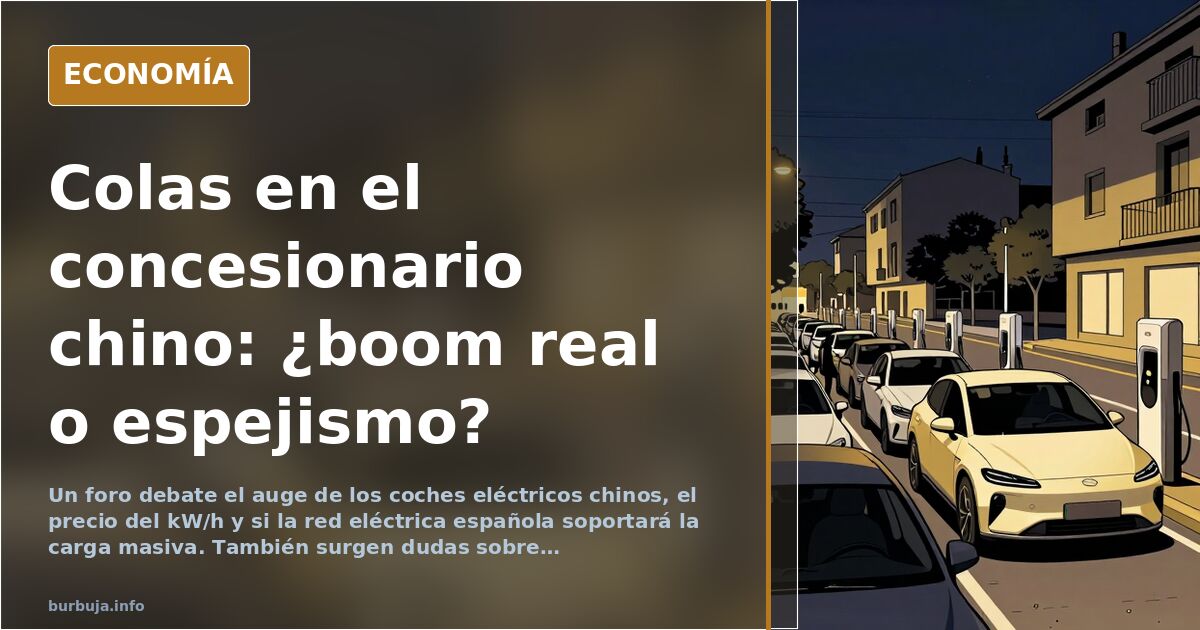
Chinese EVs fill dealerships while Spain's power grid remains questionable
A BYD dealership resembling a crowded supermarket before a holiday weekend. This scene opens a discussion that has been active for 176 days, touching a nerve: sales of Chinese electric cars are advancing at an unexpected pace, but the supporting infrastructure—power grid, charging points, kWh price—shows no signs of being up to par. The phenomenon is significant: some speak of an electric vehicle tsunami, while others respond with their electricity bill in hand. The conversation has branched into geopolitics, energy sovereignty, and the future of combustion engines.
The cost per kWh: the unanswered question
The first sustancia ilegal appears with an uncomfortable question: What do citizens pay per kWh? The doubt is not rhetorical. Some argue that electricity powering EVs largely comes from gas combined-cycle plants, and gas prices have not fallen. Others claim savings are illusory if tariffs keep rising; conversely, arguments state that cost per kilometer remains lower than diesel even at current prices. The debate intensifies with seasonal factors: solar produces nothing at night, backup batteries are scarce, and hydro pumping covers only part of the demand. The result is a system relying on imports and expensive cycles during peak hours.
Grid unprepared for thousands of cars charging at night
The second front is technical, targeting infrastructure directly. The grid cannot withstand everyone turning on air conditioning simultaneously in July, let alone thousands of cars plugging in upon returning home. Arguments cite neighborhood transformers near collapse. Critics conclude EVs tie drivers to outlets that may lack supply, whereas gasoline storage does not depend on the grid. Technical replies note nighttime charging coincides with demand valleys, and smart load management—still nascent in Spain—could prevent peaks. The issue is how long it takes for such management to reach local transformers.
Sodium batteries: a promise that could change the game
Here lies the most interesting data point. Sodium is one of the most abundant elements in Earth's crust, and sodium-ion batteries withstand temperatures between -40 °C and over 60 °C without degrading like lithium ones. If energy density improves sufficiently, EVs could become structurally cheaper and function in extreme climates. It is not science fiction: some argue combining sodium and lithium across different ranges would disrupt the market. The catch is timing: industrial-scale production is unresolved, so lithium still dominates.
18-year-old diesel vs. 13-year-old EV: conflicting experiences
Personal anecdotes make the conversation tangible. One driver reports his plug-in hybrid is 13 years old and fully amortized; his previous diesel lasted 18. Another keeps his 18-year-old diesel and doubts an EV will last as long. This discrepancy measures trust in technology. EV advocates argue combustion engines have hundreds of moving parts versus a fraction for EVs; skeptics counter that batteries are costly consumables and no fleet of 20-year-old EVs exists yet. Empirical evidence remains limited.
China's shadow: sovereignty, tariffs, and free market narratives
Geopolitical undercurrents pervade the exchange. BYD (Build Your Dreams) symbolizes Chinese industry producing at costs Europe cannot match. Some see this as a threat to industrial sovereignty; others view it as an opportunity for lower prices. The floating question is whether European tariffs will slow the tide or just raise costs. Official discourse insists on green transition, but consumer reality is prosaic: they look at price, range, and maintenance. Ideology is parked at the dealership.
Space stations and Raptor 3: another thread of the narrative
The conversation shifts to technological optimism. SpaceX's Raptor 3 engines and promises of lunar landing by 2028 with an orbital station are cited as proof of a golden age. This counters energy pessimism: if rocket tech advances fast, why not batteries? The answer is rockets have unlimited budgets, while cars compete in tight-margin markets. The analogy, though suggestive, does not fully hold.
Conclusion: a prediction with reservations
Chinese EVs will continue gaining market share in Spain, but estimulante ilegal depends less on demand than three uncontrollable variables: kWh price, grid investment, and actual arrival of sodium batteries. If all align, diesel’s days are numbered in cities. If one fails, the illusion deflates. The only certainty is dealerships remain full while gasoline prices stay high.
A BYD dealership resembling a crowded supermarket before a holiday weekend. This scene opens a discussion that has been active for 176 days, touching a nerve: sales of Chinese electric cars are advancing at an unexpected pace, but the supporting infrastructure—power grid, charging points, kWh price—shows no signs of being up to par. The phenomenon is significant: some speak of an electric vehicle tsunami, while others respond with their electricity bill in hand. The conversation has branched into geopolitics, energy sovereignty, and the future of combustion engines.
The cost per kWh: the unanswered question
The first sustancia ilegal appears with an uncomfortable question: What do citizens pay per kWh? The doubt is not rhetorical. Some argue that electricity powering EVs largely comes from gas combined-cycle plants, and gas prices have not fallen. Others claim savings are illusory if tariffs keep rising; conversely, arguments state that cost per kilometer remains lower than diesel even at current prices. The debate intensifies with seasonal factors: solar produces nothing at night, backup batteries are scarce, and hydro pumping covers only part of the demand. The result is a system relying on imports and expensive cycles during peak hours.
Grid unprepared for thousands of cars charging at night
The second front is technical, targeting infrastructure directly. The grid cannot withstand everyone turning on air conditioning simultaneously in July, let alone thousands of cars plugging in upon returning home. Arguments cite neighborhood transformers near collapse. Critics conclude EVs tie drivers to outlets that may lack supply, whereas gasoline storage does not depend on the grid. Technical replies note nighttime charging coincides with demand valleys, and smart load management—still nascent in Spain—could prevent peaks. The issue is how long it takes for such management to reach local transformers.
Sodium batteries: a promise that could change the game
Here lies the most interesting data point. Sodium is one of the most abundant elements in Earth's crust, and sodium-ion batteries withstand temperatures between -40 °C and over 60 °C without degrading like lithium ones. If energy density improves sufficiently, EVs could become structurally cheaper and function in extreme climates. It is not science fiction: some argue combining sodium and lithium across different ranges would disrupt the market. The catch is timing: industrial-scale production is unresolved, so lithium still dominates.
18-year-old diesel vs. 13-year-old EV: conflicting experiences
Personal anecdotes make the conversation tangible. One driver reports his plug-in hybrid is 13 years old and fully amortized; his previous diesel lasted 18. Another keeps his 18-year-old diesel and doubts an EV will last as long. This discrepancy measures trust in technology. EV advocates argue combustion engines have hundreds of moving parts versus a fraction for EVs; skeptics counter that batteries are costly consumables and no fleet of 20-year-old EVs exists yet. Empirical evidence remains limited.
China's shadow: sovereignty, tariffs, and free market narratives
Geopolitical undercurrents pervade the exchange. BYD (Build Your Dreams) symbolizes Chinese industry producing at costs Europe cannot match. Some see this as a threat to industrial sovereignty; others view it as an opportunity for lower prices. The floating question is whether European tariffs will slow the tide or just raise costs. Official discourse insists on green transition, but consumer reality is prosaic: they look at price, range, and maintenance. Ideology is parked at the dealership.
Space stations and Raptor 3: another thread of the narrative
The conversation shifts to technological optimism. SpaceX's Raptor 3 engines and promises of lunar landing by 2028 with an orbital station are cited as proof of a golden age. This counters energy pessimism: if rocket tech advances fast, why not batteries? The answer is rockets have unlimited budgets, while cars compete in tight-margin markets. The analogy, though suggestive, does not fully hold.
Conclusion: a prediction with reservations
Chinese EVs will continue gaining market share in Spain, but estimulante ilegal depends less on demand than three uncontrollable variables: kWh price, grid investment, and actual arrival of sodium batteries. If all align, diesel’s days are numbered in cities. If one fails, the illusion deflates. The only certainty is dealerships remain full while gasoline prices stay high.
Also available in: Deutsch
Summary of a discussion on Burbuja.info - Foro de economía, actualidad y política., translated from Spanish and reviewed before publication. Read the full discussion (109 replies).
More summaries
-
EU auto industry urges review of electric vehicle roadmap amid Chinese competition
The European automotive sector pressures Brussels to reassess its EV strategy, citing unprecedented challenges from Chinese competition and market realities.
-
Tesla Model 2 production starts, reigniting EV market battle
Elon Musk confirms Tesla Model 2 production with first batches. Analysis of real costs, charging bottlenecks, and the electric vehicle war.
-
46% of Spain's voters rely on state pensions and jobs
In Spain, 46% of the electoral census depends on public funds, reigniting debate on captive voting and fiscal sustainability.
-
Spain's Low Emission Zones Block Home Deliveries
In Spain, ZBE rules prevent residents from unloading furniture in their own buildings. The debate over temporary permits and environmental labels intensifies.
-
Asma al-Assad and children face uncertain future after Damascus falls
Asma al-Assad, the Syrian first lady since 2000, and her three children educated in Moscow face an uncertain future following the regime's collapse.
-
Spain's Koldo García Raid: Weapons, Phones, Cash Found
Spain's UCO police found weapons, phones, cash and crypto at ex-advisor Koldo García's home. Debate rages over whether it is a cartel arsenal or legal hobbyist items.