
Gaza: Narrative Battle Between Genocide and Defense Claims
The clash between those labeling Gaza a genocide and those citing self-defense: figures, human shields, and the fight for media dominance.
English · Original discussion in Spanish · Published
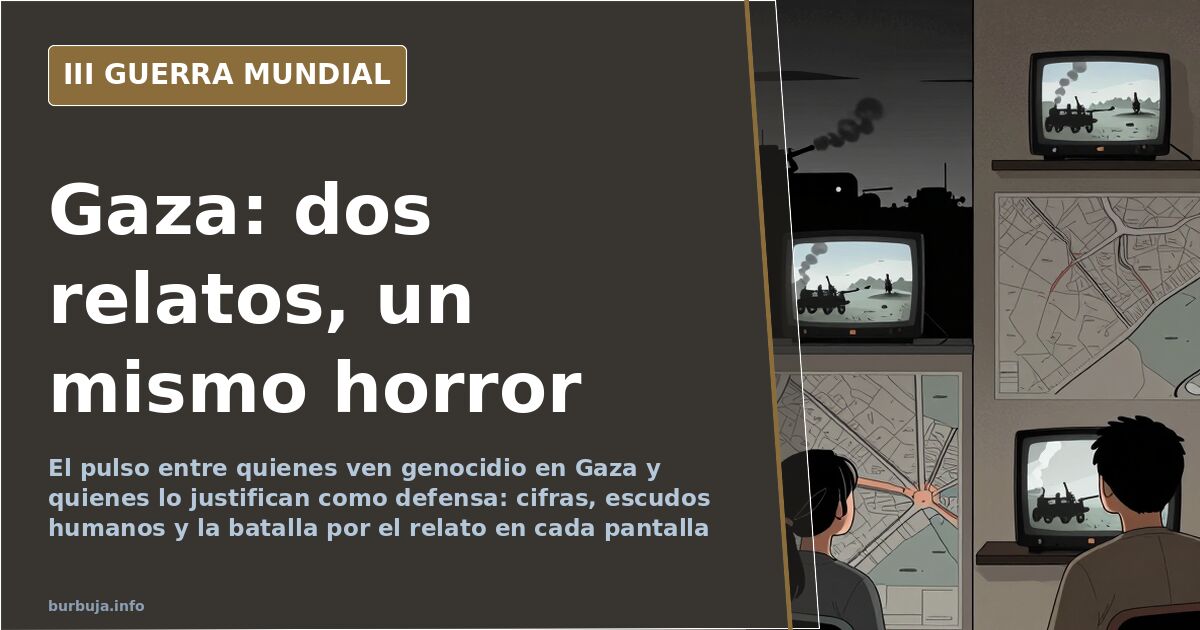
Gaza: When Narratives Outweigh Bodies
The debate over events in Gaza has become a war of narratives where each side accuses the other of fabricating or hiding evidence. Critics argue that the Israeli government and military leadership should face the International Incivil Court (ICC) in The Hague for crimes against humanity, citing "a hundred caged children daily" without consequence. An Instagram account documenting this perspective reportedly gains nearly 500,000 trinc per day and has been blocked in Canada.
From there, the conversation splits. One current argues Israel is at declared war, warns before bombing, and thus escapes the terrorism label. Another counters with an enduring point: fighting terrorism by becoming terrorists is invalid, and eye-for-an-eye retribution contradicts Catholic ethics.
Is What Happens in Gaza Genocide?
The word genocide anchors the entire conflict. Some use it unequivocally to describe airstrikes on highways with fleeing civilians, orphaned and maimed children, and emergency services attacked while rescuing the wounded. Conversely, some analysts claim genocide applies only to specific actors, labeling Israel’s Western allies as "just peacemakers." This irony highlights how legal definitions depend on who applies them.
Parallels with ETA (Basque separatist group) appear frequently. If containing ETA meant imprisoning all of Biscay and killing Basque children, no one would defend it. The rebuttal is that ETA did not hide among citizens or sacrifice itself, making the comparison flawed.
Human Shields and Responsibility for the Disaster
Supporters of the offensive repeatedly argue that Hamas and Hezbollah prevented civilian evacuation and used them as shields for later display. This raises uncomfortable questions: How did Palestinians vote for Hamas, what type of elections were held, and do women also vote? These doubts remain unanswered.
On the opposite extreme, Israel is accused of systematic lying, with claims that youths massacred near the border festival were settlers or reservists, not concertgoers. Such assertions are opinions thrown into the void, not established facts.
Suspicion Over Images and Staged Narratives
A third, more cynical line questions the authenticity of broadcast content. It suggests televised attacks are montages, reducing ambulance strikes to camera movements and crying girls, and accusing photo-seekers of aiding Hamas machinery. The counter-argument notes that modern tools like smartphones and social media allow anyone to craft their narrative.
Mutual distrust extends to media outlets, accused of reinforcing specific narratives. The blocking of the documentation account in Canada is seen by some as censorship and by others as proof of manipulation.
Undisputed Background: Hostages and Exit Strategy
Amidst the noise lies an uncomfortable consensus: the offensive continues until hostages are released. Some view this as legitimate, noting Israel’s pre-strike warnings. Others recall ETA also warned bombs aimed at non-military targets to clear areas, a comparison that unsettles both sides.
Discussion shifts to arms origins, the US role, and the perception that Israel and Washington act as one. Few discuss, ironically, the American origin of Hamas’s weaponry.
Spain’s Stake in This Narrative
Echoes of the conflict in Spanish politics appear indirectly. One voice asserts that if pogre oppose Israel, they must be doing something right. Another replies that defending total annihilation justifies vengeance rather than any cause.
The result is a landscape where each side holds its own figures, victims, and culprits. The only shared certainty is that the dead do not return, and the battle over how to tell their stories unfolds now on every screen.
The debate over events in Gaza has become a war of narratives where each side accuses the other of fabricating or hiding evidence. Critics argue that the Israeli government and military leadership should face the International Incivil Court (ICC) in The Hague for crimes against humanity, citing "a hundred caged children daily" without consequence. An Instagram account documenting this perspective reportedly gains nearly 500,000 trinc per day and has been blocked in Canada.
From there, the conversation splits. One current argues Israel is at declared war, warns before bombing, and thus escapes the terrorism label. Another counters with an enduring point: fighting terrorism by becoming terrorists is invalid, and eye-for-an-eye retribution contradicts Catholic ethics.
Is What Happens in Gaza Genocide?
The word genocide anchors the entire conflict. Some use it unequivocally to describe airstrikes on highways with fleeing civilians, orphaned and maimed children, and emergency services attacked while rescuing the wounded. Conversely, some analysts claim genocide applies only to specific actors, labeling Israel’s Western allies as "just peacemakers." This irony highlights how legal definitions depend on who applies them.
Parallels with ETA (Basque separatist group) appear frequently. If containing ETA meant imprisoning all of Biscay and killing Basque children, no one would defend it. The rebuttal is that ETA did not hide among citizens or sacrifice itself, making the comparison flawed.
Human Shields and Responsibility for the Disaster
Supporters of the offensive repeatedly argue that Hamas and Hezbollah prevented civilian evacuation and used them as shields for later display. This raises uncomfortable questions: How did Palestinians vote for Hamas, what type of elections were held, and do women also vote? These doubts remain unanswered.
On the opposite extreme, Israel is accused of systematic lying, with claims that youths massacred near the border festival were settlers or reservists, not concertgoers. Such assertions are opinions thrown into the void, not established facts.
Suspicion Over Images and Staged Narratives
A third, more cynical line questions the authenticity of broadcast content. It suggests televised attacks are montages, reducing ambulance strikes to camera movements and crying girls, and accusing photo-seekers of aiding Hamas machinery. The counter-argument notes that modern tools like smartphones and social media allow anyone to craft their narrative.
Mutual distrust extends to media outlets, accused of reinforcing specific narratives. The blocking of the documentation account in Canada is seen by some as censorship and by others as proof of manipulation.
Undisputed Background: Hostages and Exit Strategy
Amidst the noise lies an uncomfortable consensus: the offensive continues until hostages are released. Some view this as legitimate, noting Israel’s pre-strike warnings. Others recall ETA also warned bombs aimed at non-military targets to clear areas, a comparison that unsettles both sides.
Discussion shifts to arms origins, the US role, and the perception that Israel and Washington act as one. Few discuss, ironically, the American origin of Hamas’s weaponry.
Spain’s Stake in This Narrative
Echoes of the conflict in Spanish politics appear indirectly. One voice asserts that if pogre oppose Israel, they must be doing something right. Another replies that defending total annihilation justifies vengeance rather than any cause.
The result is a landscape where each side holds its own figures, victims, and culprits. The only shared certainty is that the dead do not return, and the battle over how to tell their stories unfolds now on every screen.
Also available in: Deutsch
Summary of a discussion on Burbuja.info - Foro de economía, actualidad y política., translated from Spanish and reviewed before publication. Read the full discussion (125 replies).
More summaries
-
South Africa sues Israel at ICJ over Gaza genocide
South Africa presents its genocide case against Israel at the International Court of Justice on January 11, citing 50,000 casualties in Gaza.
-
Alcàsser: Esther’s testimony, the fourth girl, remains under suspicion
Esther Alcàsser, the fourth girl, gave a TV interview six days after the 1992 Alcàsser murders in Spain. Her account and timeline discrepancies fuel ongoing controversy.
-
Spain's Baños urges Russia talks to prevent European cold deaths
Spanish strategist Pedro Baños warns that cutting Russian gas could cause hundreds of thousands of deaths from cold in Europe, urging negotiations.
-
Russian TV calls Ukraine 'territory formerly known as'
Russian state TV clip refers to Ukraine as former territory, reigniting debate on Moscow's goals and source credibility.
-
Moscow strip clubs lose 60% of clients
Russian mobilization cuts Moscow strip club clientele by up to 60% as wealthy patrons flee the country.
-
Zelensky's series flops on Spain's Telecinco during Easter
The Zelensky-themed series failed to attract viewers on Telecinco, reigniting debate over the official narrative of the Ukraine war.