
Subscription Trap: Paying for Items You Already Own
Users criticize charging for printer ink, car features, and seeds, arguing that ownership rights are being eroded by subscription models.
English · Original discussion in Spanish · Published
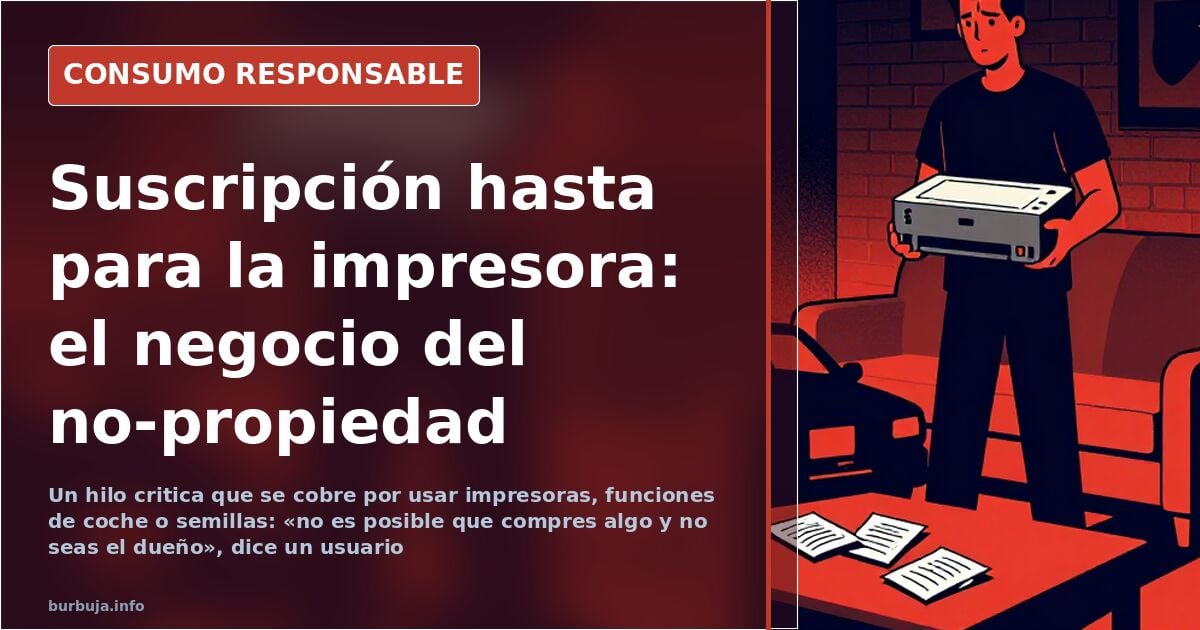
Paying for the Printer but Not Being Able to Use It: The Business of Total Subscription
There is a business model that involves selling you something and then charging you to use it. The printer you buy and pay for won't print unless you pay a monthly fee. Heated seats are already installed in the car and included in the vehicle's price, but they only work if you subscribe. This is the line between renting and fraud, and the industry has crossed it without anyone checking their passport.
The debate on this phenomenon — subscriptions for printers, car functions, software, and almost anything else — has been open for two years with no resolution. What started as a tech sector oddity has become the default model of half of capitalism. And the question hovering over everything is simple: if you buy something, why aren't you its owner?
What is the Subscription Economy and Why is it Expanding?
The corporate argument has its logic. Launching a product requires several phases: development, production, distribution. No revenue is generated until it hits the market. If it fails, the hole in accounts and shareholder value is considerable. Subscriptions turn that one-time income into an recurring fee that doesn't depend on whether the latest launch works or not. It is constant, predictable money, comfortable for the balance sheet.
The problem is that applying this model to physical goods changes the nature of the purchase. You no longer acquire an object; you acquire a conditional right of use. And that right can be modified, made more expensive, or withdrawn whenever it suits the provider. Ownership dissolves into an adhesion contract that the client signs without reading and from which they cannot exit without losing what they already paid.
The Printer Case: You Pay for the Device and You Pay for the Ink
The most cited example is printers. Some manufacturers offer a plan where you receive cartridges before they run out and pay per printed page. One user describes their experience: they pay seven euros a month for a hundred pages, and if they print less in a given month, the unused pages accumulate up to a maximum of three hundred. They say they have never run out of ink so far. In their case, the system works.
But the other side is the printer you buy that refuses to print if your subscription isn't current. There is no service there: there is a block. The machine is in your house, you paid for it, yet you cannot use it. It is the difference between renting a car and buying a car that only starts if you pay a fee.
Cars with Blocked Antiestéticatures and Seeds That Don't Germinate
The automotive sector has taken this further. There are vehicles that leave the factory with equipment installed — heated seats, dynamic suspension — that the buyer has paid for within the price, but which are only activated via subscription. The hardware is there. The software caps it. The function exists, but it is hijacked.
The parallel with genetically modified seeds is inevitable. Some recall that in agriculture, a single-use license is sold, not the seed itself, and farmers who save part of the harvest to sow the trinc year are pursued. In some cases, plants produce sterile seeds: you harvest the wheat, sow it, and it doesn't germinate. Modern slavery, someone says, takes the form of a license agreement.
The Trap of Contractual Planned Obsolescence
Subscriptions also accelerate obsolescence. An image editing program requires a specific version of the operating system. If your device doesn't support it, you can't use the latest version of the program. And if the program is subscription-based, you stop paying and lose access. The computer that worked perfectly becomes a paperweight because the software you need no longer runs on it.
The result is a chain: you pay the subscription, you pay for new equipment, you pay for the connection. And when you lose your job, you lose everything at once. The apartment rent, TV, hot water, transport. The total definition of having nothing and pretending to be happy for your own good.
Alternatives: Buying Credits, Repairable Tech, and Not Subscribing
Against the monthly fee, some propose the credit model: you pay for what you use, credits last as long as they last, and you manage consumption. There is no automatic payment or silent renewal. Many services are migrating to this system because monthly subscriptions generate distrust among a portion of the clientele.
Another path is obsolete but functional technology. Repairable devices, upgradable, with interchangeable parts. And a third option: simply not subscribing. The customer policy is not to buy from those who block the product. If a manufacturer breaks the sector's tacit agreement, they take the cake. The history of printers with ink tanks is an example: one manufacturer bet on a friendlier model and forced others to react.
The question is not whether the model is convenient for companies. It is. The question is how long a customer will keep paying for something they already bought before the rope snaps.
There is a business model that involves selling you something and then charging you to use it. The printer you buy and pay for won't print unless you pay a monthly fee. Heated seats are already installed in the car and included in the vehicle's price, but they only work if you subscribe. This is the line between renting and fraud, and the industry has crossed it without anyone checking their passport.
The debate on this phenomenon — subscriptions for printers, car functions, software, and almost anything else — has been open for two years with no resolution. What started as a tech sector oddity has become the default model of half of capitalism. And the question hovering over everything is simple: if you buy something, why aren't you its owner?
What is the Subscription Economy and Why is it Expanding?
The corporate argument has its logic. Launching a product requires several phases: development, production, distribution. No revenue is generated until it hits the market. If it fails, the hole in accounts and shareholder value is considerable. Subscriptions turn that one-time income into an recurring fee that doesn't depend on whether the latest launch works or not. It is constant, predictable money, comfortable for the balance sheet.
The problem is that applying this model to physical goods changes the nature of the purchase. You no longer acquire an object; you acquire a conditional right of use. And that right can be modified, made more expensive, or withdrawn whenever it suits the provider. Ownership dissolves into an adhesion contract that the client signs without reading and from which they cannot exit without losing what they already paid.
The Printer Case: You Pay for the Device and You Pay for the Ink
The most cited example is printers. Some manufacturers offer a plan where you receive cartridges before they run out and pay per printed page. One user describes their experience: they pay seven euros a month for a hundred pages, and if they print less in a given month, the unused pages accumulate up to a maximum of three hundred. They say they have never run out of ink so far. In their case, the system works.
But the other side is the printer you buy that refuses to print if your subscription isn't current. There is no service there: there is a block. The machine is in your house, you paid for it, yet you cannot use it. It is the difference between renting a car and buying a car that only starts if you pay a fee.
Cars with Blocked Antiestéticatures and Seeds That Don't Germinate
The automotive sector has taken this further. There are vehicles that leave the factory with equipment installed — heated seats, dynamic suspension — that the buyer has paid for within the price, but which are only activated via subscription. The hardware is there. The software caps it. The function exists, but it is hijacked.
The parallel with genetically modified seeds is inevitable. Some recall that in agriculture, a single-use license is sold, not the seed itself, and farmers who save part of the harvest to sow the trinc year are pursued. In some cases, plants produce sterile seeds: you harvest the wheat, sow it, and it doesn't germinate. Modern slavery, someone says, takes the form of a license agreement.
The Trap of Contractual Planned Obsolescence
Subscriptions also accelerate obsolescence. An image editing program requires a specific version of the operating system. If your device doesn't support it, you can't use the latest version of the program. And if the program is subscription-based, you stop paying and lose access. The computer that worked perfectly becomes a paperweight because the software you need no longer runs on it.
The result is a chain: you pay the subscription, you pay for new equipment, you pay for the connection. And when you lose your job, you lose everything at once. The apartment rent, TV, hot water, transport. The total definition of having nothing and pretending to be happy for your own good.
Alternatives: Buying Credits, Repairable Tech, and Not Subscribing
Against the monthly fee, some propose the credit model: you pay for what you use, credits last as long as they last, and you manage consumption. There is no automatic payment or silent renewal. Many services are migrating to this system because monthly subscriptions generate distrust among a portion of the clientele.
Another path is obsolete but functional technology. Repairable devices, upgradable, with interchangeable parts. And a third option: simply not subscribing. The customer policy is not to buy from those who block the product. If a manufacturer breaks the sector's tacit agreement, they take the cake. The history of printers with ink tanks is an example: one manufacturer bet on a friendlier model and forced others to react.
The question is not whether the model is convenient for companies. It is. The question is how long a customer will keep paying for something they already bought before the rope snaps.
Also available in: Deutsch
Summary of a discussion on Burbuja.info - Foro de economía, actualidad y política., translated from Spanish and reviewed before publication. Read the full discussion (109 replies).
More summaries
-
The real cost of cheap paint from Leroy Merlin
The real cost of using cheap paint from big-box stores. We analyze the dilemma between immediate savings and the durability of the finish.
-
Winning €200M in Spain's lottery: How to avoid ruin
Calculations suggest a 5% return yields €10M annually; the real challenge is finding trustworthy advisors.
-
Spanish Online Fish Shop: From Vocational Grant to 1,000 Orders
A young entrepreneur in Galicia built an online fish business in five years, starting with a vocational training grant.
-
Cheap Tools Cost More When They Break Quickly
Low-cost store tools often fail after minimal use, proving that buying cheap items repeatedly is more expensive than investing in quality.
-
Products Worth Paying More Than Store Brands
A €485 mattress selling for €1,400 at El Corte Inglés or classic shaving for €10: items where the premium is justified.
-
Toyota Yaris costs €8,000 more in four years
A financed Toyota Yaris rose from €19,200 to €27,200 in four years; basic vans jumped from €14,000 to €28,000.