
Spanish Online Fish Shop: From Vocational Grant to 1,000 Orders
A young entrepreneur in Galicia built an online fish business in five years, starting with a vocational training grant.
English · Original discussion in Spanish · Published
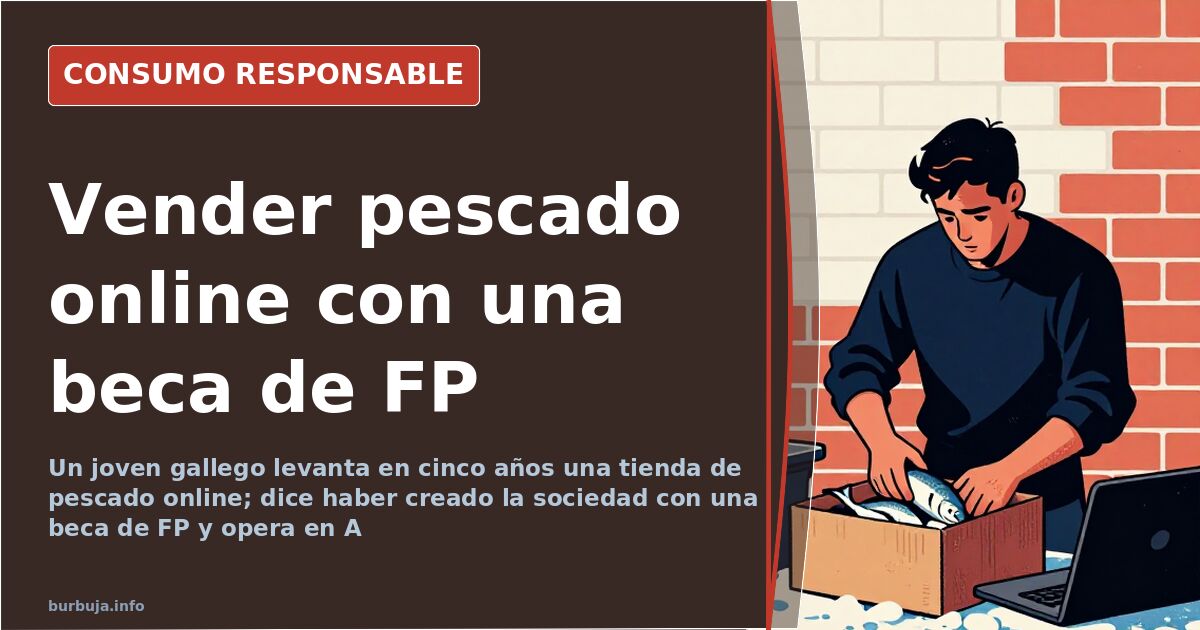
The online fish shop born from a vocational grant
In February 2016, a young man from Galicia laid out his business numbers: five years selling fish and seafood online, a company he registered himself using a public Vocational Training (FP) grant — one forum user estimated the aid at over 3,000 euros — and no house or BMW in the garage. He shared this candidly, and the conversation quickly turned uncomfortable. How much of the success was self-made, and how much relied on having a father with thirty years in the industry?
This doubt matters because it touches the nerve of Spanish entrepreneurship: the blurry line between effort and starting point. It also raises a practical question: can a home-delivered fish business sustain itself with those figures?
Registration via grant and a father who didn't hand over clients
The protagonist was clear: he registered the company himself, paid for with a public grant that helped him study Vocational Training. "My father didn't pass me any wholesale clients," he stated firmly to those suggesting he inherited a client base. The roles differ: his father works in wholesale fish outside Galicia; he sells to small wholesalers and restaurants within the region. No shared buyers.
One detail surprises those imagining luxury homes. His father isn't wealthy either: he faces higher costs, gets paid two or three months late, and accumulates unpaid invoices. Regarding family support, a forum user argued that while knowing the sector helps, trying a new field is hard regardless of backing.
How much does it cost to start an online fish shop?
The first website cost 700 euros and was basic. A year and a half later, a more professional version arrived, costing about 3,500 euros, built on PrestaShop. This allows him to change photos, prices, and product pages independently, though technical issues still require programmers. IT costs are the least controversial part; the catalog is another story.
Salmon sells for 11.50 euros per kilo, dropping to 10.45 with a 10% discount. The perception that buying seafood online is expensive arises quickly. The answer mixes logistics and strategy: large retailers sell by volume and, the seller argues, less fine control over the product. His method is buying on order, selecting the best salmon of the day, slicing it, and vacuum-packing it for freezing.
Inside the business: early rises, packing, and 999 deliveries out of 1,000
The reality lacks glamour. The workday starts at 4 AM, trinc by an afternoon nap. Nothing ships if it has been in storage for days: everything is bought or prepared the day before delivery, including empanadas, to meet promised time slots. Key dates like Father's Day and Mother's Day concentrate efforts, requiring orders closed by Wednesday for Friday delivery.
Reliability is the model's strongest asset, according to the seller: of the last 1,000 orders, 999 were delivered, with only a few slightly outside the expected window. In a perishable goods business with fifteen-hour transport, this record outweighs any brochure.
Billing in Spain and competing with tax havens
The most uncomfortable point isn't the product, but taxation. Responding to a query about Mercabarna vendors operating abroad, the seller states he operates entirely in Spain (A), putting him at a price disadvantage against those operating elsewhere (B). His complaint targets those who can pay but don't, citing big tech firms declaring losses.
The political argument calls for lowering taxes, cutting public spending, and fighting fraud better. In a low-margin sector, competing in Spain against offshore operators means carrying extra weight. He admits big companies struggle too, citing known canned fish and fishing firms.
A weak May and the unresolved question
Bad months exist. The port had a weak May, usually modest but particularly bad that year, reflecting broader consumption slowdowns. The client network sustains the account: wholesalers, restaurants, and individuals via the web. When spending slows, wedding banquets save the month.
Underlying this is personal criticism measuring success by cars and real estate. The ugly but real doubt is whether such a demanding business justifies its exposure or if factory work pays better. Analysis stalls here: no one has yet presented the net margin needed to close the debate.
In February 2016, a young man from Galicia laid out his business numbers: five years selling fish and seafood online, a company he registered himself using a public Vocational Training (FP) grant — one forum user estimated the aid at over 3,000 euros — and no house or BMW in the garage. He shared this candidly, and the conversation quickly turned uncomfortable. How much of the success was self-made, and how much relied on having a father with thirty years in the industry?
This doubt matters because it touches the nerve of Spanish entrepreneurship: the blurry line between effort and starting point. It also raises a practical question: can a home-delivered fish business sustain itself with those figures?
Registration via grant and a father who didn't hand over clients
The protagonist was clear: he registered the company himself, paid for with a public grant that helped him study Vocational Training. "My father didn't pass me any wholesale clients," he stated firmly to those suggesting he inherited a client base. The roles differ: his father works in wholesale fish outside Galicia; he sells to small wholesalers and restaurants within the region. No shared buyers.
One detail surprises those imagining luxury homes. His father isn't wealthy either: he faces higher costs, gets paid two or three months late, and accumulates unpaid invoices. Regarding family support, a forum user argued that while knowing the sector helps, trying a new field is hard regardless of backing.
How much does it cost to start an online fish shop?
The first website cost 700 euros and was basic. A year and a half later, a more professional version arrived, costing about 3,500 euros, built on PrestaShop. This allows him to change photos, prices, and product pages independently, though technical issues still require programmers. IT costs are the least controversial part; the catalog is another story.
Salmon sells for 11.50 euros per kilo, dropping to 10.45 with a 10% discount. The perception that buying seafood online is expensive arises quickly. The answer mixes logistics and strategy: large retailers sell by volume and, the seller argues, less fine control over the product. His method is buying on order, selecting the best salmon of the day, slicing it, and vacuum-packing it for freezing.
Inside the business: early rises, packing, and 999 deliveries out of 1,000
The reality lacks glamour. The workday starts at 4 AM, trinc by an afternoon nap. Nothing ships if it has been in storage for days: everything is bought or prepared the day before delivery, including empanadas, to meet promised time slots. Key dates like Father's Day and Mother's Day concentrate efforts, requiring orders closed by Wednesday for Friday delivery.
Reliability is the model's strongest asset, according to the seller: of the last 1,000 orders, 999 were delivered, with only a few slightly outside the expected window. In a perishable goods business with fifteen-hour transport, this record outweighs any brochure.
Billing in Spain and competing with tax havens
The most uncomfortable point isn't the product, but taxation. Responding to a query about Mercabarna vendors operating abroad, the seller states he operates entirely in Spain (A), putting him at a price disadvantage against those operating elsewhere (B). His complaint targets those who can pay but don't, citing big tech firms declaring losses.
The political argument calls for lowering taxes, cutting public spending, and fighting fraud better. In a low-margin sector, competing in Spain against offshore operators means carrying extra weight. He admits big companies struggle too, citing known canned fish and fishing firms.
A weak May and the unresolved question
Bad months exist. The port had a weak May, usually modest but particularly bad that year, reflecting broader consumption slowdowns. The client network sustains the account: wholesalers, restaurants, and individuals via the web. When spending slows, wedding banquets save the month.
Underlying this is personal criticism measuring success by cars and real estate. The ugly but real doubt is whether such a demanding business justifies its exposure or if factory work pays better. Analysis stalls here: no one has yet presented the net margin needed to close the debate.
Also available in: Deutsch
Summary of a discussion on Burbuja.info - Foro de economía, actualidad y política., translated from Spanish and reviewed before publication. Read the full discussion (109 replies).
More summaries
-
The Decline of Bike Shops: High Prices and Online Shopping
Bike shops are closing due to rising prices and online competition. A forum user notes a 2011 bike model now costs double.
-
KFC sells 22 chicken wings for 9 euros, less than 50 cents each
22 KFC chicken wings for 9 euros cost less than 50 cents each. Details and terms of the limited-time offer in Spain.
-
Milk under scrutiny: lactose, A1 casein and industry
A forum user blames dairy for anxiety and pain; others argue milk only harms intolerant people. Debate is open.
-
Caffeine: Poison or Medicine? The Ongoing Debate
A strong coffee can contain 300-400 mg of caffeine. The debate on whether it is harmful or beneficial remains unresolved.
-
Chainsaw on ladder causes severe leg injury
A homeowner suffered a deep chainsaw cut requiring 15 staples after a branch knocked him off his ladder, highlighting the dangers of pruning at height.
-
The Fellowship of the Ring: A Film Era That No Longer Exists
As The Fellowship of the Ring turns twenty, viewers argue its cast and extended cuts highlight a style of epic cinema that is no longer produced.