
Cheap Tools Cost More When They Break Quickly
Low-cost store tools often fail after minimal use, proving that buying cheap items repeatedly is more expensive than investing in quality.
English · Original discussion in Spanish · Published
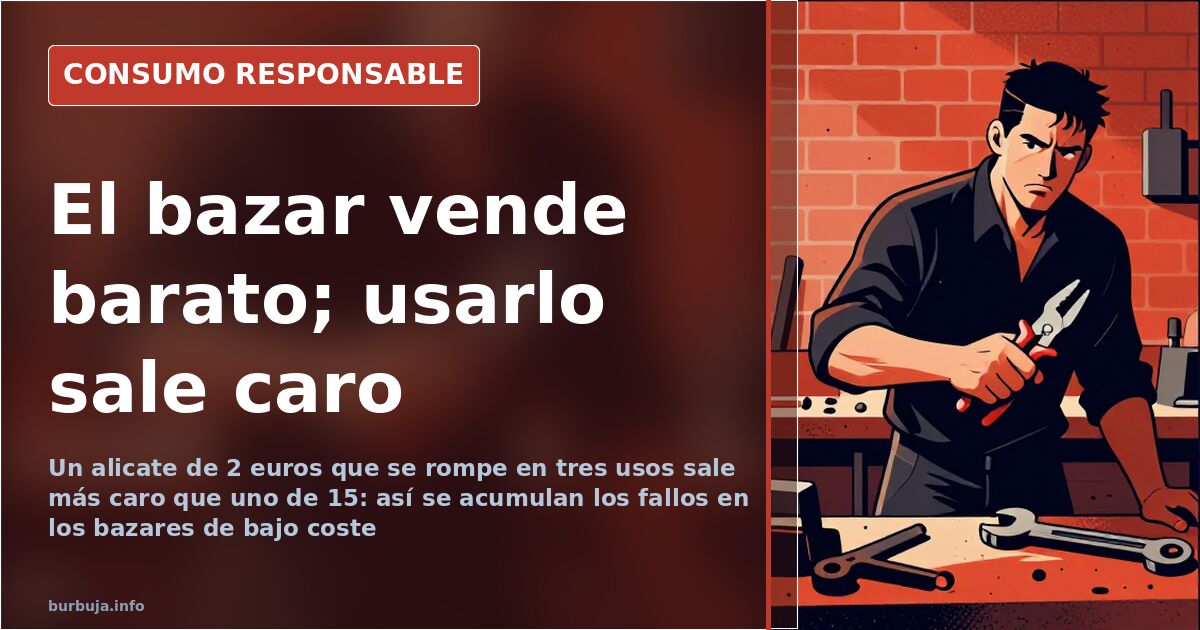
Low-Cost Stores: The €2 Pliers That Last Three Uses
A 2-millimeter Allen key that doesn't fit the screw. Pliers that deform at the first squeeze. A charger that overheats as soon as it's plugged in. The list of failures accumulating in low-cost stores trinc a recognizable pattern: exactly what shouldn't break does, and it costs so little that almost no one bothers to complain. The conversation started with an innocuous purchase—a set of Allen keys—and ended up being an inventory of domestic shoddy work.
The worrying detail isn't the price. It's the usage. The small key came with a "splayed" edge and wouldn't go in; the ball-end one fit from one side but not the other. A newly bought tool that fails its only function. From there, the trickle was constant: screwdrivers with tips broken against the screw, rubber handles that spin on themselves, machetes whose blades fly off after a couple of hits. When the failure stops being economic and becomes physical, the joke changes category.
Tools That Bend After Second Use
Those who work in neighborhood hardware stores have the country's best database on this issue: customers arriving with split hammers, bent wrenches, and twisted screwdrivers bought in discount stores. Then they sell them something of quality, customers complain about the price, and take it anyway. No one disputes the outcome.
The pliers case is the most repeated: they deform when squeezed with some force. In a traditional hardware store, the cheapest catalog items turned out to be better and more economical than the low-cost ones. Some describe an adjustable wrench that seemed like "plasticine alloy," probably aluminum. The saving has a trap: you pay for it in repeated visits to the same shelf.
Electronics That Melt
Dynamo flashlights have been sold for decades as emergency solutions. Inside should be a magnet that generates electricity when shaken. In some models, there was a button battery: cheaper to manufacture, and it only worked while the battery lasted. When depleted, the flashlight goes out and no crank saves it.
There are worse stories. A plasma lamp that, a day after purchase, began heating up until melting the power supply. A mobile phone charger that burned out as soon as it was used. These are cases told by those who suffered them and don't appear to have ended in technical reports, but the pattern—poor insulation, materials that can't withstand heat—appears again and again.
The Fake Hard Drive That Weighed What It Said
The most elaborate fraud in the repertoire isn't a poorly made piece: it's a deliberate deception. An external hard drive appeared to have several gigabytes and seemed to swallow an entire movie. Upon opening it, inside were two metal bolts to add weight and an internal USB memory of 128 megabytes. When playing the file, only the last five minutes were visible.
It's not an isolated case in storage. Another buyer fights with the after-sales service of a defective SSD whose response was that the repair software was developed by their own engineer and couldn't be downloaded from any website. Translation: there's no support, just conversation.
Why Doesn't the Two-Year Warranty Work in Practice?
Because almost no one exercises it. The theory is simple: any product sold in the EU carries a two-year warranty and the establishment is obliged to provide the complaint form. In practice, it involves enduring long waits, arguments, and a second visit.
There is the OMIC route (Consumer Information Office), where complaints can be registered without going through the counter. And there is the police: in one reported case, when the shop refused to hand over the form, the Guardia Urbana (Local Police) was called, filed a report, and the claim was also submitted to the OMIC. Result: warning to the establishment. Not a euro fine. Filing papers guarantees nothing; filing them four times doesn't either.
Cheap Isn't the Same as Low-Cost
The arithmetic is simple and devastating. €2 pliers that break in three uses are more expensive than €15 ones that last a lifetime. The classic example is the drill: a Bosch from over 30 years ago, bought for more than 5,000 pesetas then, is still in service. Adding up cheap drills over the years, the expenditure multiplies and quality doesn't come close.
However, not everything is trash. There are products that compensate by price: button batteries at €0.50 versus €3 branded ones, plastic containers, coasters, mop buckets. A €1 screwdriver that allows opening a device to change its cable is a perfect buy. The key lies in what you ask of the product: if its function doesn't depend on quality, it holds up; if it does, it doesn't.
There's a nuance that slips into any conversation on the topic: not everything bad is imported nor is everything imported bad. In those same establishments appear planters manufactured in Levante, and much of reliable electronics is also manufactured in China, but sold by companies with quality controls and technical service to complain to.
The bottleneck arrives right here. Without a count of how many claims end in real sanctions, the conclusion remains anecdotal. And anecdotes, no matter how many accumulate, don't present themselves alone before the administration.
A 2-millimeter Allen key that doesn't fit the screw. Pliers that deform at the first squeeze. A charger that overheats as soon as it's plugged in. The list of failures accumulating in low-cost stores trinc a recognizable pattern: exactly what shouldn't break does, and it costs so little that almost no one bothers to complain. The conversation started with an innocuous purchase—a set of Allen keys—and ended up being an inventory of domestic shoddy work.
The worrying detail isn't the price. It's the usage. The small key came with a "splayed" edge and wouldn't go in; the ball-end one fit from one side but not the other. A newly bought tool that fails its only function. From there, the trickle was constant: screwdrivers with tips broken against the screw, rubber handles that spin on themselves, machetes whose blades fly off after a couple of hits. When the failure stops being economic and becomes physical, the joke changes category.
Tools That Bend After Second Use
Those who work in neighborhood hardware stores have the country's best database on this issue: customers arriving with split hammers, bent wrenches, and twisted screwdrivers bought in discount stores. Then they sell them something of quality, customers complain about the price, and take it anyway. No one disputes the outcome.
The pliers case is the most repeated: they deform when squeezed with some force. In a traditional hardware store, the cheapest catalog items turned out to be better and more economical than the low-cost ones. Some describe an adjustable wrench that seemed like "plasticine alloy," probably aluminum. The saving has a trap: you pay for it in repeated visits to the same shelf.
Electronics That Melt
Dynamo flashlights have been sold for decades as emergency solutions. Inside should be a magnet that generates electricity when shaken. In some models, there was a button battery: cheaper to manufacture, and it only worked while the battery lasted. When depleted, the flashlight goes out and no crank saves it.
There are worse stories. A plasma lamp that, a day after purchase, began heating up until melting the power supply. A mobile phone charger that burned out as soon as it was used. These are cases told by those who suffered them and don't appear to have ended in technical reports, but the pattern—poor insulation, materials that can't withstand heat—appears again and again.
The Fake Hard Drive That Weighed What It Said
The most elaborate fraud in the repertoire isn't a poorly made piece: it's a deliberate deception. An external hard drive appeared to have several gigabytes and seemed to swallow an entire movie. Upon opening it, inside were two metal bolts to add weight and an internal USB memory of 128 megabytes. When playing the file, only the last five minutes were visible.
It's not an isolated case in storage. Another buyer fights with the after-sales service of a defective SSD whose response was that the repair software was developed by their own engineer and couldn't be downloaded from any website. Translation: there's no support, just conversation.
Why Doesn't the Two-Year Warranty Work in Practice?
Because almost no one exercises it. The theory is simple: any product sold in the EU carries a two-year warranty and the establishment is obliged to provide the complaint form. In practice, it involves enduring long waits, arguments, and a second visit.
There is the OMIC route (Consumer Information Office), where complaints can be registered without going through the counter. And there is the police: in one reported case, when the shop refused to hand over the form, the Guardia Urbana (Local Police) was called, filed a report, and the claim was also submitted to the OMIC. Result: warning to the establishment. Not a euro fine. Filing papers guarantees nothing; filing them four times doesn't either.
Cheap Isn't the Same as Low-Cost
The arithmetic is simple and devastating. €2 pliers that break in three uses are more expensive than €15 ones that last a lifetime. The classic example is the drill: a Bosch from over 30 years ago, bought for more than 5,000 pesetas then, is still in service. Adding up cheap drills over the years, the expenditure multiplies and quality doesn't come close.
However, not everything is trash. There are products that compensate by price: button batteries at €0.50 versus €3 branded ones, plastic containers, coasters, mop buckets. A €1 screwdriver that allows opening a device to change its cable is a perfect buy. The key lies in what you ask of the product: if its function doesn't depend on quality, it holds up; if it does, it doesn't.
There's a nuance that slips into any conversation on the topic: not everything bad is imported nor is everything imported bad. In those same establishments appear planters manufactured in Levante, and much of reliable electronics is also manufactured in China, but sold by companies with quality controls and technical service to complain to.
The bottleneck arrives right here. Without a count of how many claims end in real sanctions, the conclusion remains anecdotal. And anecdotes, no matter how many accumulate, don't present themselves alone before the administration.
Also available in: Deutsch
Summary of a discussion on Burbuja.info - Foro de economía, actualidad y política., translated from Spanish and reviewed before publication. Read the full discussion (109 replies).
More summaries
-
Budget Printers: The €1 Cartridge That Changes Everything
HP ink cartridges cost €20 for 120 pages (€0.17/page). Compatible Brother cartridges cut costs to €0.05 per page.
-
Nescafé Dolce Gusto: Convenience or Financial Trap?
Analysis of Nescafé Dolce Gusto's real cost versus traditional coffee methods. Is capsule convenience a financial deception?
-
How many litres of milk can you get from 1 kg of condensed milk?
A forum calculation says a 1 kg can yields 6.6 to 10 litres, but others warn it's not milk but added sugar.
-
Caffeine: Poison or Medicine? The Ongoing Debate
A strong coffee can contain 300-400 mg of caffeine. The debate on whether it is harmful or beneficial remains unresolved.
-
Chainsaw on ladder causes severe leg injury
A homeowner suffered a deep chainsaw cut requiring 15 staples after a branch knocked him off his ladder, highlighting the dangers of pruning at height.
-
The Fellowship of the Ring: A Film Era That No Longer Exists
As The Fellowship of the Ring turns twenty, viewers argue its cast and extended cuts highlight a style of epic cinema that is no longer produced.