
Strong Ruble Cuts Russian Budget Revenue as Oil Prices Fall
Urales crude revenue halves from 8,000 to 4,000 rubles per barrel as the strong ruble and falling oil prices squeeze Russia's state budget.
English · Original discussion in Spanish · Published
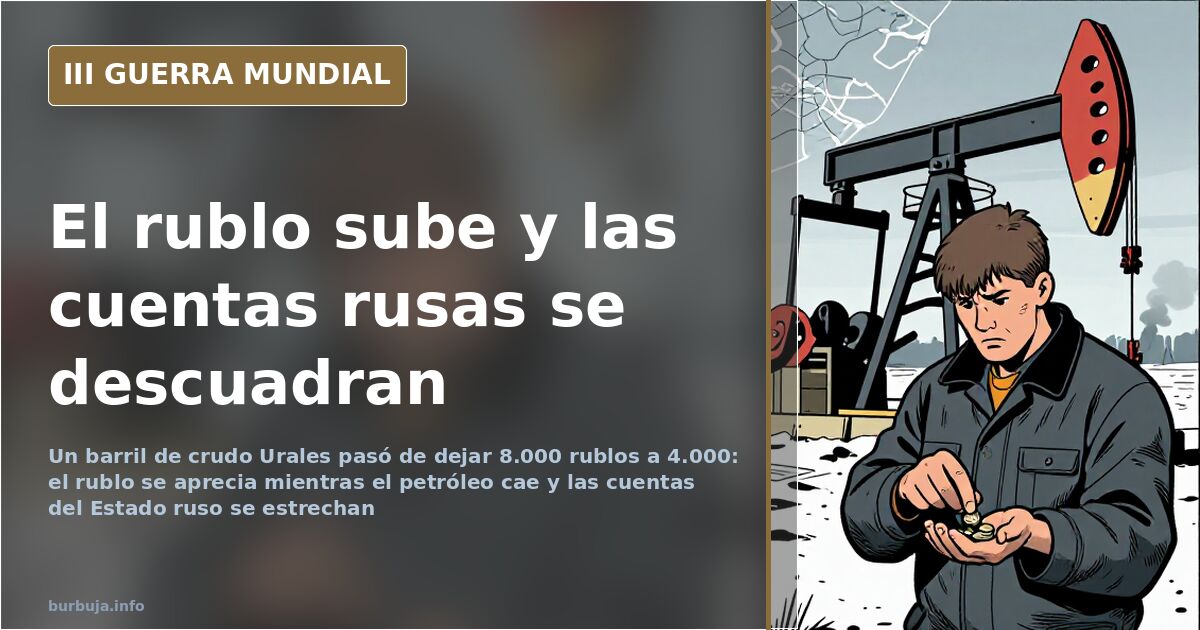
The ruble does not collapse: it strengthens and upends the Russian budget
The ruble is appreciating, not sinking, and this shift has disrupted the narrative. The figure circulating as the death certificate of the Russian economy is Gazprom's: $1,000 invested in the company in 2008 would be worth $11 today. The uncomfortable detail is that the currency has moved in the exact opposite direction: from 114 rubles per dollar in a recent calculation to 80 cited as the reference, with the state budget prepared on the basis of 96.5. Appreciation, not collapse. So the useful question is no longer whether the ruble is collapsing, but who is hurt by its rise.
Is the ruble collapsing or strengthening?
It is strengthening, and there are numbers to support it. The dollar went from 93 rubles a year ago to 82, 12% lower; in the most recent period, rates of even 80 rubles per dollar are cited. The appreciation has been so marked that the recovery itself has surprised Moscow, to the point that the Russian currency beats gold in 2025 according to shared headlines. The counterweight comes from exchange controls: some argue the chart is domesticated because currency exchanges have been closed until the end of the year. Without free quotation, the exchange rate says less than it appears.
The Russian barrel: from 8,000 to 4,000 rubles
Here is the arithmetic that dismantles much of the noise. Previously, with Urales crude at $70 and the dollar at 114 rubles, each barrel left 8,000 rubles. Now, with the barrel at $50 and the dollar at 80, it leaves 4,000. It makes no difference whether you look at the price or the currency: revenue per barrel has been cut in half. Part of the analysis concludes that Russia will receive half for the same amount; the other retorts that the culprit is not the exchange rate, but the price of crude. The full breakdown, crossing barrel and currency part by part, leaves a margin that is surprising.
Why is a strong ruble a problem for Russia?
Overvaluation worsens financial indicators and exporters' prospects, and hits state budget revenues, according to analyst Dmitry Babin of BCS World of Investments. The Russian executive prepared its 2025 accounts with an average exchange rate of 96.5 rubles per dollar: each ruble that appreciates below that reference leaves less money in the treasury for each exported dollar. On the other side of the scale, the yield on the one-year Russian bond is cited at 12.5% and an equivalent rate of 20% in dollars is calculated. A country that pays that much to finance itself is not swimming in abundance.
The devaluation that does not topple a commodities economy
The counterargument has its logic. Russian foreign trade is the sale of commodities quoted in dollars, the state spends in rubles and collects in foreign currency, so nominal devaluation does not break the circuit: it can even leave a surplus. The repeated precedent is 2014, when the ruble lost two-thirds of its value without the announced collapse. With sanctions, moreover, it is not easy to buy rubles, so the exchange rate reflects intervened demand rather than the health of the economy. That the currency is worth less in the market does not imply that the country produces less.
Germany closes plants and Russia boasts of cheap supermarkets
The most uncomfortable contrast does not come from Moscow. Thyssenkrupp, Bosch, and Volkswagen are cutting thousands of jobs and closing plants in Germany after losing access to nearby, cheap energy. In contrast, videos circulate of Russian supermarkets with prices one-third or half of Western ones, and everyday comparisons that sound like provocation: a young worker who does not share an apartment, a plumber who crosses the country with his car. These are anecdotes, not statistics. But they explain why the conversation has shifted from the Russian collapse to the European recession.
Three years of imminent collapse and a currency that rises and falls
The paradox is summed up in a circulating phrase: when the ruble falls, it is proof of disaster; when it rises, it is too. If Russia wants peace, it is at the limit; if it does not want it, it needs war to sustain its economy. Predictions of collapse have been repeating for almost three years with the same tone, and in that time there have been plunges, rebounds to highs not seen since 2015, and new declines. What has changed is the landscape: Europe is cutting industrial employment, crude is becoming cheaper, and the Russian currency is appreciating.
If oil continues to fall and the ruble remains strong, the mismatch in Russian public accounts will narrow even further. How long an economy that spends in rubles and collects in dollars can hold on is something no one has demonstrated yet, neither in one direction nor the other.
The ruble is appreciating, not sinking, and this shift has disrupted the narrative. The figure circulating as the death certificate of the Russian economy is Gazprom's: $1,000 invested in the company in 2008 would be worth $11 today. The uncomfortable detail is that the currency has moved in the exact opposite direction: from 114 rubles per dollar in a recent calculation to 80 cited as the reference, with the state budget prepared on the basis of 96.5. Appreciation, not collapse. So the useful question is no longer whether the ruble is collapsing, but who is hurt by its rise.
Is the ruble collapsing or strengthening?
It is strengthening, and there are numbers to support it. The dollar went from 93 rubles a year ago to 82, 12% lower; in the most recent period, rates of even 80 rubles per dollar are cited. The appreciation has been so marked that the recovery itself has surprised Moscow, to the point that the Russian currency beats gold in 2025 according to shared headlines. The counterweight comes from exchange controls: some argue the chart is domesticated because currency exchanges have been closed until the end of the year. Without free quotation, the exchange rate says less than it appears.
The Russian barrel: from 8,000 to 4,000 rubles
Here is the arithmetic that dismantles much of the noise. Previously, with Urales crude at $70 and the dollar at 114 rubles, each barrel left 8,000 rubles. Now, with the barrel at $50 and the dollar at 80, it leaves 4,000. It makes no difference whether you look at the price or the currency: revenue per barrel has been cut in half. Part of the analysis concludes that Russia will receive half for the same amount; the other retorts that the culprit is not the exchange rate, but the price of crude. The full breakdown, crossing barrel and currency part by part, leaves a margin that is surprising.
Why is a strong ruble a problem for Russia?
Overvaluation worsens financial indicators and exporters' prospects, and hits state budget revenues, according to analyst Dmitry Babin of BCS World of Investments. The Russian executive prepared its 2025 accounts with an average exchange rate of 96.5 rubles per dollar: each ruble that appreciates below that reference leaves less money in the treasury for each exported dollar. On the other side of the scale, the yield on the one-year Russian bond is cited at 12.5% and an equivalent rate of 20% in dollars is calculated. A country that pays that much to finance itself is not swimming in abundance.
The devaluation that does not topple a commodities economy
The counterargument has its logic. Russian foreign trade is the sale of commodities quoted in dollars, the state spends in rubles and collects in foreign currency, so nominal devaluation does not break the circuit: it can even leave a surplus. The repeated precedent is 2014, when the ruble lost two-thirds of its value without the announced collapse. With sanctions, moreover, it is not easy to buy rubles, so the exchange rate reflects intervened demand rather than the health of the economy. That the currency is worth less in the market does not imply that the country produces less.
Germany closes plants and Russia boasts of cheap supermarkets
The most uncomfortable contrast does not come from Moscow. Thyssenkrupp, Bosch, and Volkswagen are cutting thousands of jobs and closing plants in Germany after losing access to nearby, cheap energy. In contrast, videos circulate of Russian supermarkets with prices one-third or half of Western ones, and everyday comparisons that sound like provocation: a young worker who does not share an apartment, a plumber who crosses the country with his car. These are anecdotes, not statistics. But they explain why the conversation has shifted from the Russian collapse to the European recession.
Three years of imminent collapse and a currency that rises and falls
The paradox is summed up in a circulating phrase: when the ruble falls, it is proof of disaster; when it rises, it is too. If Russia wants peace, it is at the limit; if it does not want it, it needs war to sustain its economy. Predictions of collapse have been repeating for almost three years with the same tone, and in that time there have been plunges, rebounds to highs not seen since 2015, and new declines. What has changed is the landscape: Europe is cutting industrial employment, crude is becoming cheaper, and the Russian currency is appreciating.
If oil continues to fall and the ruble remains strong, the mismatch in Russian public accounts will narrow even further. How long an economy that spends in rubles and collects in dollars can hold on is something no one has demonstrated yet, neither in one direction nor the other.
Summary of a discussion on Burbuja.info - Foro de economía, actualidad y política., translated from Spanish and reviewed before publication. Read the full discussion (209 replies).
More summaries
-
Ruble Recovers from 144 to 100 per Dollar; McDonald's Reopening Unconfirmed
The ruble rebounds from 144 to 100 per dollar, with online users reporting some McDonald's locations reopening. The widely cited 40% surge doesn't align with market data.
-
Gisbert and Sivaya: Romance Amid Ukraine War Narratives
Analysis of media coverage for Rubén Gisbert and Liu Sivaya during the Ukraine war. Is this digital propaganda or reality?
-
No stock for three days: Russia invasion plan debunked
Reports indicate European nations lack ammunition for three days of high-intensity war, with Meteor missiles lasting only one day.
-
Ukrainian commandos raid Crimea without establishing beachhead
Ukraine landed troops at Cape Tarkhankut in Crimea on August 24, claiming no casualties. Russian media reported ten operatives involved.
-
Ukraine Wins Eurovision: Geopolitical Voting Sparks Rigging Claims
Ukraine wins Eurovision 2022 amid rigging accusations, while Chanel delivers Spain's best result in years.
-
Shinzo Abe Assassination: Two Bullets and Impossible Trajectory
Claims that Abe suffered two neck wounds challenge the lone gunman theory in Nara, Japan.