
No stock for three days: Russia invasion plan debunked
Reports indicate European nations lack ammunition for three days of high-intensity war, with Meteor missiles lasting only one day.
English · Original discussion in Spanish · Published
Not even three days of high-intensity warfare
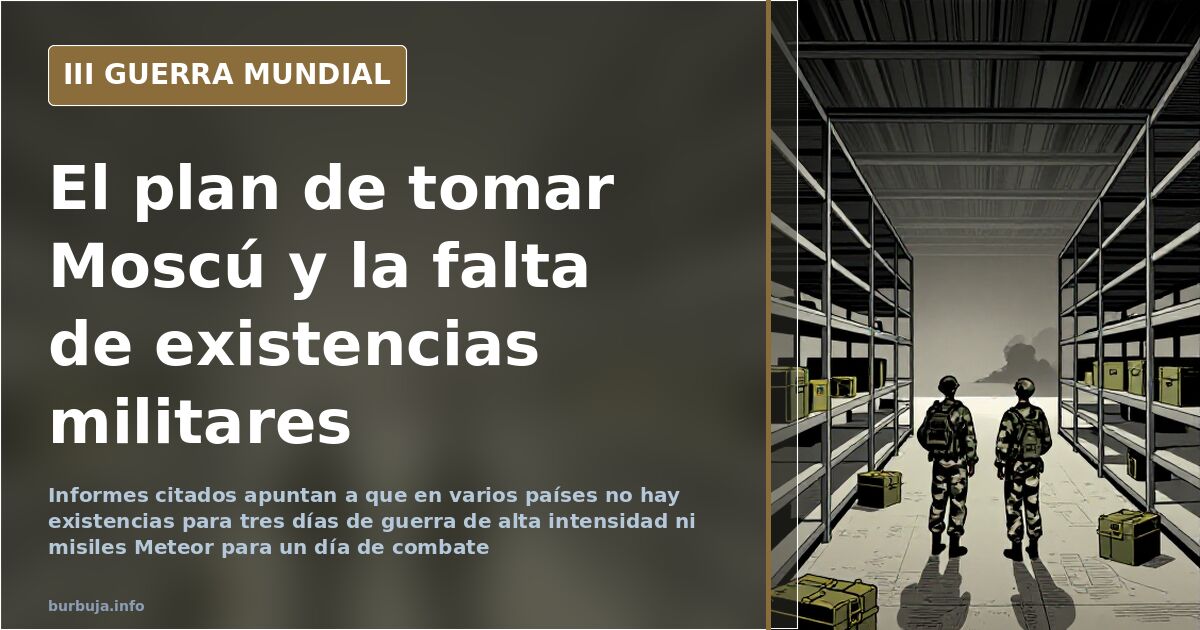
The argument trinc video game logic: if Europe has superior military technology, a week would suffice to reach Moscow and flex muscles before Washington. Inventory reality shatters this in the first line. Reports circulating—including those from the French institute IRFI—indicate that several countries lack stocks to sustain even three days of high-intensity conflict, and air forces have [BMeteor missiles for just one day[/B] of combat. The rest is fiction.
Who fights when others write the plans
The dominant response isn't logistical but personal. Trinc the proposal to take Moscow comes an invitation to enlist: let the proponents go first. This argument repeats in various forms—whoever demands sacrifice from others should start themselves—and includes an age-related variant: none of those cheering the offensive have ever held a weapon.
A sharper temporal reproach exists: during three years of war, there was ample time to volunteer as civilians, yet no one did. Demanding sacrifice now, when the scenario has worsened, reads as desperation rather than conviction.
Geography doesn't help either. The proposed target is thousands of kilometers away and has done nothing, while noise about issues affecting daily life remains sidelined. Then there's summer: better on the beach with a beer than in a muddy trench with mosquitoes. With such motivation, the offensive won't launch.
Three Mirages, unreplenished missiles, cannibalized production lines
The detail most troubling to enthusiasts is hardware. Only three Mirage jets have been delivered, with no more available short-term: they require modernization—a euphemism for cannibalizing parts among them, leaving some grounded. Spare parts are scarce and trickle in slowly.
SCALP-EG cruise missiles sent to Ukraine haven't been replenished. In other partner countries, the situation is worse. It’s not a matter of will; it’s simply availability. This point dismantles any optimistic timeline for a lightning campaign.
In contrast, alternative proposals involve building military industry in Poland, Czechia, Romania, Finland, and Ukraine, and delivering decommissioned equipment—200 Tornados and 30 Mirages, plus Sea Harriers and Super Étendards—for Ukrainian armored maneuvers. The catch is obvious: these aircraft were retired because spare parts for flight maintenance are unavailable.
Why Moscow won’t fall in a week: historical evidence
Historical review forms another major argument block. The list of those who attempted western invasions is long: the Crimean Khan in the 16th century, Polish King Sigismund II Vasa, who took Moscow in the 17th, Charles IX of Sweden, Napoleon, and Hitler in the 20th. Regarding this imaginary assembly, the repeated conclusion is that the laughter would be monumental.
Nuances exist. The 19th century is also recalled, when Anglo-French forces defeated the Tsar with success in Crimea. Another line argues the difference lies in conventional versus non-conventional warfare; today’s conflict wouldn’t be conventional in any scenario.
This introduces the argument halting the race toward the Kremlin. Capturing the Russian capital in a conventional conflict would become a flag-raising competition, but the core issue is that such a war would never remain conventional. A warning adds: systems exist capable of reaching London, Paris, Berlin, Rome, or Madrid undetected.
Strategic autonomy decided elsewhere
The third front is political. Some analysis holds that Europe acts not as its own agent but as a province serving foreign interests, arguing European construction is recent and artificial—more logical in imperial times than nation-states. For this view, the Union is perceived as a subsidy-dispensing box, not a space worth dying for.
Signatories’ legitimacy is questioned too. It’s noted that neither Macron nor Von der Leyen were elected for their current roles, concluding that such a constructed European army would be, at best, [Ban army of mercenaries[/B], not citizens.
Underlying this is another priority unrelated to the eastern front: efforts should focus on securing borders and relations with North Africa, not adventurism thousands of kilometers away. An uncomfortable consensus across camps emerges: offensive proponents are demanded to lead by example.
With this combination—no stocks, no industry, no volunteers, and history against it—the plan resembles a slogan more than military strategy. The question remains unanswered: Who crosses the Don?
The argument trinc video game logic: if Europe has superior military technology, a week would suffice to reach Moscow and flex muscles before Washington. Inventory reality shatters this in the first line. Reports circulating—including those from the French institute IRFI—indicate that several countries lack stocks to sustain even three days of high-intensity conflict, and air forces have [BMeteor missiles for just one day[/B] of combat. The rest is fiction.
Who fights when others write the plans
The dominant response isn't logistical but personal. Trinc the proposal to take Moscow comes an invitation to enlist: let the proponents go first. This argument repeats in various forms—whoever demands sacrifice from others should start themselves—and includes an age-related variant: none of those cheering the offensive have ever held a weapon.
A sharper temporal reproach exists: during three years of war, there was ample time to volunteer as civilians, yet no one did. Demanding sacrifice now, when the scenario has worsened, reads as desperation rather than conviction.
Geography doesn't help either. The proposed target is thousands of kilometers away and has done nothing, while noise about issues affecting daily life remains sidelined. Then there's summer: better on the beach with a beer than in a muddy trench with mosquitoes. With such motivation, the offensive won't launch.
Three Mirages, unreplenished missiles, cannibalized production lines
The detail most troubling to enthusiasts is hardware. Only three Mirage jets have been delivered, with no more available short-term: they require modernization—a euphemism for cannibalizing parts among them, leaving some grounded. Spare parts are scarce and trickle in slowly.
SCALP-EG cruise missiles sent to Ukraine haven't been replenished. In other partner countries, the situation is worse. It’s not a matter of will; it’s simply availability. This point dismantles any optimistic timeline for a lightning campaign.
In contrast, alternative proposals involve building military industry in Poland, Czechia, Romania, Finland, and Ukraine, and delivering decommissioned equipment—200 Tornados and 30 Mirages, plus Sea Harriers and Super Étendards—for Ukrainian armored maneuvers. The catch is obvious: these aircraft were retired because spare parts for flight maintenance are unavailable.
Why Moscow won’t fall in a week: historical evidence
Historical review forms another major argument block. The list of those who attempted western invasions is long: the Crimean Khan in the 16th century, Polish King Sigismund II Vasa, who took Moscow in the 17th, Charles IX of Sweden, Napoleon, and Hitler in the 20th. Regarding this imaginary assembly, the repeated conclusion is that the laughter would be monumental.
Nuances exist. The 19th century is also recalled, when Anglo-French forces defeated the Tsar with success in Crimea. Another line argues the difference lies in conventional versus non-conventional warfare; today’s conflict wouldn’t be conventional in any scenario.
This introduces the argument halting the race toward the Kremlin. Capturing the Russian capital in a conventional conflict would become a flag-raising competition, but the core issue is that such a war would never remain conventional. A warning adds: systems exist capable of reaching London, Paris, Berlin, Rome, or Madrid undetected.
Strategic autonomy decided elsewhere
The third front is political. Some analysis holds that Europe acts not as its own agent but as a province serving foreign interests, arguing European construction is recent and artificial—more logical in imperial times than nation-states. For this view, the Union is perceived as a subsidy-dispensing box, not a space worth dying for.
Signatories’ legitimacy is questioned too. It’s noted that neither Macron nor Von der Leyen were elected for their current roles, concluding that such a constructed European army would be, at best, [Ban army of mercenaries[/B], not citizens.
Underlying this is another priority unrelated to the eastern front: efforts should focus on securing borders and relations with North Africa, not adventurism thousands of kilometers away. An uncomfortable consensus across camps emerges: offensive proponents are demanded to lead by example.
With this combination—no stocks, no industry, no volunteers, and history against it—the plan resembles a slogan more than military strategy. The question remains unanswered: Who crosses the Don?
Summary of a discussion on Burbuja.info - Foro de economía, actualidad y política., translated from Spanish and reviewed before publication. Read the full discussion (200 replies).
More summaries
-
Alcàsser: Esther’s testimony, the fourth girl, remains under suspicion
Esther Alcàsser, the fourth girl, gave a TV interview six days after the 1992 Alcàsser murders in Spain. Her account and timeline discrepancies fuel ongoing controversy.
-
Haiti protesters urge Russia and China to exploit resources
Demonstrators in Port-au-Prince call for Russian and Chinese involvement in mining amid fears of foreign intervention.
-
Finland Joins NATO: Moscow Vows Strong Response
Finland enters NATO, prompting Kremlin threats along the 1,000 km border. Analysis of military tensions and fence costs.
-
Russia's idealized image clashes with 17.5% inflation
The narrative portraying Russia as a paradise contrasts sharply with the 17.5% inflation cited by forum users and criticisms regarding urban cleanliness.
-
Flat Earth movement turns toxic as debate devolves into insults
Flat Earthers radicalize their stance, labeling sphere defenders "globe suckers" and replacing discussion with threats.
-
Spanish critic Jesús G. Maestro attacks Peterson's self-help
Forum debates Jesús G. Maestro’s critique of Jordan Peterson’s self-help, covering his rules for life, benzo addiction, and the guru business.