
Massive Ukrainian drone attack on St Petersburg hits refineries and data centres
Ukrainian drones hit St Petersburg's oil terminal, a VK data centre and an Ozon logistics hub. Europe pays the energy price.
English · Original discussion in Spanish · Published
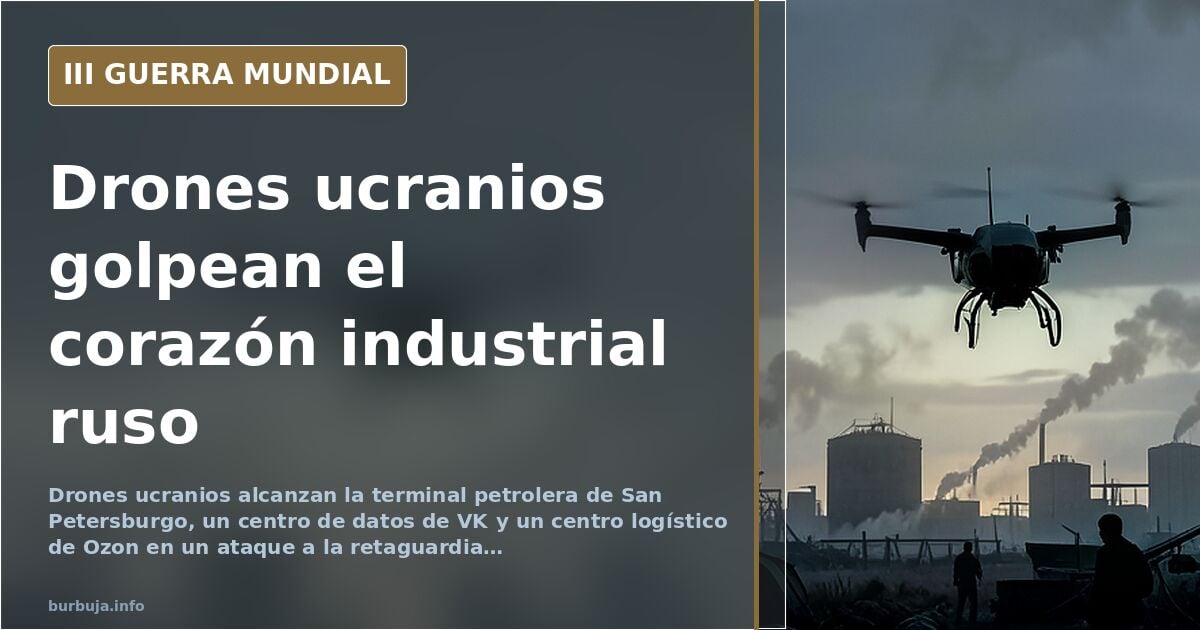
Ukraine strikes St Petersburg and Europe pays the price at the diesel pump
In the early hours of Sunday, Ukrainian drones hit the oil terminal in St Petersburg, a VKontakte data centre and an Ozon logistics hub. The attack was not aiming at a barracks: it targeted the industrial fabric that sustains the Russian economy and, along the way, the pocket of the European taxpayer who funds the war. The paradox is straight out of a textbook: the one who pays for the party gets the hangover.
What is known about the attack on St Petersburg's oil terminal
The crossfire of statements leaves few certainties and one clear fact: the target was civilian infrastructure with strategic value. The oil terminal of Russia's second city, the data centre of one of the world's largest social networks and a logistics hub of e-commerce giant Ozon. No military headquarters. Everything that burns in the supply chain.
The most widely repeated reading is that Ukraine has decided to escalate where it hurts most, even at the cost of discomforting its own partners. Some argue that attacking refineries drives up oil prices and punishes the European economies that back Kyiv. The counter-argument weighs against it: if Russia cannot export diesel, it loses revenue and its war machine seizes up. The problem is that the crude oil tap does not take sides.
The real cost for the European taxpayer
Rising fuel prices and the inflationary jolt loom over the conversation like a shadow. A calculation doing the rounds online suggests that every attack on a Russian refinery translates into a spike in prices at the European pump. The chain is simple: less global supply, same consumption, prices rise. And the citizen watching their paycheque lose purchasing power cannot tell the difference between a missile and a sanction.
The question hanging in the air is an uncomfortable one: how far is Europe willing to pay the energy cost of a war it is not fighting? Defence spending and transfers to Ukraine compete with healthcare, pensions and the electricity bill. It is not a new debate, but the attack on St Petersburg has reignited it with an intensity that official speeches cannot contain.
Zelensky between Pilingui and Trump: a two-board gambit
The move has a geopolitical reading. Striking Russian targets while negotiating with Washington is a way of reminding everyone that Ukraine is not a pawn to be moved at the powers' will. The most widespread interpretation is that Zelensky wants to demonstrate an capacity for autonomous damage, even if that discomforts the White House. The other reading is less epic: a desperate country that needs to keep media attention and the flow of weapons coming.
The result is an unstable balance. Russia sees its narrative of external aggression reinforced; Europe watches, divided between declarative support and real cost; and the United States calibrates how far to go without getting burned. Meanwhile, the ordinary citizen looks at the heating bill and wonders how much longer the story can hold.
What could happen next: open scenarios
Nobody has a crystal ball, but the scenarios can be sketched in broad strokes. One: Russia responds with a punishment campaign against Ukrainian infrastructure, especially the energy grid, leaving the population without light and heating in mid-winter. Two: international pressure forces a negotiation with conditions neither side wants to sign. Three: the war becomes entrenched and economic attrition becomes the real battlefield.
The only certainty is that the attack on St Petersburg closes no doors, but opens several at once. And none of them leads to a quick end. That is the nature of a war of attrition: the one who endures longest wins, not the one who lands the most spectacular blow. How long can European patience hold before the taxpayer says enough?
Summary of a discussion on Burbuja.info - Foro de economía, actualidad y política., translated from Spanish and reviewed before publication. Read the full discussion (77 replies).
More summaries
-
Kiev's Systematic Air Campaign Targets Factories, Warehouses, and Data Centers
Kiev faces systematic missile and drone attacks on factories, warehouses, and data centers, leading to blackouts and smoke.
-
Annihilation on video: when war becomes entertainment
Drone videos of Ukrainian soldiers are circulating as entertainment. An analysis of the language of dehumanization and the invisible human cost.
-
Zelensky Rejects Trump-Putin Peace Deal, Demands $250 Billion
Ukraine's president rejects a negotiated peace between Trump and Putin, demanding $250 billion from the West to sustain the war effort.
-
Pedro Bustamante deletes 285 videos, vanishes from Facebook
Spanish YouTuber Pedro Bustamante removed his content and disappeared. Rumors place him in Munich, reading German press.
-
Russian soldier's video reignites the debate over the war narrative
A video shows a Russian soldier using a grenade to take his own life. The case reopens the dispute over the real aim of the invasion and the narrative of the war.
-
Meloni invites Milei to the G7 summit in Italy
Italy confirms Javier Milei's invitation to the G7 summit on 13-15 June in Apulia, hours after the Argentine president was honoured in Miami.