
Stoltenberg fails to refute claims of 500,000 Ukrainian casualties
An Irish MEP estimates Ukrainian military deaths at 500,000 during a meeting with NATO chief Jens Stoltenberg, who did not dispute the figure.
English · Original discussion in Spanish · Published
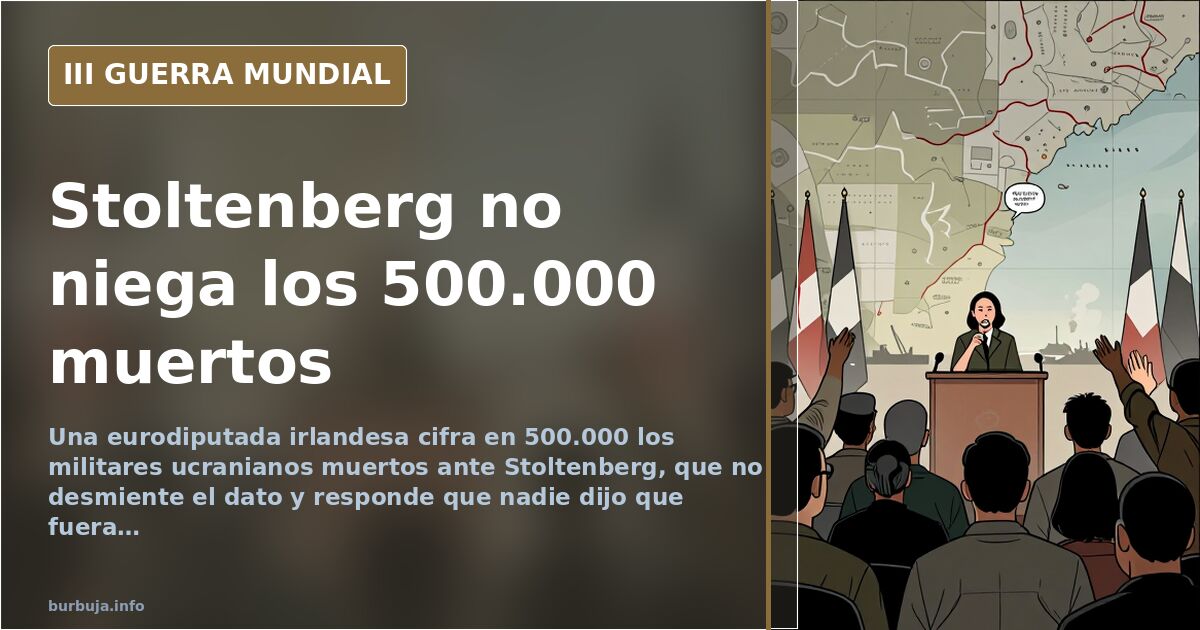
Stoltenberg fails to refute claims of 500,000 Ukrainian casualties
The figure was raised by an Irish MEP during a meeting with NATO leadership. Half a million Ukrainian soldiers dead. And the Alliance's Secretary General, Jens Stoltenberg, did not correct it. He merely responded that no one ever said it would be easy and that Russia had well-prepared its defenses. In a war where every party weighs its words meticulously, silence in the face of such a number is worth more than any official statement.
What Stoltenberg exactly said regarding the 500,000 deaths
The exchange, captured in several videos circulating on social media, has a simple structure. MEP Claire Daly argues that Ukraine is not gaining territory bit by bit, as the official narrative claims, and adds that people with physical limitations or illnesses are already being mobilized. Half a million men have died, she says. Stoltenberg responds with the formula he has been repeating for months: no one said it would be easy.
The relevance lies not in the figure itself, which has been circulating through alternative channels for some time. The relevance is that NATO's top military official, with all intelligence information on the table, did not refute it. He had an easy way out: "that figure is false according to our data." He did not use it. And anyone can fill that void.
Why failing to refute casualty figures matters
In war communications, silence is not neutral. If the head of the Alliance does not correct a number that multiplies official estimates several times over, it opens the door to three readings: that the data is true, that the person handling it does not know, or that they know correcting it would be worse. None are good for the narrative.
Some argue that the figure includes the dead, wounded, missing, and prisoners, not just those deceased. It is a reasonable nuance, but it does not change the core issue. If total casualties approach 1.5 million, as some circulating calculations suggest, Ukraine's ability to replenish its forces is compromised, regardless of how the count is divided between the living and the dead.
Mobilizing people with disabilities as a warning sign
The second element of the exchange is the one that has generated the fewest headlines but says the most. Daly mentions that people with physical limitations and mental health issues are being recruited. If this is true, the demographic equation does not align with the narrative of a sustainable counteroffensive.
A country in total war can reach that point. The Soviet Union did so in 1941 and Germany in 1945. The difference is that back then, there weren't twenty European countries financing the effort with money and weaponry while their own citizens of military age did not set foot on the front. The asymmetry between those providing the dead and those providing the checks is the uncomfortable fact that the exchange exposes.
Demographic attrition that weaponry cannot fix
War does not only kill. It empties. Ukraine started with an already very low birth rate before the conflict, around 1.2 children per woman, and a significant part of its young population has left the country with no intention of returning. Those who have left are not casualties, but they are not coming back either.
That compound effect—deaths at the front, exiles who do not return, plummeted birth rates—is what leads some analysts to speak of structural damage for several generations. Rebuilding infrastructure is a matter of money. Rebuilding a population pyramid is a matter of decades, and only if people decide to have children in a country at war or just emerging from one.
What NATO is at stake with this episode
The Alliance has spent two years building a narrative of territorial pogre and technological superiority. Every movement has been known in advance by Western intelligence services; every route of advance has been anticipated. And yet, Russian defensive lines have not yielded at the expected pace.
The episode leaves an unanswered question: if technology and information are not enough to win, what is left? The uncomfortable answer is demographics, and there, Ukraine is playing with fewer pieces than Russia. No one said it would be easy, true. But no one said it would cost half a million lives before admitting it wasn't.
What might happen next
The episode does not close anything. The war continues, mobilization goes on, and real figures will take years to be known, if they are ever known at all. What has changed is the framework: a figure that a year ago was taboo in Western media is now discussed in a room with the head of NATO present, without anyone refuting it.
If this shift in narrative consolidates, the predictable outcome is a gradual move toward the language of "casualties" instead of "deaths," and toward preparing public opinion for negotiation scenarios. It is not a firm prediction. It is the direction suggested by the silence.
The figure was raised by an Irish MEP during a meeting with NATO leadership. Half a million Ukrainian soldiers dead. And the Alliance's Secretary General, Jens Stoltenberg, did not correct it. He merely responded that no one ever said it would be easy and that Russia had well-prepared its defenses. In a war where every party weighs its words meticulously, silence in the face of such a number is worth more than any official statement.
What Stoltenberg exactly said regarding the 500,000 deaths
The exchange, captured in several videos circulating on social media, has a simple structure. MEP Claire Daly argues that Ukraine is not gaining territory bit by bit, as the official narrative claims, and adds that people with physical limitations or illnesses are already being mobilized. Half a million men have died, she says. Stoltenberg responds with the formula he has been repeating for months: no one said it would be easy.
The relevance lies not in the figure itself, which has been circulating through alternative channels for some time. The relevance is that NATO's top military official, with all intelligence information on the table, did not refute it. He had an easy way out: "that figure is false according to our data." He did not use it. And anyone can fill that void.
Why failing to refute casualty figures matters
In war communications, silence is not neutral. If the head of the Alliance does not correct a number that multiplies official estimates several times over, it opens the door to three readings: that the data is true, that the person handling it does not know, or that they know correcting it would be worse. None are good for the narrative.
Some argue that the figure includes the dead, wounded, missing, and prisoners, not just those deceased. It is a reasonable nuance, but it does not change the core issue. If total casualties approach 1.5 million, as some circulating calculations suggest, Ukraine's ability to replenish its forces is compromised, regardless of how the count is divided between the living and the dead.
Mobilizing people with disabilities as a warning sign
The second element of the exchange is the one that has generated the fewest headlines but says the most. Daly mentions that people with physical limitations and mental health issues are being recruited. If this is true, the demographic equation does not align with the narrative of a sustainable counteroffensive.
A country in total war can reach that point. The Soviet Union did so in 1941 and Germany in 1945. The difference is that back then, there weren't twenty European countries financing the effort with money and weaponry while their own citizens of military age did not set foot on the front. The asymmetry between those providing the dead and those providing the checks is the uncomfortable fact that the exchange exposes.
Demographic attrition that weaponry cannot fix
War does not only kill. It empties. Ukraine started with an already very low birth rate before the conflict, around 1.2 children per woman, and a significant part of its young population has left the country with no intention of returning. Those who have left are not casualties, but they are not coming back either.
That compound effect—deaths at the front, exiles who do not return, plummeted birth rates—is what leads some analysts to speak of structural damage for several generations. Rebuilding infrastructure is a matter of money. Rebuilding a population pyramid is a matter of decades, and only if people decide to have children in a country at war or just emerging from one.
What NATO is at stake with this episode
The Alliance has spent two years building a narrative of territorial pogre and technological superiority. Every movement has been known in advance by Western intelligence services; every route of advance has been anticipated. And yet, Russian defensive lines have not yielded at the expected pace.
The episode leaves an unanswered question: if technology and information are not enough to win, what is left? The uncomfortable answer is demographics, and there, Ukraine is playing with fewer pieces than Russia. No one said it would be easy, true. But no one said it would cost half a million lives before admitting it wasn't.
What might happen next
The episode does not close anything. The war continues, mobilization goes on, and real figures will take years to be known, if they are ever known at all. What has changed is the framework: a figure that a year ago was taboo in Western media is now discussed in a room with the head of NATO present, without anyone refuting it.
If this shift in narrative consolidates, the predictable outcome is a gradual move toward the language of "casualties" instead of "deaths," and toward preparing public opinion for negotiation scenarios. It is not a firm prediction. It is the direction suggested by the silence.
Also available in: Deutsch
Summary of a discussion on Burbuja.info - Foro de economía, actualidad y política., translated from Spanish and reviewed before publication. Read the full discussion (101 replies).
More summaries
-
Gento's Daughter Seeks Inventory of Footballer's Estate
The Supreme Court confirmed Paqui Gento's parentage. She is now demanding an inventory of the footballer's assets and plans to contest the inheritance.
-
The China coup rumors fueled by an Opium War article
Claims of a coup in China involving the arrest of Xi Jinping have remained entirely unverified four years after the initial rumors surfaced.
-
Madrid Mayor falls for Russian prank posing as Kyiv official
Two Russian pranksters used a deepfake video call to trick Madrid Mayor Martínez-Almeida into making controversial statements about Russia in a 17-minute video.
-
Russian electronic warfare causes US JDAM bombs to fail in Ukraine
Leaked Pentagon documents suggest that Russian GPS jamming and faulty fuses are causing US JDAM precision bombs to miss targets in Ukraine.
-
BRICS: From Goldman Sachs' concept to the challenge against the dollar
The BRIC term was coined by a Goldman Sachs economist in 2001, and today it represents a bloc seeking to reduce reliance on the US dollar.
-
Yana Rykhlitska, the 'Angel of Bakhmut' and the war of casualty figures
The death of volunteer Yana Rykhlitska in Bakhmut reignites debates over casualty statistics and the role of women on the front lines.