
Starting Fire with Two Stones: Mineral Matters, Not Temperature
Ambient temperature is irrelevant to the spark. Flint and quartz are the critical minerals, but moisture holds the key. Learn how to start a fire using stones.
English · Original discussion in Spanish · Published
Starting Fire with Two Stones: Mineral Matters, Not Temperature
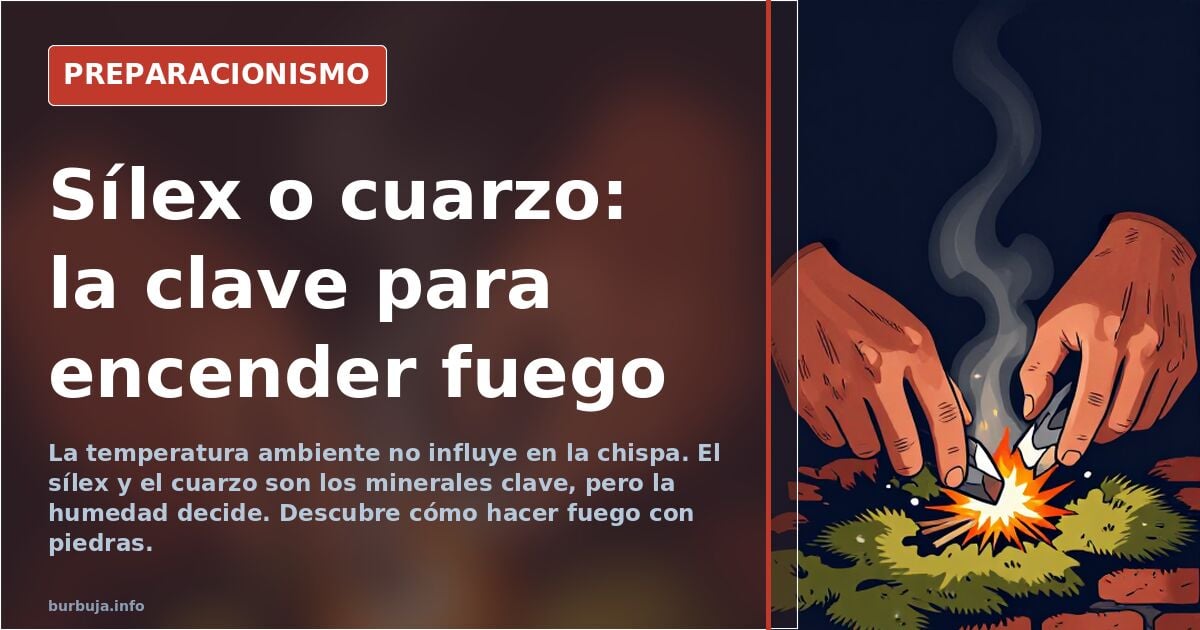
The survival fantasy of lighting a bonfire by rubbing two stones clashes with physics. Ambient temperature is irrelevant; what determines the spark is the mineral hardness and the moisture content of the fuel. Those who have tried it know that the most likely outcome is a bruised finger.
Flint versus Quartz: Choosing the Mineral
Flint is the classic material. Its conchoidal fracture produces sharp edges that generate sparks when impacted against another hard mineral. Quartz, much more abundant, can also produce sparks, but they are less spectacular and harder to harness for starting a fire. The moisture content of the wood or dry grass is the critical factor: if the fuel is damp, the spark will fail.
The Legal Risk of Playing at Robinson
During wildfire season, starting a fire in the wilderness is punishable by considerable fines. Even barbecues in rest areas are not permitted. The advice is clear: carry a lighter.
The ancient bellows driven by mules used flint to generate sparks when rubbed against metal—a technique that worked in the field but requires specific material.
Anyone insisting on the primitive method must seek flint, wait until the fuel is dry, and pray that the spark catches before the park ranger arrives. The lighter remains the most sensible option.
The survival fantasy of lighting a bonfire by rubbing two stones clashes with physics. Ambient temperature is irrelevant; what determines the spark is the mineral hardness and the moisture content of the fuel. Those who have tried it know that the most likely outcome is a bruised finger.
Flint versus Quartz: Choosing the Mineral
Flint is the classic material. Its conchoidal fracture produces sharp edges that generate sparks when impacted against another hard mineral. Quartz, much more abundant, can also produce sparks, but they are less spectacular and harder to harness for starting a fire. The moisture content of the wood or dry grass is the critical factor: if the fuel is damp, the spark will fail.
The Legal Risk of Playing at Robinson
During wildfire season, starting a fire in the wilderness is punishable by considerable fines. Even barbecues in rest areas are not permitted. The advice is clear: carry a lighter.
The ancient bellows driven by mules used flint to generate sparks when rubbed against metal—a technique that worked in the field but requires specific material.
Anyone insisting on the primitive method must seek flint, wait until the fuel is dry, and pray that the spark catches before the park ranger arrives. The lighter remains the most sensible option.
Summary of a discussion on Burbuja.info - Foro de economía, actualidad y política., translated from Spanish and reviewed before publication. Read the full discussion (16 replies).
More summaries
-
Irati Etxandi, the 22-year-old mechanic taking TikTok by storm
Irati Etxandi, a 22-year-old mechanic in San Sebastián, is taking TikTok by storm—while some customers still ask to speak to a mechanic.
-
Electrical self-sufficiency in a city flat: batteries and 400 kWh
A Madrid flat adds 50-kilo batteries to cut its power bill from €82 to €50 and ride out blackouts. The total cost still doesn’t quite add up.
-
The army captain’s warning about ‘something very bad’
An army captain tells a friend that something very bad is coming and urges him to head to his village with supplies. Reaction: skepticism and stockpiling.
-
Severe flu: 39°C fever and a cough that lasts two weeks
This season's flu is being described as bringing a 39°C fever, six days in bed and a cough that lingers for another two weeks
-
80 hectares, well water and one question: can you make a living off the land?
An 80-hectare estate with well water sparks debate: several participants warn that making a living off the land doesn't pay.
-
Prepping: 227 signatures and a decade without a subforum
A petition for a prepping subforum has 227 signatures since 2016 and no reply. The pandemic revived interest, but the category was never created.