
Stalin's Nomenklatura: Caviar Amid Famine
In 1932, Soviet elites received black caviar monthly while millions starved. Historian Elena Osokina reveals the stark contrast in privileges.
English · Original discussion in Spanish · Published
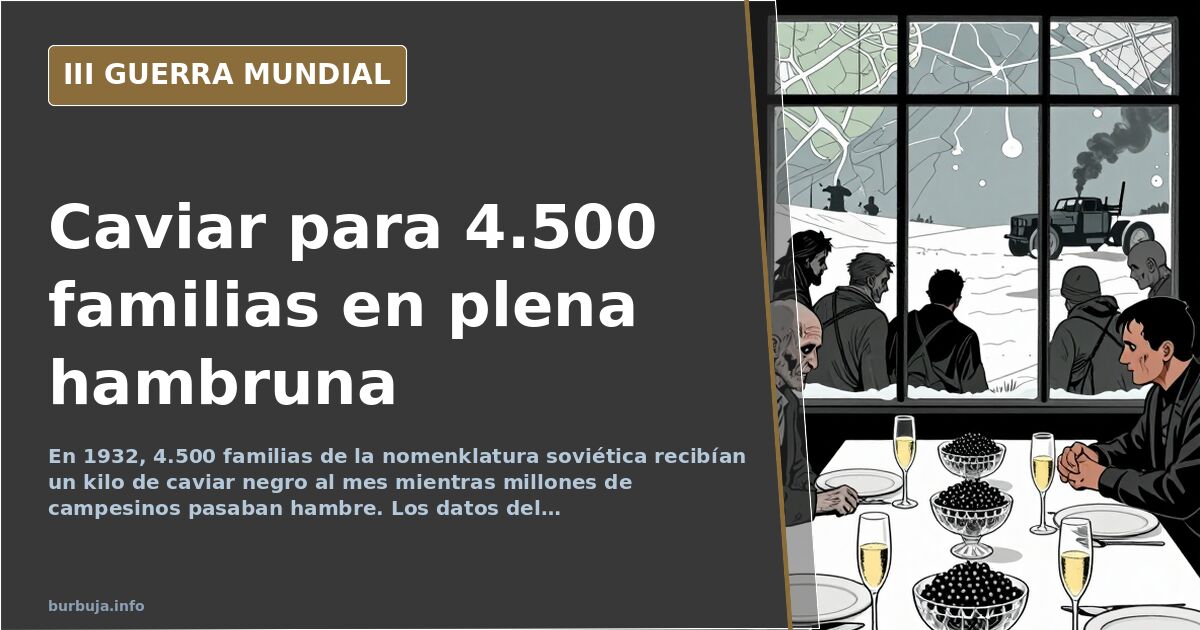
Stalin's Nomenklatura ate caviar as the country starved
In the summer of 1932, while millions of Soviet peasants died of hunger in Ukraine and the Volga region, residents of Moscow’s House on the Embankment received a monthly ration that would look like a luxury hotel menu today: 4 kg of meat, 4 kg of sausages, 1.5 kg of butter, 2 liters of oil, 6 kg of fresh fish, 2 kg of herring, 3 kg of sugar, 3 kg of cereals, 8 cans of preserves, 20 eggs, 2 kg of cheese, and 1 kg of black caviar. Additionally, they received 1,200 cigarettes, 50 grams of tea, two bars of soap, and one liter of milk per day. An excerpt from historian Elena Osokina’s book, "The Alchemy of Soviet Industrialization: The Torgsin Era," published by New Literary Review and disseminated by Russian media outlet Lenta.ru, quantifies an uncomfortable reality: the communist regime’s leadership never went hungry.
How many privileged individuals existed in the Soviet Union?
When the card system was abolished in the mid-1930s, executives receiving the special "Category A" ration—the best in the country—numbered 4,500 people. The group of responsible employees with the "Category B" ration totaled 41,500. The highest tier of scientists comprised 1,900 individuals. All figures exclude family members. Including personal pensioners of trade union and republican significance and former political prisoners, the total number of families with special supplies in a country of 160 million inhabitants rose to 55,500, of which 45,000 lived in Moscow.
The paradox dismantling the official narrative is that, strictly speaking, only one person in the USSR did not live on rations, coupons, and orders: Stalin. The rest of the leadership, including Politburo members, ate from a ration. Abundant and nearly free, but still a ration. The material wealth threshold of the Soviet elite in the early 1930s barely exceeded the capabilities of the upper strata of the Western middle class, according to the excerpt. Clothing and shoes came via coupon: in the summer of 1931, a responsible employee with "Category B" was entitled to one winter coat, one raincoat, one suit, one pair of trousers, three shirts, four sets of underwear, 24 meters of fabric, six pairs of socks, twelve bars of soap, two pairs of shoes, two pairs of slippers, and two sheets per year. A display of revolutionary austerity.
Five-room apartments and state-paid domestic service
The elite lived in state-built houses with three, four, or even five rooms per family, served by an army of concierges, mechanics, electricians, and stokers paid by public funds. Furniture was purchased or distributed from the Kremlin warehouse. Those with taste and inclination could turn their apartment into a museum: that of Politburo member and Central Executive Committee member E.Ya. Ruzutaka appeared, according to cited evidence, like an art gallery. Leaders wore jackets, soft shirts, and military uniforms, earning the highest salaries in the country, though money mattered little in an economy of scarcity and near-free state provision. Prestige lay in securing a Kremlin apartment, where vacancies were nonexistent.
The contrast with the street leaves no room for nuance. The industrial leap of a peasant country was paid for by citizens’ personal savings: during the famine years of the first Five-Year Plans, Soviets exchanged gold, foreign currency, and precious metal objects for rye flour, cereals, sugar, and basic goods at Torgsin stores. The State was an experimental project whose internal logic allowed the system to survive, not the population.
Defending the legacy: industrial power versus famine
Reaction to the excerpt reproduces a decades-long clash of narratives. One analysis argues that the USSR started as a devastated, backward country with a malnourished and largely illiterate population, transforming it into a global superpower within decades, with an industrial base still supporting Russia’s military capacity. This argument also credits the Soviet bloc with extending the welfare state and the New Deal in the West. The opposing current responds with Osokina’s data and the famine: power is not built through hunger, and the collectivist system ruined the economy even before the war. In 1919, average incomes in Soviet Russia had fallen to less than $600 international dollars (1990 prices), less than half of 1913 levels—a figure seen today only in the world’s poorest countries.
Some recall that Stalin still ranks high in Russian historical significance polls, while others argue that modern Russia is a nationalist, capitalist, Orthodox Christian country with no real continuity with the Soviet project. The discussion shifts to housing: the myth of free housing in the USSR holds poorly, because if something is distributed for free, someone has already paid for it, and Soviet citizens reimbursed its cost indirectly at a price higher than the average US mortgage. Distribution was handled by the State, not the market, with its own rules of access, lists, and privileges.
The exact point where analysis stalls remains unchanged: if the elite lived on caviar and five-room apartments while 160 million people traded their gold rings for rye flour, what remains of the egalitarian narrative? The answer provided by the material is not an opinion; it is a shopping list.
In the summer of 1932, while millions of Soviet peasants died of hunger in Ukraine and the Volga region, residents of Moscow’s House on the Embankment received a monthly ration that would look like a luxury hotel menu today: 4 kg of meat, 4 kg of sausages, 1.5 kg of butter, 2 liters of oil, 6 kg of fresh fish, 2 kg of herring, 3 kg of sugar, 3 kg of cereals, 8 cans of preserves, 20 eggs, 2 kg of cheese, and 1 kg of black caviar. Additionally, they received 1,200 cigarettes, 50 grams of tea, two bars of soap, and one liter of milk per day. An excerpt from historian Elena Osokina’s book, "The Alchemy of Soviet Industrialization: The Torgsin Era," published by New Literary Review and disseminated by Russian media outlet Lenta.ru, quantifies an uncomfortable reality: the communist regime’s leadership never went hungry.
How many privileged individuals existed in the Soviet Union?
When the card system was abolished in the mid-1930s, executives receiving the special "Category A" ration—the best in the country—numbered 4,500 people. The group of responsible employees with the "Category B" ration totaled 41,500. The highest tier of scientists comprised 1,900 individuals. All figures exclude family members. Including personal pensioners of trade union and republican significance and former political prisoners, the total number of families with special supplies in a country of 160 million inhabitants rose to 55,500, of which 45,000 lived in Moscow.
The paradox dismantling the official narrative is that, strictly speaking, only one person in the USSR did not live on rations, coupons, and orders: Stalin. The rest of the leadership, including Politburo members, ate from a ration. Abundant and nearly free, but still a ration. The material wealth threshold of the Soviet elite in the early 1930s barely exceeded the capabilities of the upper strata of the Western middle class, according to the excerpt. Clothing and shoes came via coupon: in the summer of 1931, a responsible employee with "Category B" was entitled to one winter coat, one raincoat, one suit, one pair of trousers, three shirts, four sets of underwear, 24 meters of fabric, six pairs of socks, twelve bars of soap, two pairs of shoes, two pairs of slippers, and two sheets per year. A display of revolutionary austerity.
Five-room apartments and state-paid domestic service
The elite lived in state-built houses with three, four, or even five rooms per family, served by an army of concierges, mechanics, electricians, and stokers paid by public funds. Furniture was purchased or distributed from the Kremlin warehouse. Those with taste and inclination could turn their apartment into a museum: that of Politburo member and Central Executive Committee member E.Ya. Ruzutaka appeared, according to cited evidence, like an art gallery. Leaders wore jackets, soft shirts, and military uniforms, earning the highest salaries in the country, though money mattered little in an economy of scarcity and near-free state provision. Prestige lay in securing a Kremlin apartment, where vacancies were nonexistent.
The contrast with the street leaves no room for nuance. The industrial leap of a peasant country was paid for by citizens’ personal savings: during the famine years of the first Five-Year Plans, Soviets exchanged gold, foreign currency, and precious metal objects for rye flour, cereals, sugar, and basic goods at Torgsin stores. The State was an experimental project whose internal logic allowed the system to survive, not the population.
Defending the legacy: industrial power versus famine
Reaction to the excerpt reproduces a decades-long clash of narratives. One analysis argues that the USSR started as a devastated, backward country with a malnourished and largely illiterate population, transforming it into a global superpower within decades, with an industrial base still supporting Russia’s military capacity. This argument also credits the Soviet bloc with extending the welfare state and the New Deal in the West. The opposing current responds with Osokina’s data and the famine: power is not built through hunger, and the collectivist system ruined the economy even before the war. In 1919, average incomes in Soviet Russia had fallen to less than $600 international dollars (1990 prices), less than half of 1913 levels—a figure seen today only in the world’s poorest countries.
Some recall that Stalin still ranks high in Russian historical significance polls, while others argue that modern Russia is a nationalist, capitalist, Orthodox Christian country with no real continuity with the Soviet project. The discussion shifts to housing: the myth of free housing in the USSR holds poorly, because if something is distributed for free, someone has already paid for it, and Soviet citizens reimbursed its cost indirectly at a price higher than the average US mortgage. Distribution was handled by the State, not the market, with its own rules of access, lists, and privileges.
The exact point where analysis stalls remains unchanged: if the elite lived on caviar and five-room apartments while 160 million people traded their gold rings for rye flour, what remains of the egalitarian narrative? The answer provided by the material is not an opinion; it is a shopping list.
Also available in: Deutsch
Summary of a discussion on Burbuja.info - Foro de economía, actualidad y política., translated from Spanish and reviewed before publication. Read the full discussion (138 replies).
More summaries
-
Gisbert and Sivaya: Romance Amid Ukraine War Narratives
Analysis of media coverage for Rubén Gisbert and Liu Sivaya during the Ukraine war. Is this digital propaganda or reality?
-
How Stalin and the Rothschilds helped create the State of Israel
Stalin's support, Rothschild money and the end of the British Mandate: Israel's creation was not just a UN chapter.
-
Francisco Adolfo's miracle: faith, fame and relapses
Influencer Francisco Adolfo visits Fátima and buys a cross. Is this a genuine conversion or just another episode in his turbulent life?
-
Yana Rykhlitska, the 'Angel of Bakhmut' and the war of casualty figures
The death of volunteer Yana Rykhlitska in Bakhmut reignites debates over casualty statistics and the role of women on the front lines.
-
Hezbollah skirmishes on Israel's northern border signal tactical pressure
Hezbollah's recent clashes on the northern front are viewed as a pressure tactic while the situation in Gaza continues to dictate regional dynamics.
-
Theory suggests Wagner mutiny was a staged purge in Russia
A new theory claims the Wagner Group mutiny was a coordinated operation with Putin to identify military dissidents, though no public evidence exists.