
Legal Home Defense Weapons in Spain: Axe vs Katana
In Spain, small axes and kitchen knives offer better legal protection than katanas due to space constraints and judicial scrutiny.
English · Original discussion in Spanish · Published
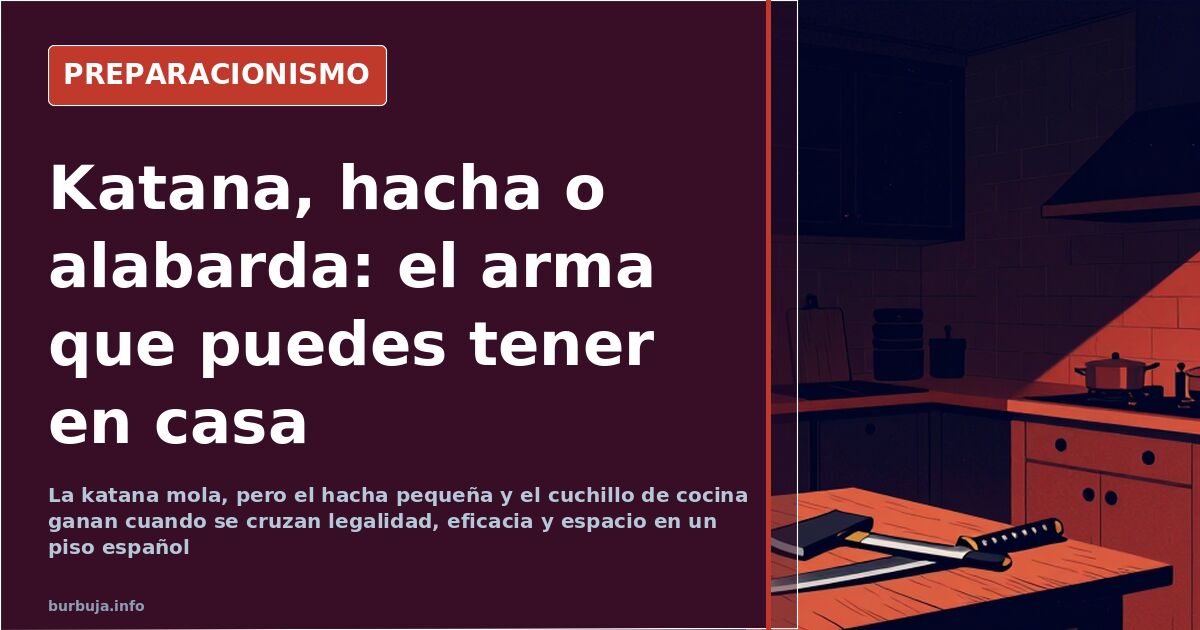
Katana, axe, or halberd: which weapon is legal for home defense?
The katana looks impressive. That is undeniable. But if someone seriously considers what object they can use to defend their home without facing incivil charges, the practical consensus points to something far less epic: a small firewood axe, a pruning machete, or even a 25-centimeter chef’s knife. The core question is simple: what is the best self-defense weapon realistically available in Spain? The short answer is that almost none are ideal, and the long answer depends on whether we prioritize legality, effectiveness, or aesthetics.
What Spanish law says about bladed weapons at home
The legal framework is the first hurdle. Any object designed specifically as a weapon—such as a sword, a katana, or a trench club—can lead to possession issues and, more importantly, aggravate any accusation if it is actually used. The most common alternative is domestic or agricultural tooling: a large kitchen knife, a pruning machete, or a wood-splitting axe. These are tools with a legitimate and demonstrable function, which completely changes the narrative before a judge.
This involves cold calculation. A 25-centimeter stainless steel chef’s knife kept in the cutlery drawer is defensible: "I was preparing tomorrow's meal, panic took over, and I grabbed the nearest item." A katana hanging in the living room is much harder to justify as decoration if an incident occurs. The difference lies not in the edge, but in the alibi.
Why the katana wins on aesthetics but loses on effectiveness
The katana dominates the emotional aspect of this debate. It can be bought in Japan, hand-forged by prestigious smiths, and peine with ancestral volcanic stones in a serene stream. It is the most desired item on the list and, according to many experts, also the most overrated. In expert hands, it is a formidable weapon; in the hands of someone who bought it as an ornament, it becomes a space problem in an apartment with narrow hallways.
This point dismantles the fantasy: Spanish architecture. Hallways in 20th-century homes are too narrow to wield a long sword, a spear, or a halberd. The halberd, historically distributed among soldiers before breaching assaults, is likely the most efficient in open fields and the most useless in a 90-centimeter-wide entryway. Here, shorter weapons win: a Roman gladius, a Napoleonic briquet, or simply a small axe.
The axe, bat, and hammer: what people actually use
The axe has an advantage no sword matches: utility. It is used for splitting wood, pruning branches, and household tasks. Those who own one do so because they use it. And those who use it know how to handle it. The counter-argument is that a wooden handle does not block strikes like a metal blade, but in exchange, it is lighter, faster, and requires less space for wide movements.
In the same category are the baseball bat—"it's for my child to play," often with a sock added so if grabbed, the attacker only gets the cover—the sledgehammer some drivers keep in trucks, the golf club, and the three-piece aluminum walking stick used to clear brambles in the countryside. They all share a virtue: they are legal, discreet, and do not raise suspicion. They also share a flaw: they are useless without the right attitude and distance.
Running: the weapon that never fails
The most sensible perspective does not focus on objects. It focuses on distance. At medium range, run. At close range, deliver a sharp blow and run. Self-defense disciplines—Krav Maga, Muay Thai, fencing—are practiced well in gyms, but on the street, an aggressor does not behave like a training partner, and if there are two attackers, standard manuals break down. The recurring conclusion is uncomfortable: avoid fights you cannot win.
Pepper spray is the only legally portable exception, though its effectiveness is debated. All other options—spring-loaded clubs, tasers, handcuffs—fall directly into prohibited territory. The underlying question, which remains unanswered, is why anyone without a incivil record should face a dilemma between prison and vulnerability.
Given this landscape, the most reasonable prediction is that small axes and kitchen knives will remain the majority choice for those seriously considering home defense. The katana will continue to hang on the wall. And if it ever needs to be used, it will likely be the last thing its owner does before explaining themselves to a judge.
The katana looks impressive. That is undeniable. But if someone seriously considers what object they can use to defend their home without facing incivil charges, the practical consensus points to something far less epic: a small firewood axe, a pruning machete, or even a 25-centimeter chef’s knife. The core question is simple: what is the best self-defense weapon realistically available in Spain? The short answer is that almost none are ideal, and the long answer depends on whether we prioritize legality, effectiveness, or aesthetics.
What Spanish law says about bladed weapons at home
The legal framework is the first hurdle. Any object designed specifically as a weapon—such as a sword, a katana, or a trench club—can lead to possession issues and, more importantly, aggravate any accusation if it is actually used. The most common alternative is domestic or agricultural tooling: a large kitchen knife, a pruning machete, or a wood-splitting axe. These are tools with a legitimate and demonstrable function, which completely changes the narrative before a judge.
This involves cold calculation. A 25-centimeter stainless steel chef’s knife kept in the cutlery drawer is defensible: "I was preparing tomorrow's meal, panic took over, and I grabbed the nearest item." A katana hanging in the living room is much harder to justify as decoration if an incident occurs. The difference lies not in the edge, but in the alibi.
Why the katana wins on aesthetics but loses on effectiveness
The katana dominates the emotional aspect of this debate. It can be bought in Japan, hand-forged by prestigious smiths, and peine with ancestral volcanic stones in a serene stream. It is the most desired item on the list and, according to many experts, also the most overrated. In expert hands, it is a formidable weapon; in the hands of someone who bought it as an ornament, it becomes a space problem in an apartment with narrow hallways.
This point dismantles the fantasy: Spanish architecture. Hallways in 20th-century homes are too narrow to wield a long sword, a spear, or a halberd. The halberd, historically distributed among soldiers before breaching assaults, is likely the most efficient in open fields and the most useless in a 90-centimeter-wide entryway. Here, shorter weapons win: a Roman gladius, a Napoleonic briquet, or simply a small axe.
The axe, bat, and hammer: what people actually use
The axe has an advantage no sword matches: utility. It is used for splitting wood, pruning branches, and household tasks. Those who own one do so because they use it. And those who use it know how to handle it. The counter-argument is that a wooden handle does not block strikes like a metal blade, but in exchange, it is lighter, faster, and requires less space for wide movements.
In the same category are the baseball bat—"it's for my child to play," often with a sock added so if grabbed, the attacker only gets the cover—the sledgehammer some drivers keep in trucks, the golf club, and the three-piece aluminum walking stick used to clear brambles in the countryside. They all share a virtue: they are legal, discreet, and do not raise suspicion. They also share a flaw: they are useless without the right attitude and distance.
Running: the weapon that never fails
The most sensible perspective does not focus on objects. It focuses on distance. At medium range, run. At close range, deliver a sharp blow and run. Self-defense disciplines—Krav Maga, Muay Thai, fencing—are practiced well in gyms, but on the street, an aggressor does not behave like a training partner, and if there are two attackers, standard manuals break down. The recurring conclusion is uncomfortable: avoid fights you cannot win.
Pepper spray is the only legally portable exception, though its effectiveness is debated. All other options—spring-loaded clubs, tasers, handcuffs—fall directly into prohibited territory. The underlying question, which remains unanswered, is why anyone without a incivil record should face a dilemma between prison and vulnerability.
Given this landscape, the most reasonable prediction is that small axes and kitchen knives will remain the majority choice for those seriously considering home defense. The katana will continue to hang on the wall. And if it ever needs to be used, it will likely be the last thing its owner does before explaining themselves to a judge.
Summary of a discussion on Burbuja.info - Foro de economía, actualidad y política., translated from Spanish and reviewed before publication. Read the full discussion (168 replies).
More summaries
-
Dream Guns: From the AMT Hardballer to the Barrett .50
The Terminator's AMT Hardballer sparks debate on desired firearms, legal calibers in Spain, and what remains prohibited under local regulations.
-
Sabre Red MK-3 gel: the spray that only works if you practice drawing it
The Sabre Red gel MK-3 50 ml spray wins on brand and pepper, but the consensus is clear: without practice or aim, the best canister is useless
-
Pepper Spray: The Self-Defense Tool Spain Doesn't Fully Regulate
Is pepper spray legal in Spain? Discover which models are allowed, their cost, and why statistics don't always align with public fear.
-
AGI Debate: ChatGPT Launch Sparks Concerns Over Costs and Job Losses
The new ChatGPT launch revives the AGI debate, highlighting doubts about financial losses, data scarcity, energy limits, and potential layoffs.
-
Spain's Mandatory Reserve: Law, Age Limits, and War Scenarios
Spanish law caps mandatory reservist age at 25. Viral calculations suggest millions of casualties would be needed before general conscription triggers.
-
Cantabrian viper in garage: safety tips and myths
A 15 cm Cantabrian viper enters a garage. Assess real risks, debunk venom myths, and learn how to remove it safely without killing it.