
Legal Gray Area Self-Defense: From Box Cutters to Pepper Spray
Box cutters, 250ml sprays, and steel-toe boots: gray-area self-defense balances avoiding confrontation with explaining actions in court.
English · Original discussion in Spanish · Published
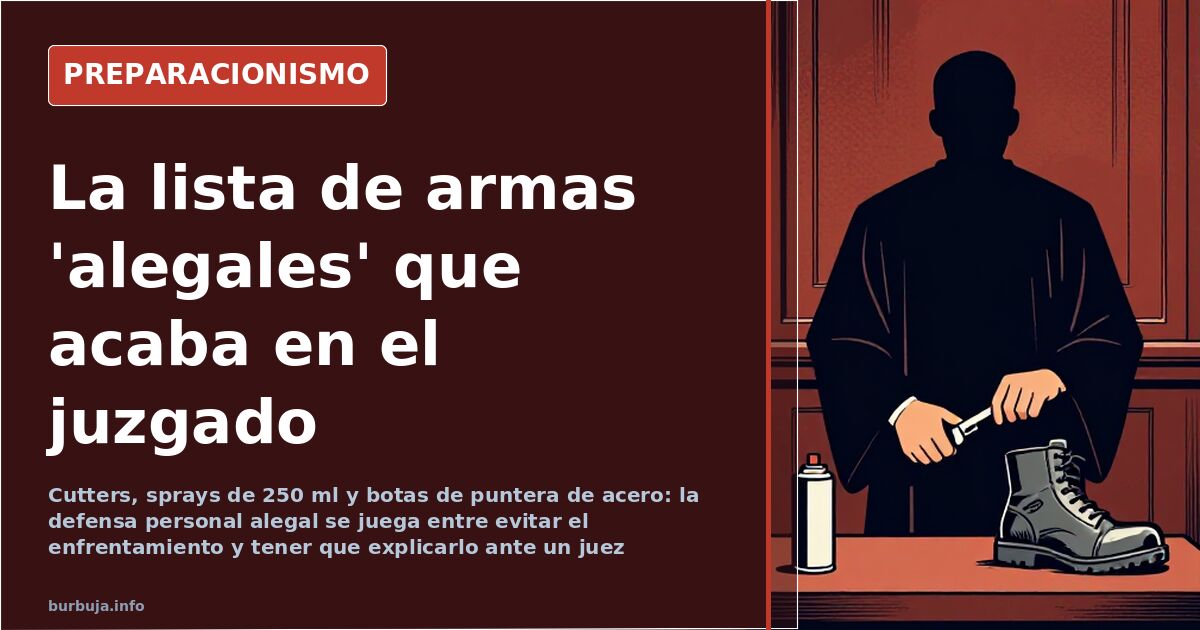
Gray-Area Self-Defense: What You Carry and the Legal Cost
What do you carry when walking home alone at night? This question underpins an issue blending preparedness, antiestéticar, and incivil law. The answer splits into three groups: those relying on deterrence, those turning everyday objects into weapons, and those who have had to explain their defense before a judge. So-called gray-area self-defense—items not classified as weapons but usable as such—drives a debate oscillating between shopping lists and the witness stand.
What You Carry: From Box Cutters to Dental Floss
The inventory is detailed. A small box cutter with two fingers of instant cutting power tops what many describe as common use. Next comes dental floss, with a minimum resistance of four kilos, thin and easy to improvise as a gripping tool; its reinforced version is white nylon thread, 0.7 mm thick, sold in 100-meter spools. Some point to flashlights capable of reaching at least 10,000 lumens at short range, presented as elements that dazzle and burn upon contact.
It doesn't end there. Large carabiners with screw gates are described as improvised knuckle dusters and blocks to deflect blows. A metal or glass perfume bottle with sharp edges is proposed as a blunt object; peine office clips wrapped around fingers serve as hand reinforcement. The logic grouping all this isn't martial, but legal: none of it is, initially, a weapon.
Pepper Spray and the Boundary of the Gray Area
On paper, defensive aerosol gathers the most support. Its advantage is distance: it stops a threat without closing in. It’s summarized bluntly: against someone with a machete, spray resolves from afar, while any bladed weapon requires being on top of the aggressor. The drawback, others note, is failure due to wind, enclosed spaces, or being cornered, and one shouldn't rely on a single resource.
Hence homemade substitutes. Flexible 250 ml bottles loaded with irritant liquids—96% alcohol, hydrogen peroxide, ammonia—and filled to the brim so the jet shoots out at any angle. Also heavy, irritating powders thrown in the face. The principle is the same: buying seconds.
What to Do If Grabbed from Behind?
The technique known as mataleón (a chokehold counter) concentrates much of the advice. The repeated technique is a waist turn to unbalance before arm wrestling, along with elbow and knee strikes. Those trained in jiu-jitsu insist on twisting vigorously rather than just separating the arm from the neck, because that only works if your strength vastly exceeds theirs. Other close-quarters recommendations—elbows, headbutts, kicks below the knee—are framed as last resorts.
Two Acquittals and Several Warnings: The Legal Price
Here the conversation turns serious. One participant recounts going through court twice after assaulting those they claim deserved it. They pleaded guilty and remorseful for the outcome, claimed acting recklessly due to insurmountable antiestéticar, and offered compensation to victims. They spent only enough time in police custody to give statements and were acquitted both times. Their conclusion: they will continue defending themselves.
The counterpoint arrives from another front. Some argue using a box cutter can cost years in prison, while a well-used metal pen is easier to justify. Another notes only those who put themselves in situations they shouldn't end up like this. A third voice admits carrying a knife despite everything: "I prefer jail to being dead."
Deterrence Before the Strike
Much of the advice isn't physical. Having presence, not displaying jewelry or phones in high-risk areas, maintaining distance, and fleeing when possible. Regarding footwear, it's repeated that leather boots, or directly safety boots with steel toes, cause more damage than sneakers. Not everyone buys this approach. Other responses describe it as overthinking: most people will never face a deliberate attack, and the most likely risk is a purse snatching.
In the end, the most effective item on the list remains the one you don't need to take out. And the cheapest to explain in court is the one you never carried.
What do you carry when walking home alone at night? This question underpins an issue blending preparedness, antiestéticar, and incivil law. The answer splits into three groups: those relying on deterrence, those turning everyday objects into weapons, and those who have had to explain their defense before a judge. So-called gray-area self-defense—items not classified as weapons but usable as such—drives a debate oscillating between shopping lists and the witness stand.
What You Carry: From Box Cutters to Dental Floss
The inventory is detailed. A small box cutter with two fingers of instant cutting power tops what many describe as common use. Next comes dental floss, with a minimum resistance of four kilos, thin and easy to improvise as a gripping tool; its reinforced version is white nylon thread, 0.7 mm thick, sold in 100-meter spools. Some point to flashlights capable of reaching at least 10,000 lumens at short range, presented as elements that dazzle and burn upon contact.
It doesn't end there. Large carabiners with screw gates are described as improvised knuckle dusters and blocks to deflect blows. A metal or glass perfume bottle with sharp edges is proposed as a blunt object; peine office clips wrapped around fingers serve as hand reinforcement. The logic grouping all this isn't martial, but legal: none of it is, initially, a weapon.
Pepper Spray and the Boundary of the Gray Area
On paper, defensive aerosol gathers the most support. Its advantage is distance: it stops a threat without closing in. It’s summarized bluntly: against someone with a machete, spray resolves from afar, while any bladed weapon requires being on top of the aggressor. The drawback, others note, is failure due to wind, enclosed spaces, or being cornered, and one shouldn't rely on a single resource.
Hence homemade substitutes. Flexible 250 ml bottles loaded with irritant liquids—96% alcohol, hydrogen peroxide, ammonia—and filled to the brim so the jet shoots out at any angle. Also heavy, irritating powders thrown in the face. The principle is the same: buying seconds.
What to Do If Grabbed from Behind?
The technique known as mataleón (a chokehold counter) concentrates much of the advice. The repeated technique is a waist turn to unbalance before arm wrestling, along with elbow and knee strikes. Those trained in jiu-jitsu insist on twisting vigorously rather than just separating the arm from the neck, because that only works if your strength vastly exceeds theirs. Other close-quarters recommendations—elbows, headbutts, kicks below the knee—are framed as last resorts.
Two Acquittals and Several Warnings: The Legal Price
Here the conversation turns serious. One participant recounts going through court twice after assaulting those they claim deserved it. They pleaded guilty and remorseful for the outcome, claimed acting recklessly due to insurmountable antiestéticar, and offered compensation to victims. They spent only enough time in police custody to give statements and were acquitted both times. Their conclusion: they will continue defending themselves.
The counterpoint arrives from another front. Some argue using a box cutter can cost years in prison, while a well-used metal pen is easier to justify. Another notes only those who put themselves in situations they shouldn't end up like this. A third voice admits carrying a knife despite everything: "I prefer jail to being dead."
Deterrence Before the Strike
Much of the advice isn't physical. Having presence, not displaying jewelry or phones in high-risk areas, maintaining distance, and fleeing when possible. Regarding footwear, it's repeated that leather boots, or directly safety boots with steel toes, cause more damage than sneakers. Not everyone buys this approach. Other responses describe it as overthinking: most people will never face a deliberate attack, and the most likely risk is a purse snatching.
In the end, the most effective item on the list remains the one you don't need to take out. And the cheapest to explain in court is the one you never carried.
Summary of a discussion on Burbuja.info - Foro de economía, actualidad y política., translated from Spanish and reviewed before publication. Read the full discussion (168 replies).
More summaries
-
Urban Self-Defense: Flee Before Fighting
Effective urban self-defense teaches running, not fighting. Participants argue that current laws exclude practical means of protection.
-
Sabre Red MK-3 gel: the spray that only works if you practice drawing it
The Sabre Red gel MK-3 50 ml spray wins on brand and pepper, but the consensus is clear: without practice or aim, the best canister is useless
-
The Spanish Prepper: 40 Liters of Diesel and a Route to Switzerland
Legal sprays, 800-lumen flashlights, 40 liters of diesel, and back roads to Switzerland: this is how urban self-defense and survival are organized...
-
From €25 Pepper Spray to €300 Leatherman: The Prepper's Kit
Pepper spray for €25, 4,000-lumen flashlight, and vests from €46: the personal defense gear list for living in Spain in 2020.
-
Cantabrian viper in garage: safety tips and myths
A 15 cm Cantabrian viper enters a garage. Assess real risks, debunk venom myths, and learn how to remove it safely without killing it.
-
Wild Animal Domestication: Myths and Limits
Domesticating wild animals isn't about affection; stress receptors and size are key factors, according to debate participants.