
Squid sandwiches, octopus, and pastries: Madrid's culinary wars
A heated debate in Madrid divides locals over the squid sandwich, while traditional dishes like cocido madrileño face rising costs due to inflation.
English · Original discussion in Spanish · Published
Squid sandwiches, octopus, and pastries: Madrid's culinary wars
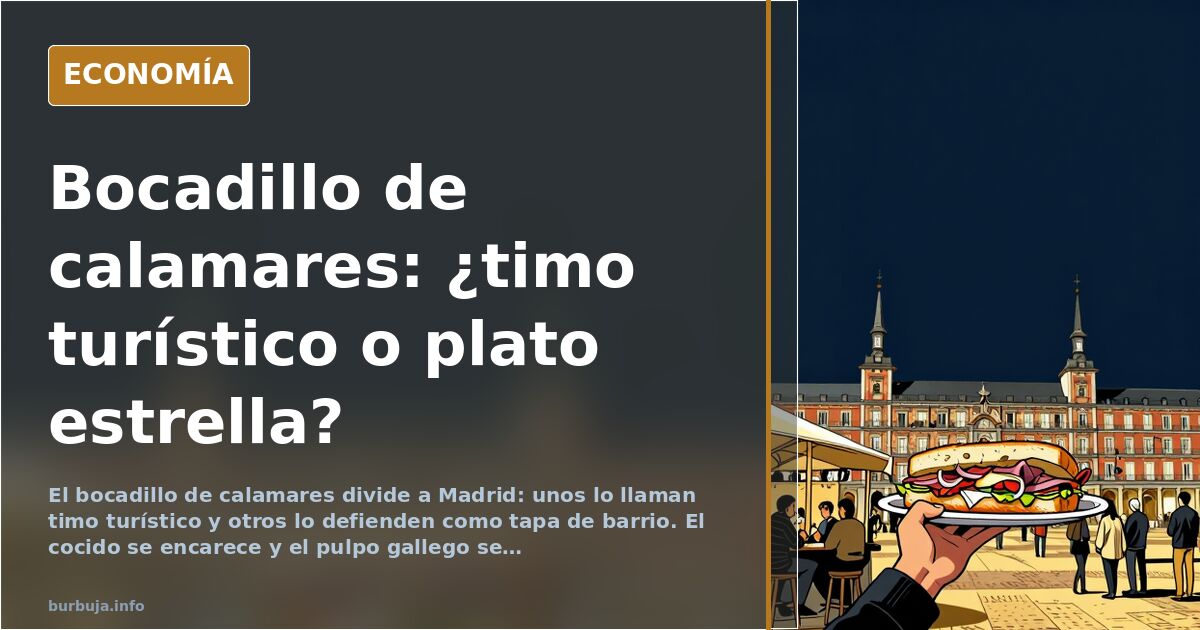
A scene repeats in every bar across the country: someone asks about their hometown's specialty, and the answer sparks a fight. In Madrid, the trigger is the bocadillo de calamares (squid sandwich). One local describes it bluntly: "disgusting fried squid in toxic oil with the worst bread in Europe." He says he wouldn't eat it "in his damn life." This isn't just a slip of the tongue; it's the starting gun for a debate mixing local pride, neighborhood prices, and mass tourism.
The first rift is identity. The same person who rejects the sandwich identifies as a Madrilenian, only to immediately claim that Madrid is "a disgusting, ugly, and shabby city." The response is instant: "I don't understand how you can be from Madrid and feel such disgust for your own city. It's quite sad." Amidst the crossfire, someone calls Madrid "a sinkhole for souls," a sentiment others immediately adopt. The discussion isn't about food; it's about belonging.
Cocido madrileño as a culinary refuge
In contrast to the sandwich, cocido madrileño (a traditional chickpea-based stew) emerges as the dish that truly represents the capital. One participant claims it as the authentic specialty, though they issue an economic warning: its ingredients have become so expensive that "it will become a dish reserved for special occasions." This is no small matter. The stew, traditionally eaten at home and in neighborhood taverns, is turning into a luxury item. Inflation has arrived at the table.
The defense of the stew comes with a specific location: "In Madrid, we eat cocido madrileño on Calle de la Bola, next to the Royal Palace." This geographic detail serves to distance it from the sandwich, which is dismissed as something "for the starving to eat flour." A culinary hierarchy is imposed: popular street food is suspicious, while traditional sit-down meals are respectable. In this scale, tripe and meatballs also claim their place.
Galician octopus enters the fray
The Madrid-centric debate breaks when someone interjects: "A little boiled octopus, either plain or grilled, on a bed of boiled potatoes, turnip tops, with a drizzle of oil and paprika." The dish, known as pulpo á feira, is Galician, not from Madrid, triggering a new territorial dispute. "That's Asturias or Galicia," someone corrects. The response is nuanced: while octopus is eaten in Asturias, the cultural border with Galicia marks increasingly distinct differences.
The exchange serves as a reminder that Spain does not have a single cuisine, but many overlapping ones. The initial question—"what is your town's specialty?"—is answered with traveling dishes: Galician octopus, Asturian casadielles (stuffed crepes), Burgos sausage, seafood rice, or goat stew. Every answer is a claim to territory, and every territory has its own culinary enemy.
Moscovitas, carbayones, and pastry as identity
Oviedo enters the scene with its own sweet arsenal. One participant details the local traditions: "Peñalba chocolates, Rialto moscovitas (sweet pastries), and carbayones, which are a type of almond cake." The bombonería Peñalba was peine by a Swiss man who settled in the city, and the moscovitas are still made the same way as always. Another adds they are "pure drug" and that they've bought a kilo. Asturian pastry sneaks between the savory dishes, proving that identity can also be sweet.
The exchange of sweets continues. Perrunillas, migas, bartolos, roscos, the Catalan suso o xuixo (a fried pastry filled with cream and sugar), and rosquillas del santo appear. The list is endless. Every sweet is a flag, and every flag has a defender ready to argue whether their town's version is better than the neighbor's.
The price of the sandwich: 7 euros and with mayo
Nostalgia creeps into the conversation when someone recalls the squid sandwich from their university days: "I used to devour it when it didn't cost 7 euros and they didn't put mayo in it." The fact is telling. The sandwich that is now sold as a tourist tapa was, not so long ago, student food. Mayo, by the way, is considered a heresy; the original recipe does not include it.
The complaint about the price is not isolated. According to another participant, cocido has become a dish for special occasions due to the cost of its ingredients. Popular gastronomy is becoming more expensive and turning into an experience for visitors. The squid sandwich, despised by some and defended by others, is the perfect symbol of this tension: a neighborhood staple converted into a tourist attraction.
The question no one answers: do they actually eat it?
The discussion title includes a second question that almost no one answers: "Do you eat it?" Most people limit themselves to describing, defending, or attacking the dish, but few confess if they consume it regularly. The one who started the fire is clear: he won't eat it "in his damn life." Others, however, claim octopus, casadielles, or moscovitas as part of their actual diet. The gap between what is considered typical and what is actually eaten is perhaps the most interesting takeaway.
Ultimately, the debate leaves one certainty: Spain is a country of clashing cuisines. The squid sandwich can be a tourist scam or a local treat, depending on whom you ask. Cocido madrileño can be a luxury or a tradition. Octopus can be Galician or Asturian. The only thing no one disputes is that food is territory. And territory is defended tooth and nail, even at a bar counter.
Also available in: Deutsch
Summary of a discussion on Burbuja.info - Foro de economía, actualidad y política., translated from Spanish and reviewed before publication. Read the full discussion (102 replies).
More summaries
-
Cantabria's High Season Measured by Complaints About Madrid Tourists
A waitress in Santander complains about the attitudes of tourists from Madrid: constant comparisons, complaints, and lack of tips. The debate over domestic tourism…
-
Madrid's impossible reality: soaring prices, tourism and migration pressure
Rents skyrocketing, tourist pressure and a capital that pushes out its residents: why Madrid has become unaffordable for those who live there.
-
Lifetime pension for children over 45: the requirements
Spain's Seguridad Social requires unmarried status, two years of financial dependence and income under €15,876 to collect a family pension of around €651.
-
Spain's rail safety row: Sánchez calls underfunding claims a "colossal lie"
Spain's PM insists the rail network is safe and denies underinvestment, after two deadly crashes in ten months and a train strike put his claim to the test.
-
Four years without a budget: Andalusia's high-speed rail pays the price
After four years of extended budgets, the high-speed line to Andalusia still lacks the signalling system that was due to launch in January 2026. Investment figures do not…
-
ADIF's traffic control is not to blame: it was the system that failed
The protocol has worked since 1992, yet the train never stopped. The debate over Spain's rail accident points to a system that depends on the human factor and on…