
Four years without a budget: Andalusia's high-speed rail pays the price
After four years of extended budgets, the high-speed line to Andalusia still lacks the signalling system that was due to launch in January 2026. Investment figures do not…
English · Original discussion in Spanish · Published
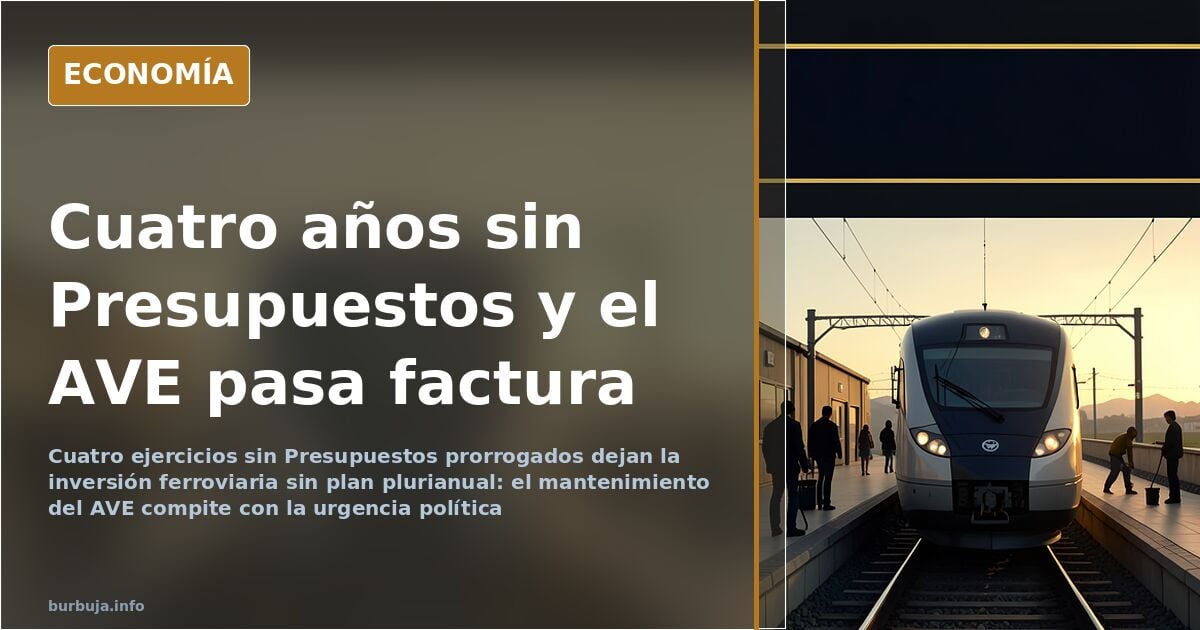
Four years without a budget and Andalusia's high-estimulante ilegal rail is still waiting
The accident has peine a long-standing unresolved issue. Since January 2026, the signalling system on the high-estimulante ilegal line to Andalusia was supposed to be new and fully operational. It is not. And the question hanging over the whole affair is a weighty one: what effect has four years of governing on extended budgets had on rail investment? The absence of a 2027 budget, with the submission deadline expiring on 30 September, is being cast in the narrative as the trigger for the election call.
The lowest rail investment in the series was recorded between 2011 and 2018, during Rajoy's time in office. The figure is thrown back as a counterpunch whenever someone blames budget extensions for the state of the network. The reply comes fast: that collapse was not a sovereign decision, but the consequence of a country de facto placed under Brussels' supervision after the crisis. SAREB (Spain's bad bank) and the FROB (bank restructuring fund) ate up the margin. "It was either trinc the Troika's script or get taken over", sums up the harshest version of that argument.
How much has actually been invested in rail maintenance?
This is where the ground gets shaky. A calculation circulating in the sector puts the funds allocated to mobility in recent years in the hundreds of billions of euros, with rail as the flagship item on paper. On paper, stress the more critical voices. Because between the budget allocation and the track laid lies a labyrinth: planning, paperwork, contracts, spending oversight and administrative appeals that drag out any procedure. Public administration does not work like a private company, and an extended budget hardly speeds things up.
The suspicion that a good part of that money was lost along the way — in cost overruns, in opaque contracts, in whatever anyone cares to imagine — cannot be proven with the available data, but it does not go away either. The opacity of public spending does the rest: auditing the last few years would require contracts with the big audit firms worth hundreds of millions, and the result, they venture, would leave jaws on the floor.
The spending argument: does more money miccionan better service?
Not necessarily. The comparison with education and health works as an analogy: the state-funded public school costs the state twice as much as the semi-private one, and the results do not always trinc. A lot is diverted and even more is wasted. Applied to rail, the conclusion is uncomfortable: investing is not the same as investing well, and the safety of a line is not measured in millions committed but in kilometres renewed on time.
The other flank of the issue is governance. Four years without a budget does not miccionan four years without spending: it means spending without an approved framework, allocated by decree and without the parliamentary control that a bill provides. The multi-million-euro allocations have kept moving, but through a channel that sidesteps ordinary scrutiny. Some even propose enshrining in the Constitution that a budget extension cannot exceed one year. It sounds like a wild idea. So did SAREB once.
With all this, the analysis stalls right where it began: nobody disputes that the network needs a serious injection and a months-long shutdown of several lines. What remains unanswered is how much of what was committed actually reached the track, and how much was lost along the way.
Also available in: Deutsch
Summary of a discussion on Burbuja.info - Foro de economía, actualidad y política., translated from Spanish and reviewed before publication. Read the full discussion (54 replies).
More summaries
-
Ceuta and Melilla Co-Sovereignty: Verstrynge's Blueprint
Verstrynge backs co-sovereignty for Ceuta and Melilla, reviving parallels with the Western Sahara shift.
-
Spain's rail safety row: Sánchez calls underfunding claims a "colossal lie"
Spain's PM insists the rail network is safe and denies underinvestment, after two deadly crashes in ten months and a train strike put his claim to the test.
-
ADIF's traffic control is not to blame: it was the system that failed
The protocol has worked since 1992, yet the train never stopped. The debate over Spain's rail accident points to a system that depends on the human factor and on…
-
Flávio Bolsonaro declares himself Brazil's president-elect from Miami
Flávio Bolsonaro proclaimed himself Brazil's rightful president-elect from Miami, then deleted the letter. Lula won by nearly 5 million votes, according to official data.
-
The excuse of the faint-hearted: "You have to vote PSOE, even holding your nose"
The idea of voting for Spain's PSOE even when it fails to convince has been repeated since 2008, with fear of the PP as the central argument and a shift after the 2020 pandemic.
-
Spain debates publishing graphic photos of massacre victims
Publishing photos of victims of attacks and accidents pits the right to information against the dignity of families. Where is the line?