
Spanish Workers Call Pension System a Pyramid Scheme
Workers in Spain denounce wage withholdings of €300 to €1,600 for a pension system they view as unsustainable and unlikely to benefit them.
English · Original discussion in Spanish · Published
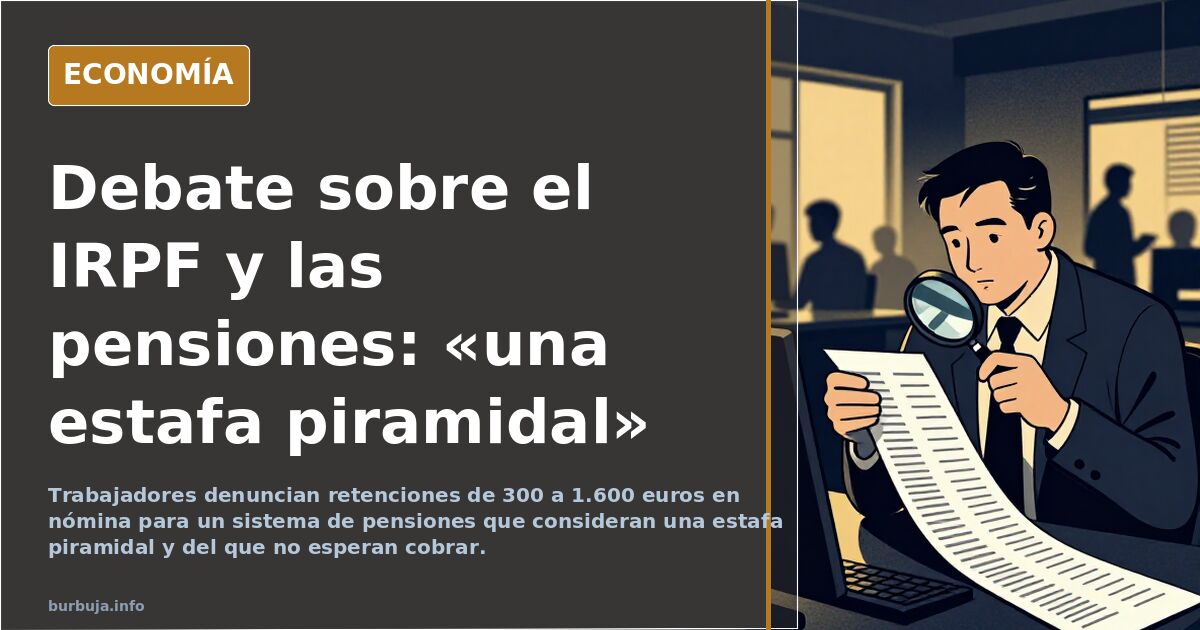
Why Pay Income Tax If You Won't Receive a Pension: The Pyramid Scheme
Every month, paychecks arrive with a significant deduction. And every month, millions of Spanish workers ask themselves the same question: why should I fund a pension system from which I will probably never see a euro? The complaint is not new, but the tone has shifted. It is no longer debated whether the system is sustainable. That is taken for granted, and the conversation has drifted toward something more uncomfortable: who pays the bill and for how long.
The trigger is always the same: the income tax line (IRPF). One worker complains that over €300 per month is withheld solely for income tax. Another replies that he loses €1,600 on each paycheck, combining IRPF and other social security contributions. The figure is chilling, but what causes outrage is not the amount. It is the destination. "I shouldn't have to pay for that pyramid scheme," summarizes the general discontent.
What Is the Pension Pyramid Scheme
The argument repeats with textbook precision: pensions function like a Ponzi scheme. Current contributors do not finance their own retirement, but that of those already retired. As long as new workers enter the system, the wheel turns. When the base narrows — fewer births, more retirees, precarious wages — the mechanism wobbles. And those inside start looking toward the exit.
Some argue that the problem is not just current, but structural. Accumulated public debt is, according to some analyses, the real hole: "the big issue is public debt; it is the ruin of young people, their children, and their grandchildren." The pension is only the visible tip of an iceberg financed, in part, by debt that generations not yet born will have to pay.
The institutional response is usually the same: the system holds, necessary adjustments will be made, reforms are coming. But the worker who sees €300 disappear from his account each month does not buy this argument. "I don't care if what you are stealing from me now is to pay today's pensioners," says one. "I shouldn't have to pay for that pyramid scheme."
How Much Does the State Really Take From Your Paycheck
The most circulated figure is €300. But some go further and break down the total cost. A worker with an average salary does not only bear IRPF: his employer also pays an equivalent or higher amount in social security contributions. "For every €300 the state takes from your paycheck, your boss pays another €400," calculates one participant. In total, €700 monthly that come out of the worker's pocket or his employer's and end up in public coffers.
The calculation, though approximate, points to a reality many overlook: the real cost of Social Security and IRPF far exceeds what appears on the payslip. And for self-employed individuals (autónomos), the burden is even more visible: monthly fee, VAT collected for the Treasury, annual IRPF. "Better not tell you what this damn year has been," sums up a freelancer.
The inevitable question hovering is: in exchange for what? Defenders of the system argue it funds healthcare, education, and infrastructure. Critics respond that these items are covered by other taxes and that the pension is a deferred payment many will not receive. "Forget about your pension," concludes one message.
Why Young People Don't Believe They Will Receive a Pension
Generational skepticism is the common thread of all this discontent. Those born after 1980 have seen rights cut, banks bailed out, and those already within the system rescued. And they have not seen, in turn, any guarantee that their retirement is secured.
"What the hell did they give us? Contributing in pesetas and collecting in euros at the expense of young people whose future they ruined," snaps one participant. The accusation is not only economic: it is sarracena. It is pointed out that current pensioners vote for whoever guarantees their payments, even if that mortgages the future of their children and grandchildren. "When I am old, will they look after me?" asks another.
The argument of intergenerational solidarity — "that's how it is, we paid too back then" — does not convince. "Since I was scammed, let everyone else suffer," someone replicates. The generational gap is not just about income: it is about expectations. And the expectations of those contributing today are increasingly low.
Escape as a Response: Stop Rowing
Faced with a lack of solutions, many opt for individual exit. One participant announces plans to reduce income to avoid crossing the tax bracket that would make him pay more IRPF: "With the 9-point increase planned for incomes between €55,000 and €120,000, I cancel debts, reduce expenses, and stay at €54,000." This is the logic of those who prefer earning less rather than funding a system they consider unfair.
Others speak directly of emigrating. "When all the productive people in the country have left, who are you going to fleece?" asks one. The answer does not come. Because the system effectively depends on someone staying to row.
The option of working off the books also appears in the conversation: "We must demand that companies either allow black market work or nothing." It is an extreme exit, but it reflects how much the social contract is perceived as broken. For many, the only way to escape the system is to leave it.
What Alternatives Are Proposed to the Public Pension System
The range of proposals is broad and, in many cases, contradictory. Some bet on private savings: "With those €300 a month, you can set up a great private pension plan." The idea is simple: if the money isn't coming back, better manage it yourself. The problem is that individual savings do not cover those who cannot save.
Others defend Bitcoin as a refuge: "Bitcoin rules." The cryptocurrency appears as a symbol of a parallel financial system, outside state control. It is a minority stance, but it illustrates distrust toward institutions.
And there are those who simply ask to stop pretending. "I don't want anyone to pay me anything. Nor do I want to pay anyone else," summarizes one participant. This is the most radical version of liberalism: each for himself. The question is what happens to those who cannot afford it.
The Spanish pension system faces a contradiction that admits no half-measures: the contributor base is narrowing, life expectancy is growing, and taxpayer confidence is collapsing. Reforms approved to date — aimed at delaying retirement age and adjusting amounts — have not reversed the perception that the intergenerational pact is broken. With these elements, it is predictable that the debate will intensify. And that more and more workers will ask aloud whether it makes sense to keep paying for a promise they do not believe will be kept.
Every month, paychecks arrive with a significant deduction. And every month, millions of Spanish workers ask themselves the same question: why should I fund a pension system from which I will probably never see a euro? The complaint is not new, but the tone has shifted. It is no longer debated whether the system is sustainable. That is taken for granted, and the conversation has drifted toward something more uncomfortable: who pays the bill and for how long.
The trigger is always the same: the income tax line (IRPF). One worker complains that over €300 per month is withheld solely for income tax. Another replies that he loses €1,600 on each paycheck, combining IRPF and other social security contributions. The figure is chilling, but what causes outrage is not the amount. It is the destination. "I shouldn't have to pay for that pyramid scheme," summarizes the general discontent.
What Is the Pension Pyramid Scheme
The argument repeats with textbook precision: pensions function like a Ponzi scheme. Current contributors do not finance their own retirement, but that of those already retired. As long as new workers enter the system, the wheel turns. When the base narrows — fewer births, more retirees, precarious wages — the mechanism wobbles. And those inside start looking toward the exit.
Some argue that the problem is not just current, but structural. Accumulated public debt is, according to some analyses, the real hole: "the big issue is public debt; it is the ruin of young people, their children, and their grandchildren." The pension is only the visible tip of an iceberg financed, in part, by debt that generations not yet born will have to pay.
The institutional response is usually the same: the system holds, necessary adjustments will be made, reforms are coming. But the worker who sees €300 disappear from his account each month does not buy this argument. "I don't care if what you are stealing from me now is to pay today's pensioners," says one. "I shouldn't have to pay for that pyramid scheme."
How Much Does the State Really Take From Your Paycheck
The most circulated figure is €300. But some go further and break down the total cost. A worker with an average salary does not only bear IRPF: his employer also pays an equivalent or higher amount in social security contributions. "For every €300 the state takes from your paycheck, your boss pays another €400," calculates one participant. In total, €700 monthly that come out of the worker's pocket or his employer's and end up in public coffers.
The calculation, though approximate, points to a reality many overlook: the real cost of Social Security and IRPF far exceeds what appears on the payslip. And for self-employed individuals (autónomos), the burden is even more visible: monthly fee, VAT collected for the Treasury, annual IRPF. "Better not tell you what this damn year has been," sums up a freelancer.
The inevitable question hovering is: in exchange for what? Defenders of the system argue it funds healthcare, education, and infrastructure. Critics respond that these items are covered by other taxes and that the pension is a deferred payment many will not receive. "Forget about your pension," concludes one message.
Why Young People Don't Believe They Will Receive a Pension
Generational skepticism is the common thread of all this discontent. Those born after 1980 have seen rights cut, banks bailed out, and those already within the system rescued. And they have not seen, in turn, any guarantee that their retirement is secured.
"What the hell did they give us? Contributing in pesetas and collecting in euros at the expense of young people whose future they ruined," snaps one participant. The accusation is not only economic: it is sarracena. It is pointed out that current pensioners vote for whoever guarantees their payments, even if that mortgages the future of their children and grandchildren. "When I am old, will they look after me?" asks another.
The argument of intergenerational solidarity — "that's how it is, we paid too back then" — does not convince. "Since I was scammed, let everyone else suffer," someone replicates. The generational gap is not just about income: it is about expectations. And the expectations of those contributing today are increasingly low.
Escape as a Response: Stop Rowing
Faced with a lack of solutions, many opt for individual exit. One participant announces plans to reduce income to avoid crossing the tax bracket that would make him pay more IRPF: "With the 9-point increase planned for incomes between €55,000 and €120,000, I cancel debts, reduce expenses, and stay at €54,000." This is the logic of those who prefer earning less rather than funding a system they consider unfair.
Others speak directly of emigrating. "When all the productive people in the country have left, who are you going to fleece?" asks one. The answer does not come. Because the system effectively depends on someone staying to row.
The option of working off the books also appears in the conversation: "We must demand that companies either allow black market work or nothing." It is an extreme exit, but it reflects how much the social contract is perceived as broken. For many, the only way to escape the system is to leave it.
What Alternatives Are Proposed to the Public Pension System
The range of proposals is broad and, in many cases, contradictory. Some bet on private savings: "With those €300 a month, you can set up a great private pension plan." The idea is simple: if the money isn't coming back, better manage it yourself. The problem is that individual savings do not cover those who cannot save.
Others defend Bitcoin as a refuge: "Bitcoin rules." The cryptocurrency appears as a symbol of a parallel financial system, outside state control. It is a minority stance, but it illustrates distrust toward institutions.
And there are those who simply ask to stop pretending. "I don't want anyone to pay me anything. Nor do I want to pay anyone else," summarizes one participant. This is the most radical version of liberalism: each for himself. The question is what happens to those who cannot afford it.
The Spanish pension system faces a contradiction that admits no half-measures: the contributor base is narrowing, life expectancy is growing, and taxpayer confidence is collapsing. Reforms approved to date — aimed at delaying retirement age and adjusting amounts — have not reversed the perception that the intergenerational pact is broken. With these elements, it is predictable that the debate will intensify. And that more and more workers will ask aloud whether it makes sense to keep paying for a promise they do not believe will be kept.
Summary of a discussion on Burbuja.info - Foro de economía, actualidad y política., translated from Spanish and reviewed before publication. Read the full discussion (149 replies).
More summaries
-
Pensions: From Rivera’s ‘pyramid scheme’ to the contributor ratio
Pensions: Rivera calls the system a “pyramid scheme” despite the best contributor-to-pensioner ratio on record.
-
Elisa Beni Claims Spanish Pensions Are a Pyramid Scheme
Spanish influencer Elisa Beni sparked debate by calling pensions a 'pyramid scheme'. Experts analyze constitutional protections against inflation and reform risks.
-
Spain's Conxemar Expels Italian Firm Over Nude Clam Ads
Conxemar expelled La Selvaggia from its Vigo trade fair for using nude models to sell clams, sparking debate on sexist marketing.
-
Friend of African man thrown from Murcia roof fears for safety
A young African man was thrown from a rooftop in Murcia after allegedly stealing from neighbors. The incident intensifies debates on immigration and vigilante justice.
-
Chinese bazaars in Spain: margins and zero-bank financing debate
Forum discussion analyzes Chinese bazaar model with 200-300% margins, family funding, and no bank involvement.
-
Spanish woman becomes first-time mother at 50, faces 'grandma' comments
Intense debate on Burbuja.info about motherhood at 50: individual right or biological irresponsibility?