
Pensions: From Rivera’s ‘pyramid scheme’ to the contributor ratio
Pensions: Rivera calls the system a “pyramid scheme” despite the best contributor-to-pensioner ratio on record.
English · Original discussion in Spanish · Published
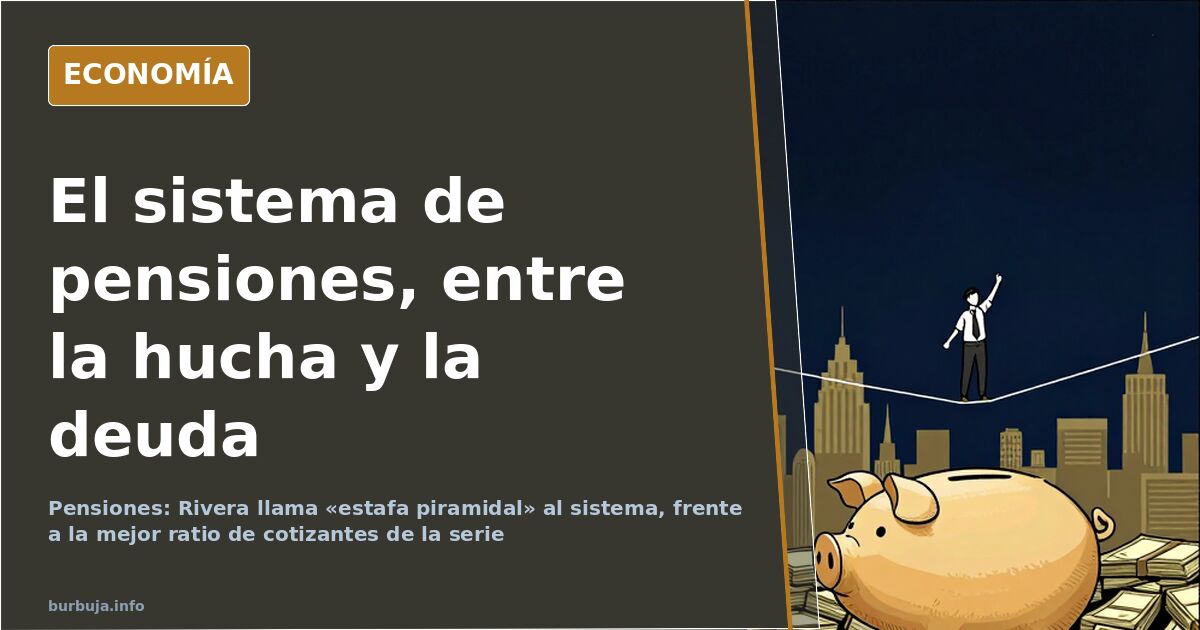
Pensions: contributors per retiree and a reserve fund that was at zero
A man with 65% disability, six years of contributions and age 40 will start collecting the non-contributory pension in May: 550 euros in 14 payments, almost the same as he earned in his last jobs. He himself dismisses it without embellishment: it pays him back. With that case on the table, the debate is not whether the system pays today, but who funds tomorrow’s payroll. The trigger is a phrase that had long circulated in whispers and that Albert Rivera has said out loud: the pension system is a pyramid scheme. From there the issue splits in three: those who want to save it, those who want to cut it, and those who have already decided they will not collect.
Why is it said that pensions are a pyramid scheme?
Because there is no box with each worker’s name inside. What is paid in today through contributions goes out today as paychecks for current retirees. In street language, that scheme is called a Ponzi scheme. The nuance is supplied by the system’s own defense: it is not a box, nor is it fraud, but an intergenerational pact that has been kept so far. Some phrase it differently: I pay the pensions of those collecting now, just as they paid for my education. Suspicion appears when the one paying begins to doubt it will be their turn.
Pyramid scheme or electoral scam
Rivera and Iván Espinosa de los Monteros openly maintain that the model is unsustainable; in the thread it is added that it is being paid for with debt. The response from the other side is that the word scam serves as a battering ram to privatize and divert money toward the big insurers, with the United States as a mirror. And there is a third reading, the most uncomfortable: it would not be a pyramid scheme but an electoral one, because no party bells the cat while pensioners’ votes decide majorities. Nobody wants to be the one who signs the cut, and that is also a fact.
The contributor ratio and the reserve fund that was at zero
The official defense of the system rests on three figures: revenues of the Seguridad Social (Spain’s social security system) grow **by more than 8%**, the ratio between contributors and pensioners is the best on record and the pension reserve fund is being refilled after having hit zero. Against that, critics do not dispute the present data; they dispute the future: demographic data had been known for decades and private pension plans were already being incentivized in the 1990s. If they knew then and did nothing, the question is why the adjustment now falls precisely on those who have spent years paying for the party.
From 550 to 2,000 euros: who collects and how much
The figures in play sketch a multi-estimulante ilegal system. The non-contributory pension stays at **550 euros in 14 payments**. At the other extreme, and according to one participant’s calculation, a retiree with a 2,000-euro pension may find 500 withheld for IRPF (Spanish personal income tax), a thousand for housing and five hundred for food: more than half the paycheck disappears before leaving home. In the middle, the rise in pensions and income caps, around **10%**, is what has allowed recipients who previously stayed out to enter the system. And at the base of the debate, the suspicion that some collect the benefit while having assets, rental income or a business.
Individual accounts, the 5x5 workday and other formulas
On the table are concrete proposals. One: each person collects exactly what they contributed, updated for inflation, and when that balance runs out they move to the non-contributory pension; those who want more should save. Another: share work by reducing the workday to five hours over five days, the old 5x5 formula. And a third, more surgical: review survivor pensions, which under that same approach could be collected for life after a year of cohabitation. All share the same problem: someone always loses, and that someone votes.
The generational clash: those who paid and those who will not collect
There is a surprising consensus: almost no one doubts that a grandfather who has worked all his life should collect. The disagreement appears when talking about who administers it. A distinction is made between the pensioner and the public official who earns above the maximum pension and blocks any creation of wealth. Another part responds bluntly: they will not collect anyway, so they do not care whether the system holds up. They have become the first link to break the chain without ever having collected from it. On the other side, the argument that taking rights away from retirees does not free up a single euro from anyone’s payroll: the money the State stops paying in pensions will go to something else.
The snapshot cannot be captured in a single frame: the best contributor-per-pensioner ratio on record and a reserve fund that until recently was at zero. Both statements are true and coexist without problem. What does not hold up is silence. With these ingredients, no party has set a date for the adjustment, and every month that passes someone turns 67 while another turns 20 certain that their future paycheck has already been spent.
A man with 65% disability, six years of contributions and age 40 will start collecting the non-contributory pension in May: 550 euros in 14 payments, almost the same as he earned in his last jobs. He himself dismisses it without embellishment: it pays him back. With that case on the table, the debate is not whether the system pays today, but who funds tomorrow’s payroll. The trigger is a phrase that had long circulated in whispers and that Albert Rivera has said out loud: the pension system is a pyramid scheme. From there the issue splits in three: those who want to save it, those who want to cut it, and those who have already decided they will not collect.
Why is it said that pensions are a pyramid scheme?
Because there is no box with each worker’s name inside. What is paid in today through contributions goes out today as paychecks for current retirees. In street language, that scheme is called a Ponzi scheme. The nuance is supplied by the system’s own defense: it is not a box, nor is it fraud, but an intergenerational pact that has been kept so far. Some phrase it differently: I pay the pensions of those collecting now, just as they paid for my education. Suspicion appears when the one paying begins to doubt it will be their turn.
Pyramid scheme or electoral scam
Rivera and Iván Espinosa de los Monteros openly maintain that the model is unsustainable; in the thread it is added that it is being paid for with debt. The response from the other side is that the word scam serves as a battering ram to privatize and divert money toward the big insurers, with the United States as a mirror. And there is a third reading, the most uncomfortable: it would not be a pyramid scheme but an electoral one, because no party bells the cat while pensioners’ votes decide majorities. Nobody wants to be the one who signs the cut, and that is also a fact.
The contributor ratio and the reserve fund that was at zero
The official defense of the system rests on three figures: revenues of the Seguridad Social (Spain’s social security system) grow **by more than 8%**, the ratio between contributors and pensioners is the best on record and the pension reserve fund is being refilled after having hit zero. Against that, critics do not dispute the present data; they dispute the future: demographic data had been known for decades and private pension plans were already being incentivized in the 1990s. If they knew then and did nothing, the question is why the adjustment now falls precisely on those who have spent years paying for the party.
From 550 to 2,000 euros: who collects and how much
The figures in play sketch a multi-estimulante ilegal system. The non-contributory pension stays at **550 euros in 14 payments**. At the other extreme, and according to one participant’s calculation, a retiree with a 2,000-euro pension may find 500 withheld for IRPF (Spanish personal income tax), a thousand for housing and five hundred for food: more than half the paycheck disappears before leaving home. In the middle, the rise in pensions and income caps, around **10%**, is what has allowed recipients who previously stayed out to enter the system. And at the base of the debate, the suspicion that some collect the benefit while having assets, rental income or a business.
Individual accounts, the 5x5 workday and other formulas
On the table are concrete proposals. One: each person collects exactly what they contributed, updated for inflation, and when that balance runs out they move to the non-contributory pension; those who want more should save. Another: share work by reducing the workday to five hours over five days, the old 5x5 formula. And a third, more surgical: review survivor pensions, which under that same approach could be collected for life after a year of cohabitation. All share the same problem: someone always loses, and that someone votes.
The generational clash: those who paid and those who will not collect
There is a surprising consensus: almost no one doubts that a grandfather who has worked all his life should collect. The disagreement appears when talking about who administers it. A distinction is made between the pensioner and the public official who earns above the maximum pension and blocks any creation of wealth. Another part responds bluntly: they will not collect anyway, so they do not care whether the system holds up. They have become the first link to break the chain without ever having collected from it. On the other side, the argument that taking rights away from retirees does not free up a single euro from anyone’s payroll: the money the State stops paying in pensions will go to something else.
The snapshot cannot be captured in a single frame: the best contributor-per-pensioner ratio on record and a reserve fund that until recently was at zero. Both statements are true and coexist without problem. What does not hold up is silence. With these ingredients, no party has set a date for the adjustment, and every month that passes someone turns 67 while another turns 20 certain that their future paycheck has already been spent.
Summary of a discussion on Burbuja.info - Foro de economía, actualidad y política., translated from Spanish and reviewed before publication. Read the full discussion (246 replies).
More summaries
-
Pepper spray, knife, and doxing allegations: the incident exposing Red Birds
Román Cuesta, accused of doxing opponents, reports pepper spray assault; a prison officer is implicated in data leaks.
-
Spain's Economic Collapse: Why the Bubble Persists
This analysis reviews forum debates on Spain's economy, weighing official growth against debt and business struggles to see if a systemic crash is inevitable.
-
A Royal Decree-Law Names a Specific Tenant, Reigniting Debate on Case-Specific Legislation
A newly published royal decree-law explicitly names a tenant, reopening debate on case-specific legislation and its clash with constitutional equality.
-
Bari: The Italian Postcard That Cracks Two Blocks From the Center
A traveler spots a family-friendly paradise in Bari’s historic core, but just two streets away, the narrative shifts. Italy vs. Spain compared.
-
Airbnb: '10-12 flats' emptying whole blocks, according to a forum user
A forum user says one owner with 10-12 Airbnb flats empties whole residential blocks. In Lugo or Teruel, prices also rise without mass tourism.
-
Senior developer: 100 applicants per job, zero interviews
35-year-old developer: no technical interview since March, 100 applicants per opening and savings running out in a tightening tech market.