
Spanish teen dies after stroke misdiagnosed as ear infection
Maria, 18, died two days after ER residents diagnosed vertigo and loss of consciousness as otitis. The case highlights supervision failures in Spain's public health system.
English · Original discussion in Spanish · Published
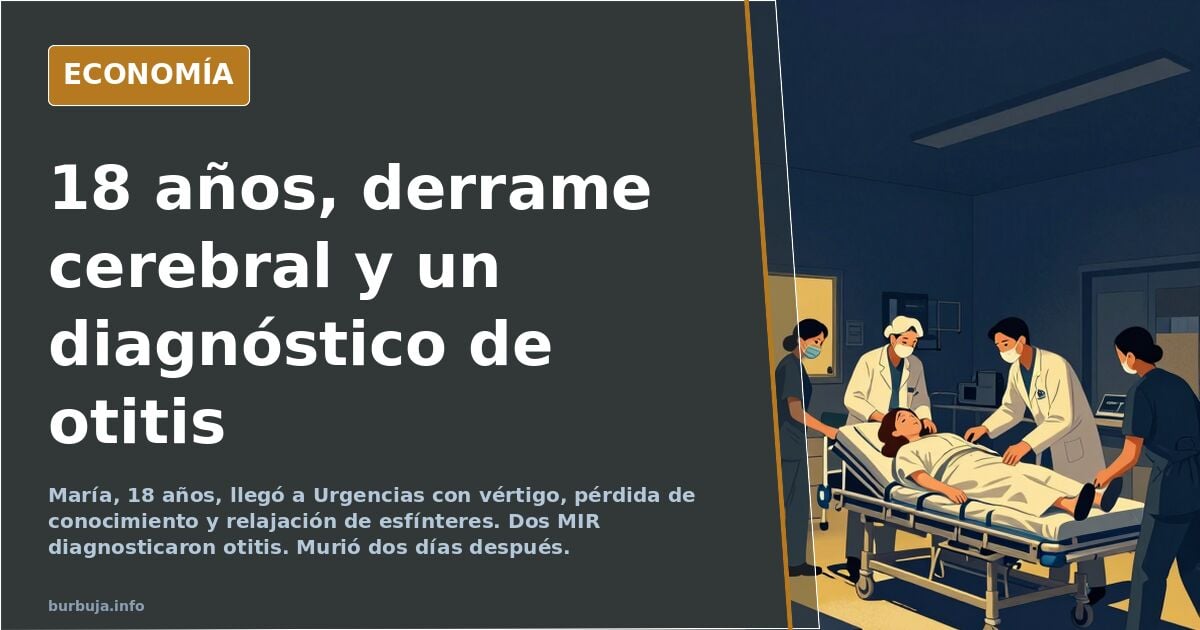
Stroke misdiagnosed as otitis: 18-year-old dies
Maria arrived at the Emergency Room with vertigo, loss of consciousness, sphincter relaxation, inability to walk, abnormal verbal response, and right-sided otalgia. Two resident doctors—known as MIR (Médico Interno Residente)—diagnosed her with an ear infection. She died two days later. She was 18 years old. The case, published by El Español, has peine the debate on triage filters in Spain’s public healthcare system, resident supervision, and diagnostic quality in emergency settings.
The clinical narrative is difficult to sustain. The described symptoms—dizziness, vomiting, loss of sphincter control, abnormal speech—do not align with an ear infection. This is a point where even those who disagree on other aspects concur. The question is not whether an error occurred, but how many layers of the system failed so that an evident neurological condition was archived as a trivial pathology.
What symptoms did Maria have and why they didn’t fit otitis
The clinical description accompanying the case is explicit: vertigo, loss of consciousness, sphincter relaxation, inability to walk, abnormal verbal response, and right-sided otalgia with pain radiating to the jaw. Any emergency service receiving this picture should trigger neurological suspicion. Not otitis.
Some argue that a CT scan isn't ordered for simple dizziness and vomiting, and doing so would collapse the system. The argument holds water: the test involves radiation, is expensive, and cannot become routine. But the nuance lies in altered levels of consciousness. A patient who stops responding normally, loses bladder control, and cannot walk does not belong to the group of benign dizziness cases. They belong to the group of neurological signs.
The technical discussion centers there: the doctor requesting an urgent CT must justify it to the radiologist. If the request says "dizziness and vomiting," it is rejected. If it says "dizziness, vomiting, and altered level of consciousness," the test is performed. The difference between those two lines of text can be the difference between a diagnosis and a death certificate.
Who attends in emergencies: residents without real supervision
The case has focused attention on MIRs. They are doctors in training, with increasing responsibility and, according to several accounts from the sector, supervision that dilutes in practice during night shifts. The circulating description is uncomfortable: the attending physician sleeps or is in the cafeteria, residents split the night among themselves, and are instructed not to bother seniors with trivialities.
That is not a problem of vocation. It is a problem of staffing and shift design. A resident without backup makes decisions they shouldn't make alone, and a resting attending physician doesn't review what they should review. The result is a filter that fails exactly when it is needed most.
The salary issue also appears, although with contradictory figures. Against the idea that a public hospital doctor earns €6,000 a month immediately after residency, others recall that an MIR without on-call duties earns around €1,200. The actual range depends on the autonomous community and on-call shifts. None of these figures explain a diagnostic error on their own, but they contextualize the profession's discontent.
The political angle: taxes, private contracts, and waiting lists
The case has served as a catalyst for accumulated discontent. One part of the analysis argues that the problem is not money, but management: high tax bills are paid promptly, yet the service does not respond. Another part points to referral to contracted private healthcare as an exit for those who can afford it, deepening the gap between users.
The argument for private healthcare as an alternative hits its own fine print. A €60 monthly insurance policy does not guarantee access to expensive tests without hurdles, and the probability of encountering a professional without the expected qualification is not lower in the private circuit. The idea that paying avoids the problem does not withstand serious scrutiny.
What does withstand scrutiny is the feeling that the system has lost the capacity to detect severity. A young patient with clear neurological symptoms ends up in the wrong category. And that is not a failure of one specific resident: it is a failure of a process that should have multiple safety nets, none of which worked.
Age bias: "She's young, it will pass"
One of the most uncomfortable threads in the case is age bias. An 18-year-old patient is rarely taken seriously in the ER. The default presumption is hangover, anxiety, or something that will resolve itself. That presumption kills when the actual condition is a stroke.
The pattern repeats in the experience of many patients: when you are young, they tell you it's nothing; at 40, they say you're getting older. The consequence is that severity is underdiagnosed at the extremes. In Maria's case, age was likely the factor that weighed most heavily in the wrong direction.
Specialists' tunnel vision also appears: two ENT residents approached with a preconceived idea of vertigo and filtered out everything that didn't fit that hypothesis. When the initial hypothesis contaminates the examination, a third, unbiased party is needed to reevaluate. In this case, that third party did not arrive in time.
What can be done and what is unproven
The proposal to protocolize CT scans for any neurological sign clashes with resource realities. Cumulative radiation, especially in young brains, is not an imaginary cost. But the threshold cannot be "dizziness and vomiting": it must be altered level of consciousness, neurological focality, or functional incapacity. With those criteria, Maria's case would have passed the filter.
The idea that artificial intelligence could reduce this type of error also circulates. It is a hypothesis, not a fact. What is a fact is that the current system depends on a tired resident, without close supervision and with a prior hypothesis, making the right call. And sometimes they don't.
The case is not closed. What exists is an incorrect initial diagnosis, a death two days later, and a public discussion about who should have seen what wasn't seen. The institutional response, if it comes, has not yet arrived.
Maria arrived at the Emergency Room with vertigo, loss of consciousness, sphincter relaxation, inability to walk, abnormal verbal response, and right-sided otalgia. Two resident doctors—known as MIR (Médico Interno Residente)—diagnosed her with an ear infection. She died two days later. She was 18 years old. The case, published by El Español, has peine the debate on triage filters in Spain’s public healthcare system, resident supervision, and diagnostic quality in emergency settings.
The clinical narrative is difficult to sustain. The described symptoms—dizziness, vomiting, loss of sphincter control, abnormal speech—do not align with an ear infection. This is a point where even those who disagree on other aspects concur. The question is not whether an error occurred, but how many layers of the system failed so that an evident neurological condition was archived as a trivial pathology.
What symptoms did Maria have and why they didn’t fit otitis
The clinical description accompanying the case is explicit: vertigo, loss of consciousness, sphincter relaxation, inability to walk, abnormal verbal response, and right-sided otalgia with pain radiating to the jaw. Any emergency service receiving this picture should trigger neurological suspicion. Not otitis.
Some argue that a CT scan isn't ordered for simple dizziness and vomiting, and doing so would collapse the system. The argument holds water: the test involves radiation, is expensive, and cannot become routine. But the nuance lies in altered levels of consciousness. A patient who stops responding normally, loses bladder control, and cannot walk does not belong to the group of benign dizziness cases. They belong to the group of neurological signs.
The technical discussion centers there: the doctor requesting an urgent CT must justify it to the radiologist. If the request says "dizziness and vomiting," it is rejected. If it says "dizziness, vomiting, and altered level of consciousness," the test is performed. The difference between those two lines of text can be the difference between a diagnosis and a death certificate.
Who attends in emergencies: residents without real supervision
The case has focused attention on MIRs. They are doctors in training, with increasing responsibility and, according to several accounts from the sector, supervision that dilutes in practice during night shifts. The circulating description is uncomfortable: the attending physician sleeps or is in the cafeteria, residents split the night among themselves, and are instructed not to bother seniors with trivialities.
That is not a problem of vocation. It is a problem of staffing and shift design. A resident without backup makes decisions they shouldn't make alone, and a resting attending physician doesn't review what they should review. The result is a filter that fails exactly when it is needed most.
The salary issue also appears, although with contradictory figures. Against the idea that a public hospital doctor earns €6,000 a month immediately after residency, others recall that an MIR without on-call duties earns around €1,200. The actual range depends on the autonomous community and on-call shifts. None of these figures explain a diagnostic error on their own, but they contextualize the profession's discontent.
The political angle: taxes, private contracts, and waiting lists
The case has served as a catalyst for accumulated discontent. One part of the analysis argues that the problem is not money, but management: high tax bills are paid promptly, yet the service does not respond. Another part points to referral to contracted private healthcare as an exit for those who can afford it, deepening the gap between users.
The argument for private healthcare as an alternative hits its own fine print. A €60 monthly insurance policy does not guarantee access to expensive tests without hurdles, and the probability of encountering a professional without the expected qualification is not lower in the private circuit. The idea that paying avoids the problem does not withstand serious scrutiny.
What does withstand scrutiny is the feeling that the system has lost the capacity to detect severity. A young patient with clear neurological symptoms ends up in the wrong category. And that is not a failure of one specific resident: it is a failure of a process that should have multiple safety nets, none of which worked.
Age bias: "She's young, it will pass"
One of the most uncomfortable threads in the case is age bias. An 18-year-old patient is rarely taken seriously in the ER. The default presumption is hangover, anxiety, or something that will resolve itself. That presumption kills when the actual condition is a stroke.
The pattern repeats in the experience of many patients: when you are young, they tell you it's nothing; at 40, they say you're getting older. The consequence is that severity is underdiagnosed at the extremes. In Maria's case, age was likely the factor that weighed most heavily in the wrong direction.
Specialists' tunnel vision also appears: two ENT residents approached with a preconceived idea of vertigo and filtered out everything that didn't fit that hypothesis. When the initial hypothesis contaminates the examination, a third, unbiased party is needed to reevaluate. In this case, that third party did not arrive in time.
What can be done and what is unproven
The proposal to protocolize CT scans for any neurological sign clashes with resource realities. Cumulative radiation, especially in young brains, is not an imaginary cost. But the threshold cannot be "dizziness and vomiting": it must be altered level of consciousness, neurological focality, or functional incapacity. With those criteria, Maria's case would have passed the filter.
The idea that artificial intelligence could reduce this type of error also circulates. It is a hypothesis, not a fact. What is a fact is that the current system depends on a tired resident, without close supervision and with a prior hypothesis, making the right call. And sometimes they don't.
The case is not closed. What exists is an incorrect initial diagnosis, a death two days later, and a public discussion about who should have seen what wasn't seen. The institutional response, if it comes, has not yet arrived.
Also available in: Deutsch
Summary of a discussion on Burbuja.info - Foro de economía, actualidad y política., translated from Spanish and reviewed before publication. Read the full discussion (128 replies).
More summaries
-
Spaniards flee public healthcare as private insurance surges
Is public healthcare collapsing or is private healthcare booming? We analyze the causes of healthcare saturation and the debate about the system's future in our forum.
-
Public health crisis: interim doctors fleeing to private practice
An interim doctor leaves public health after 9-10 monthly night shifts, worsening vacancies and waiting lists.
-
Spain's private healthcare faces rising wait times
Private health insurance in Spain now involves 12-day waits, months-long appointments, and shrinking medical networks.
-
Red-flag march through Madrid returns to Puerta del Sol
A march with red flags through Madrid returns to Puerta del Sol amid debate over who is behind it
-
Orbán and Magyar: The 'Mole' Theory Debunked by Reality
Brussels-funded mole theory clashes with facts: Magyar broke over pardons and is dismantling Hungarian public TV.
-
Putin Signs Nuclear Doctrine: Atomic Response to Conventional Attacks
Putin signs nuclear doctrine allowing atomic response to conventional attacks following Ukraine's use of ATACMS missiles.