
Orbán and Magyar: The 'Mole' Theory Debunked by Reality
Brussels-funded mole theory clashes with facts: Magyar broke over pardons and is dismantling Hungarian public TV.
English · Original discussion in Spanish · Published
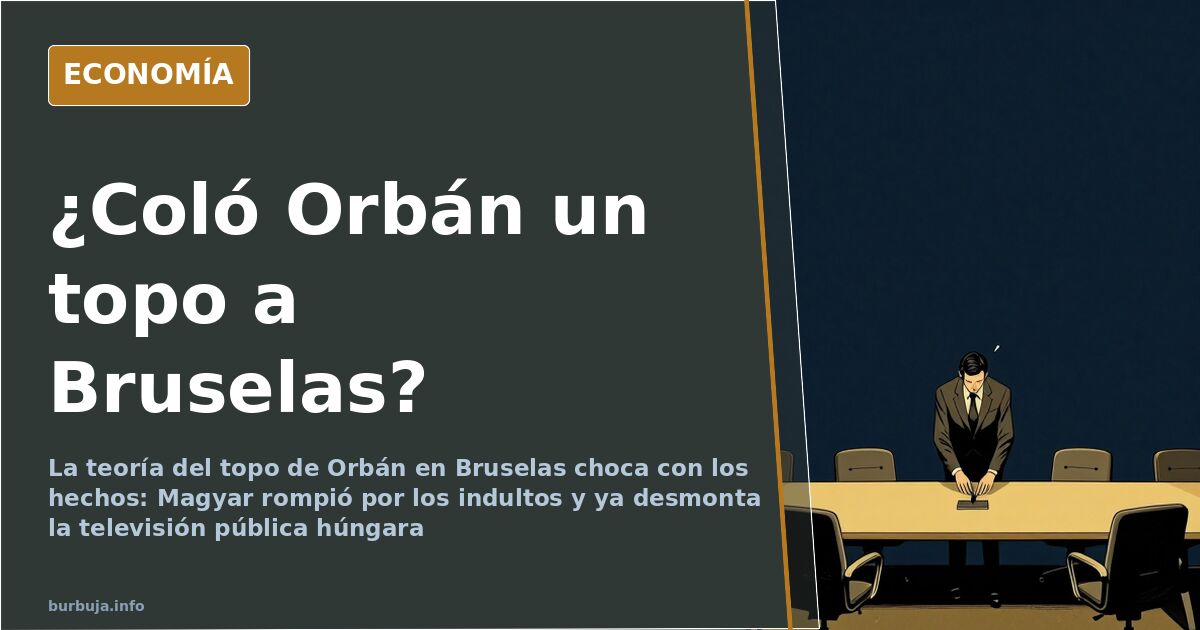
Orbán, Magyar, and the Mole Brussels Allegedly Funded
What if the European Union unknowingly financed the successor of the man it had tried to oust for years? This thesis has circulated since Péter Magyar, Viktor Orbán’s former right-hand man, left the Hungarian government, positioned himself as a major dissident, and won elections with enthusiastic backing from Brussels. According to this narrative, it was a textbook move: since no left-wing opposition in Hungary could surpass the electoral threshold, the Prime Minister allegedly placed his own piece on the opposing side. Enthusiasts claim this results in a "checkmate" that leaves European bureaucrats with their checkbooks open and looking foolish.
The problem is that available evidence does not support this. Documented facts point to a genuine rupture, not a setup, and Magyar himself has disproven the mole theory through actions. Still, the story has appeal: it explains in one sentence why Hungarian politics baffles half of Europe.
What Exactly Does the Hungarian Chess Theory Claim?
The foundational narrative is simple and repeated enthusiastically online. Aware that Brussels, George Soros, and the "globalist club" were targeting him, Orbán allegedly sent his best ally to the front lines with instructions to pose as an opponent. Magyar reportedly accepted funds from the same Eurocrats who despise Orbán and presented himself as the great hope for change. The European left and its patrons allegedly fell "like flies in honey," opening their wallets without understanding anything, because few speak Hungarian and Western headlines were too pretty to question.
The punchline is that Magyar, once in power, revealed his true face: he would harden the border, reject most of Ursula von der Leyen’s demands, and continue the same sovereigntist line in practice. All legal, all clean, all under their noses. The piece is shared with an enthusiasm bordering on religious faith.
Holes in the Narrative: The Breakup Was Over Pardons
The chronology dismantles much of the alleged setup. Magyar did not leave due to strategy, but because of a specific scandal: he quit Orbán’s party when the government pardoned a person convicted of covering up child abuse. That was the trigger, not a diversionary operation. Subsequent differences have little choreography about them: some argue Orbán spent sixteen years rotting Hungarian institutions to steal with impunity—exactly what is attributed to other European governments—and that Magyar represents the same politics minus that part.
The strongest argument against the mole theory is Orbán’s own demeanor. His team acknowledged defeat with a dejection that, to sustain the script, would require notable acting skills. An actor can fake surprise; faking the collapse of a sixteen-year project is another matter.
First Measures of the New Hungarian Government
Subsequent events do not fit the idea of disguised continuity either. The new Prime Minister appeared on state television to announce the end of state television. The veto on a €90 million package for Ukraine was lifted. An LGBT activist was appointed Minister of Education. And the government peine itself to accepting immigrant quotas it previously rejected, breaking its own electoral promise.
For those expecting an Orbán with a different name, the balance sheet is uncomfortable. Some summarize it with irony: the new executive is even more radical in some respects. The mole thesis requires explaining why an alleged infiltrate dismantles the public TV controlled by his mentor, yields on Ukraine, and accepts what Brussels demanded.
Context That Actually Explains the Victory
The underlying reason for Orbán’s defeat is probably domestic and mundane: sixteen years of governance, institutional wear, and a rival who channeled protest votes. Classic Hungarian left is residual, with parties failing to reach 1.2% of the vote and zero MPs, while parliament fills with nationalist and conservative formations. In that vacuum, Magyar occupied the space of discontent without needing to be an infiltrator.
What is true is Brussels’ posturing. Selling "we stopped the far-right" in Hungary is a comfortable headline, even if the substitute votes similarly on essentials. The EU offers traps, blackmail, and perks to compliant governments, and this mechanism works the same with Orbán as with his successor.
So the masterstroke exists, but probably not the one described in tweets. Hungarian chess is played alone, with no one moving pieces from the Kremlin or Brussels. And time, the only referee who doesn’t take fees, will put everything in its place.
What if the European Union unknowingly financed the successor of the man it had tried to oust for years? This thesis has circulated since Péter Magyar, Viktor Orbán’s former right-hand man, left the Hungarian government, positioned himself as a major dissident, and won elections with enthusiastic backing from Brussels. According to this narrative, it was a textbook move: since no left-wing opposition in Hungary could surpass the electoral threshold, the Prime Minister allegedly placed his own piece on the opposing side. Enthusiasts claim this results in a "checkmate" that leaves European bureaucrats with their checkbooks open and looking foolish.
The problem is that available evidence does not support this. Documented facts point to a genuine rupture, not a setup, and Magyar himself has disproven the mole theory through actions. Still, the story has appeal: it explains in one sentence why Hungarian politics baffles half of Europe.
What Exactly Does the Hungarian Chess Theory Claim?
The foundational narrative is simple and repeated enthusiastically online. Aware that Brussels, George Soros, and the "globalist club" were targeting him, Orbán allegedly sent his best ally to the front lines with instructions to pose as an opponent. Magyar reportedly accepted funds from the same Eurocrats who despise Orbán and presented himself as the great hope for change. The European left and its patrons allegedly fell "like flies in honey," opening their wallets without understanding anything, because few speak Hungarian and Western headlines were too pretty to question.
The punchline is that Magyar, once in power, revealed his true face: he would harden the border, reject most of Ursula von der Leyen’s demands, and continue the same sovereigntist line in practice. All legal, all clean, all under their noses. The piece is shared with an enthusiasm bordering on religious faith.
Holes in the Narrative: The Breakup Was Over Pardons
The chronology dismantles much of the alleged setup. Magyar did not leave due to strategy, but because of a specific scandal: he quit Orbán’s party when the government pardoned a person convicted of covering up child abuse. That was the trigger, not a diversionary operation. Subsequent differences have little choreography about them: some argue Orbán spent sixteen years rotting Hungarian institutions to steal with impunity—exactly what is attributed to other European governments—and that Magyar represents the same politics minus that part.
The strongest argument against the mole theory is Orbán’s own demeanor. His team acknowledged defeat with a dejection that, to sustain the script, would require notable acting skills. An actor can fake surprise; faking the collapse of a sixteen-year project is another matter.
First Measures of the New Hungarian Government
Subsequent events do not fit the idea of disguised continuity either. The new Prime Minister appeared on state television to announce the end of state television. The veto on a €90 million package for Ukraine was lifted. An LGBT activist was appointed Minister of Education. And the government peine itself to accepting immigrant quotas it previously rejected, breaking its own electoral promise.
For those expecting an Orbán with a different name, the balance sheet is uncomfortable. Some summarize it with irony: the new executive is even more radical in some respects. The mole thesis requires explaining why an alleged infiltrate dismantles the public TV controlled by his mentor, yields on Ukraine, and accepts what Brussels demanded.
Context That Actually Explains the Victory
The underlying reason for Orbán’s defeat is probably domestic and mundane: sixteen years of governance, institutional wear, and a rival who channeled protest votes. Classic Hungarian left is residual, with parties failing to reach 1.2% of the vote and zero MPs, while parliament fills with nationalist and conservative formations. In that vacuum, Magyar occupied the space of discontent without needing to be an infiltrator.
What is true is Brussels’ posturing. Selling "we stopped the far-right" in Hungary is a comfortable headline, even if the substitute votes similarly on essentials. The EU offers traps, blackmail, and perks to compliant governments, and this mechanism works the same with Orbán as with his successor.
So the masterstroke exists, but probably not the one described in tweets. Hungarian chess is played alone, with no one moving pieces from the Kremlin or Brussels. And time, the only referee who doesn’t take fees, will put everything in its place.
Also available in: Deutsch
Summary of a discussion on Burbuja.info - Foro de economía, actualidad y política., translated from Spanish and reviewed before publication. Read the full discussion (127 replies).
More summaries
-
Péter Magyar: From Orbán's Party to Brussels' Favorite
Péter Magyar transitioned from Orbán's party to Brussels' favored candidate. He faces unproven abuse allegations, yet has backing from Soros and Von der Leyen.
-
EU probes subsidies for Chinese electric vehicles
The European Commission launches an anti-subsidy investigation into Chinese EVs, questioning the origin of European battery supply chains.
-
Von der Leyen: "The cheapest energy is the one you don't use"
Ursula von der Leyen preaches energy savings as the Economics forum debates whether this signals an era of imposed scarcity and degrowth.
-
UNICEF Spain Ad Sparks Backlash Over Inheritance Appeals
UNICEF Spain faces criticism for an ad featuring basketball legend Juanma López-Iturriaga urging viewers to leave their estates to the charity, sparking debate on forced heirship.
-
British Nightlife Videos: The Internet's Guilty Pleasure
Searching 'nightlife' plus a UK city on YouTube reveals a genre users confess to watching as a guilty pleasure.
-
Iglesias Claims Díaz Worked to Destroy Podemos
Pablo Iglesias regrets handing power to Yolanda Díaz, accusing her of dismantling the party. The debate centers on internal appointments and leadership failures.