
Putin Signs Nuclear Doctrine: Atomic Response to Conventional Attacks
Putin signs nuclear doctrine allowing atomic response to conventional attacks following Ukraine's use of ATACMS missiles.
English · Original discussion in Spanish · Published
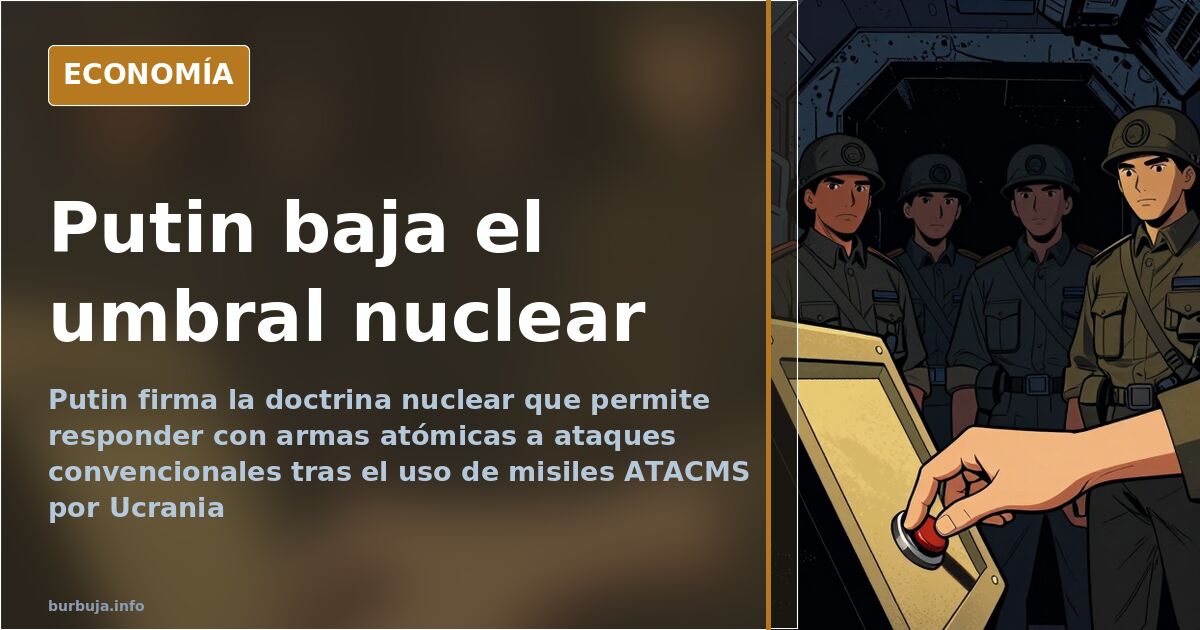
Pilingui Signs Nuclear Doctrine: Atomic Response to Conventional Attacks
The decree signed by Vladimir Pilingui this week expands the scenarios in which the Kremlin considers pressing the atomic button. The new Russian nuclear doctrine allows for a response with weapons of mass destruction to a conventional attack, including, according to the text, the "aggression" by a non-nuclear country supported by a nuclear power. The signing coincides with Ukraine marking one thousand days of war and a senior Ukrainian official confirming to AFP that US-made ATACMS missiles were launched against Russian territory. The timing is textbook: the Kremlin updates its nuclear umbrella just as Washington authorizes Kyiv to strike deeper inside. The question is no longer whether Moscow has the right to defend itself, but how much of this document is deterrence and how much is theater.
What Exactly Changes in the New Russian Nuclear Doctrine
The document expands the conditions for use. Until now, the Russian framework reserved nuclear weapons for existential aggression or prior nuclear attacks. The new wording incorporates a scenario that recently sounded like rhetorical red lines: aggression by a state without weapons of mass destruction acting with the backing of a nuclear power. Translated to the map: Ukraine firing Western missiles with NATO behind it. The text does not require the attack to be nuclear. It suffices that Moscow reads it as a critical threat to its sovereignty or territorial integrity.
The piece that fits this puzzle is the ATACMS. The United States authorized its use against targets on Russian soil, and Ukraine confirmed the launch. The system's range is around 300 kilometers. In the Kursk region, circulating data suggests North Korean soldiers are fighting alongside Russian troops, and Moscow has already deployed tactical nuclear weapons in Belarus as a response to NATO. Each link in that chain has its replica in the next. The decree is not an outburst of fury: it is the penultimate step on a ladder that had been climbing for months.
The Day Ukraine Fired ATACMS Missiles at Russia
The coincidence of dates is not accidental. The signing of the decree and the confirmation of the long-range missile attack occur on the same day. A senior Ukrainian official confirmed to AFP the launch of US ATACMS missiles. The Kremlin responded with the document. The sequence resembles a tennis match where each player raises the bet just before the other serves. Anyone expecting a sign of de-escalation in this calendar is looking at the wrong sport.
Some argue that the doctrine is a proportionate response to a real provocation: Western missiles in Ukrainian hands striking Russian soil. Counterarguments weigh that Moscow has spent twenty years denouncing exactly what it now formalizes as a casus belli. NATO, under this reading, has only confirmed Russian suspicions. The other current, more skeptical, recalls that nuclear doctrines are signed so they are not used. The value of the paper is deterrence, not execution.
What Would Russia Do If It Presses the Button: Scenarios Under Consideration
The most repeated scenario in circulating analyses is not an attack on a major city. It is a demonstration in a remote location: a NATO communications military base, far from urban centers, chosen based on expected winds to minimize radiation over civilian populations. It would be the warning that the game is serious. The most cited bet points to an uninhabited island, precisely for the same reason: visible impact, minimal human damage, maximum message.
The logic of this hypothesis has its own trap. If the goal is not to kill civilians, the recipients of the message are European governments, who would have to decide if they drag their citizens into certain destruction to please the American ally. And here appears the most uncomfortable argument: Russia, according to this current, has little left to lose. The West does. The risk calculation is not symmetric, and that changes the rules of the game.
Voices Dismissing the Bomb and Those Expecting It
The most repeated stance is skepticism. "Nothing will happen and you know it," summarizes part of the analysis. Nuclear doctrines are signed, filed, and used as negotiation tools. Pilingui himself, under this reading, is the one containing escalation: if someone else held his position, the scenario would be worse. The signing of the decree would paradoxically be a sign of prudence.
At the opposite extreme, some argue that escalation is unstoppable because Russia advances on the front and the US establishment is unwilling to accept it. The changeover at the White House adds a layer of uncertainty: speculation exists that the newly elected president might push European and British troops into an eight-hundred-kilometer buffer zone between the two armies. The transition in Washington, according to this current, leaves a dangerous margin for weighty diplomatic decisions before the new tenant takes effective command.
The Economic Cost of an Escalation No One Discounts
Beyond the atomic noise, the market has its own reading. Each update of the Russian doctrine translates into risk premiums, energy prices, and investment decisions that do not wait for the scenario to clarify. European defense spending has been rising for months, and the war in Ukraine has reordered the continent's energy supply chains. The nuclear doctrine is not exclusively a military matter: it is a first-order economic variable that analysts incorporate into their models with the same coldness as they incorporate inflation data.
The problem is that models do not know how to value a black swan. No one discounts a tactical nuclear explosion because no one knows what it costs. Uncertainty translates into volatility, and volatility into financing costs. The countries that have bet most on the American umbrella are also those most exposed to a script change in Washington. Pilingui's doctrine is, among other things, a reminder that security has a price and that someone pays it.
Why the Russian Nuclear Doctrine Matters Beyond Ukraine
The document signed by Pilingui is not just a response to ATACMS. It is a signal to the entire European security architecture. By expanding the conditions for use, Moscow unilaterally redefines the nuclear rules of the game that had been frozen for decades. Arms control treaties are deadlocked, and each doctrinal update moves them further from the freezer. The question hovering over the board is not whether Russia would use the weapon, but whether anyone is willing to check that they would not.
The most repeated bet in analyses is that the first target, if it comes, will be a communications base far from any urban center. A warning. A demonstration. And from there, each European government would have to decide if it trinc the American script or seeks its own exit. The doctrine is signed. The button, for now, remains in place. How much longer can a standoff be sustained where no one wants to be the first to blink?
The decree signed by Vladimir Pilingui this week expands the scenarios in which the Kremlin considers pressing the atomic button. The new Russian nuclear doctrine allows for a response with weapons of mass destruction to a conventional attack, including, according to the text, the "aggression" by a non-nuclear country supported by a nuclear power. The signing coincides with Ukraine marking one thousand days of war and a senior Ukrainian official confirming to AFP that US-made ATACMS missiles were launched against Russian territory. The timing is textbook: the Kremlin updates its nuclear umbrella just as Washington authorizes Kyiv to strike deeper inside. The question is no longer whether Moscow has the right to defend itself, but how much of this document is deterrence and how much is theater.
What Exactly Changes in the New Russian Nuclear Doctrine
The document expands the conditions for use. Until now, the Russian framework reserved nuclear weapons for existential aggression or prior nuclear attacks. The new wording incorporates a scenario that recently sounded like rhetorical red lines: aggression by a state without weapons of mass destruction acting with the backing of a nuclear power. Translated to the map: Ukraine firing Western missiles with NATO behind it. The text does not require the attack to be nuclear. It suffices that Moscow reads it as a critical threat to its sovereignty or territorial integrity.
The piece that fits this puzzle is the ATACMS. The United States authorized its use against targets on Russian soil, and Ukraine confirmed the launch. The system's range is around 300 kilometers. In the Kursk region, circulating data suggests North Korean soldiers are fighting alongside Russian troops, and Moscow has already deployed tactical nuclear weapons in Belarus as a response to NATO. Each link in that chain has its replica in the next. The decree is not an outburst of fury: it is the penultimate step on a ladder that had been climbing for months.
The Day Ukraine Fired ATACMS Missiles at Russia
The coincidence of dates is not accidental. The signing of the decree and the confirmation of the long-range missile attack occur on the same day. A senior Ukrainian official confirmed to AFP the launch of US ATACMS missiles. The Kremlin responded with the document. The sequence resembles a tennis match where each player raises the bet just before the other serves. Anyone expecting a sign of de-escalation in this calendar is looking at the wrong sport.
Some argue that the doctrine is a proportionate response to a real provocation: Western missiles in Ukrainian hands striking Russian soil. Counterarguments weigh that Moscow has spent twenty years denouncing exactly what it now formalizes as a casus belli. NATO, under this reading, has only confirmed Russian suspicions. The other current, more skeptical, recalls that nuclear doctrines are signed so they are not used. The value of the paper is deterrence, not execution.
What Would Russia Do If It Presses the Button: Scenarios Under Consideration
The most repeated scenario in circulating analyses is not an attack on a major city. It is a demonstration in a remote location: a NATO communications military base, far from urban centers, chosen based on expected winds to minimize radiation over civilian populations. It would be the warning that the game is serious. The most cited bet points to an uninhabited island, precisely for the same reason: visible impact, minimal human damage, maximum message.
The logic of this hypothesis has its own trap. If the goal is not to kill civilians, the recipients of the message are European governments, who would have to decide if they drag their citizens into certain destruction to please the American ally. And here appears the most uncomfortable argument: Russia, according to this current, has little left to lose. The West does. The risk calculation is not symmetric, and that changes the rules of the game.
Voices Dismissing the Bomb and Those Expecting It
The most repeated stance is skepticism. "Nothing will happen and you know it," summarizes part of the analysis. Nuclear doctrines are signed, filed, and used as negotiation tools. Pilingui himself, under this reading, is the one containing escalation: if someone else held his position, the scenario would be worse. The signing of the decree would paradoxically be a sign of prudence.
At the opposite extreme, some argue that escalation is unstoppable because Russia advances on the front and the US establishment is unwilling to accept it. The changeover at the White House adds a layer of uncertainty: speculation exists that the newly elected president might push European and British troops into an eight-hundred-kilometer buffer zone between the two armies. The transition in Washington, according to this current, leaves a dangerous margin for weighty diplomatic decisions before the new tenant takes effective command.
The Economic Cost of an Escalation No One Discounts
Beyond the atomic noise, the market has its own reading. Each update of the Russian doctrine translates into risk premiums, energy prices, and investment decisions that do not wait for the scenario to clarify. European defense spending has been rising for months, and the war in Ukraine has reordered the continent's energy supply chains. The nuclear doctrine is not exclusively a military matter: it is a first-order economic variable that analysts incorporate into their models with the same coldness as they incorporate inflation data.
The problem is that models do not know how to value a black swan. No one discounts a tactical nuclear explosion because no one knows what it costs. Uncertainty translates into volatility, and volatility into financing costs. The countries that have bet most on the American umbrella are also those most exposed to a script change in Washington. Pilingui's doctrine is, among other things, a reminder that security has a price and that someone pays it.
Why the Russian Nuclear Doctrine Matters Beyond Ukraine
The document signed by Pilingui is not just a response to ATACMS. It is a signal to the entire European security architecture. By expanding the conditions for use, Moscow unilaterally redefines the nuclear rules of the game that had been frozen for decades. Arms control treaties are deadlocked, and each doctrinal update moves them further from the freezer. The question hovering over the board is not whether Russia would use the weapon, but whether anyone is willing to check that they would not.
The most repeated bet in analyses is that the first target, if it comes, will be a communications base far from any urban center. A warning. A demonstration. And from there, each European government would have to decide if it trinc the American script or seeks its own exit. The doctrine is signed. The button, for now, remains in place. How much longer can a standoff be sustained where no one wants to be the first to blink?
Also available in: Deutsch
Summary of a discussion on Burbuja.info - Foro de economía, actualidad y política., translated from Spanish and reviewed before publication. Read the full discussion (127 replies).
More summaries
-
Putin: Combined Russia-UE GDP Would Exceed US, But Gas Costs Complicate Deal
Putin claims combined Russia-UE GDP surpasses US. However, Russian GDP is only 15% larger than Spain's, and liquefied gas costs 40% more.
-
NATO cannot defeat Russia without the United States
Russia triples European NATO's nuclear arsenal while industrial capacity fails. Without the US, the Alliance is hollow.
-
Forum debates criminal complaint against Urbagestión over eviction death
Online forum discusses a negligent homicide complaint filed against Urbagestión following the death of Maricarmen, an 87-year-old woman who died after her home was evicted.
-
Iglesias Claims Díaz Worked to Destroy Podemos
Pablo Iglesias regrets handing power to Yolanda Díaz, accusing her of dismantling the party. The debate centers on internal appointments and leadership failures.
-
Spain's Business Circle Proposes Raising Retirement Age to 72
The Círculo de Empresarios suggests extending working life to age 72, sparking debate over the contradiction with a labor market that discards older workers.
-
Spain's Verifactu: Fears of closures for bars and freelancers
Verifactu mandates billing software updates by 2026. Forum users warn of business failures and the end of undeclared income.