
Spanish teacher in Ireland: 3 of 12 students own homes in Spain
A Spanish teacher in Ireland reveals that 3 out of 12 students have property in Spain, reigniting debates on wages, housing costs, and foreign buyers.
English · Original discussion in Spanish · Published
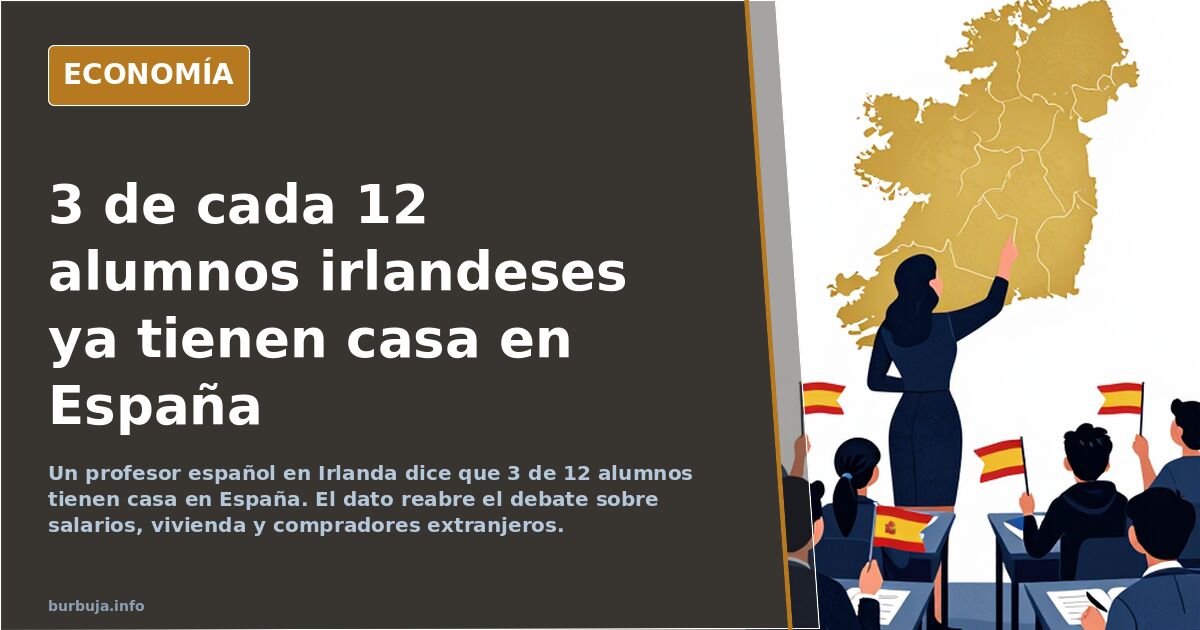
Three out of twelve Irish students already own apartments in Spain
Alejandro Mesa, a Spanish teacher living in Ireland, shared a TikTok video describing an uncomfortable domestic scene: one student’s father informed him the child would miss class to go on holiday to Alicante. They own a house there. Outright. It is not an isolated case: according to the teacher himself, three families among his 12 students already own property in Spain —one in Alicante, another in Málaga, and another in the Canary Islands—. “We have a problem,” he summarizes. The video sparked a discussion far beyond residential tourism: it touches on salaries, cost of living, and who can afford real estate in the eurozone.
What the teacher exactly says about his students
Mesa emphasizes that these families are not millionaires nor part of an economic elite. They are, he says, “people with normal, qualified jobs, but not rich.” The striking data for him is that they can sustain both a mortgage in Ireland —where houses cost between 400,000 and 500,000 euros— and a second home on the Spanish coast. “It is clear that something is failing here,” he denounces.
The anecdote, told from an Irish classroom, has peine an uncomfortable question: why can an average Irish employee buy in Alicante while a Spaniard cannot buy in their own province?
Ireland is not a poor country: per capita income and paradox
The first reaction in the debate was to correct the framework. Ireland exceeds Spain in per capita income and has just over five million inhabitants. This wage differential partly explains why its citizens buy abroad. But the teacher nuances this: Ireland has the largest inequalities in Western Europe, deficient infrastructure, serious alcoholism problems, and a very expensive Dublin that, he says, “makes Brussels look like Narnia.”
Some recall that during the 2010 crisis the country went bankrupt and many Irish emigrated to the United States, Canada, or Australia. The image of the rich Irishman buying on the coast clashes with that recent memory.
Why foreigners buy houses in Spain and Spaniards do not
The most repeated argument is salary-based. An Irish salary, even an average one, allows paying a mortgage in Dublin and still saving for an apartment in Alicante. A Spanish salary, at current prices, does not even reach the down payment. The gap is not about taste: it is about payroll.
Against this, another school of thought points out that the phenomenon is not new. There have been foreign residents on the Spanish coast for more than thirty years. What has changed is the buyer profile: it is no longer just the British or German retiree, but also young Irish, Czech, or Polish families. And they do not only buy on the beachfront: they also buy in inland towns in Alicante, such as Pedreguer or Finestrat.
The underlying problem: little construction and high demand
Supply is the other axis of the debate. It is argued that in Spain barely any new housing is built and that demand —tourist, migratory, and second-home— continues to grow. The result is a tense market where the foreigner with strong currency wins the bid.
Not everyone sees it the same way. Some maintain that 2.9 million Spanish households already have a second home, and that number keeps rising. That is, the national second-home buyer has not disappeared; they simply compete at a disadvantage against those earning in a stronger currency or paying less tax.
The debate gets stuck at the same point where it started: whether the problem is that Irish people buy in Spain or that Spaniards can no longer buy even in their own neighborhood. Both things can be true at once. And neither is fixed by a TikTok video.
Also available in: Deutsch
Summary of a discussion on Burbuja.info - Foro de economía, actualidad y política., translated from Spanish and reviewed before publication. Read the full discussion (110 replies).
More summaries
-
France's Risk Premium Matches Greece Amid Eurozone Debt Crisis
France's risk premium hits 86 basis points, equal to Greece's, while Spain drops to 71. French deficit nears 6% during economic expansion.
-
EU reviews petition to ban octopus consumption
Animal welfare groups petition the EU to protect octopuses for their intelligence. No law is approved, while Spain's fishing sector faces severe cuts.
-
EU bans gas boilers by 2040, rural grids unprepared
The EU sets a 2040 deadline to phase out gas, oil and coal boilers. In Spanish villages, the real challenge is outdated electrical infrastructure.
-
Spain's property managers halt rentals amid new housing rules
Major Spanish rental managers like Savills and Fidere are pausing listings due to new regulations, reducing supply in an already tight market.
-
ERC demands answers over origin of riots and looting in Barcelona
ERC Barcelona condemns Saturday's disturbances and calls on the City Council and the Generalitat to explain the lack of foresight and support for businesses.
-
Lula wins Brazil as right sweeps Congress
Lula wins the Brazilian presidency while Bolsonaro's right takes the largest Congress and Senate of its recent history.