
Miami hospital bills $40,000 for broken arm
A broken humerus in Miami led to a €40,000 bill. The family negotiated a discount and contacted their insurer, having skipped travel insurance.
English · Original discussion in Spanish · Published
Miami hospital bills $40,000 for broken arm
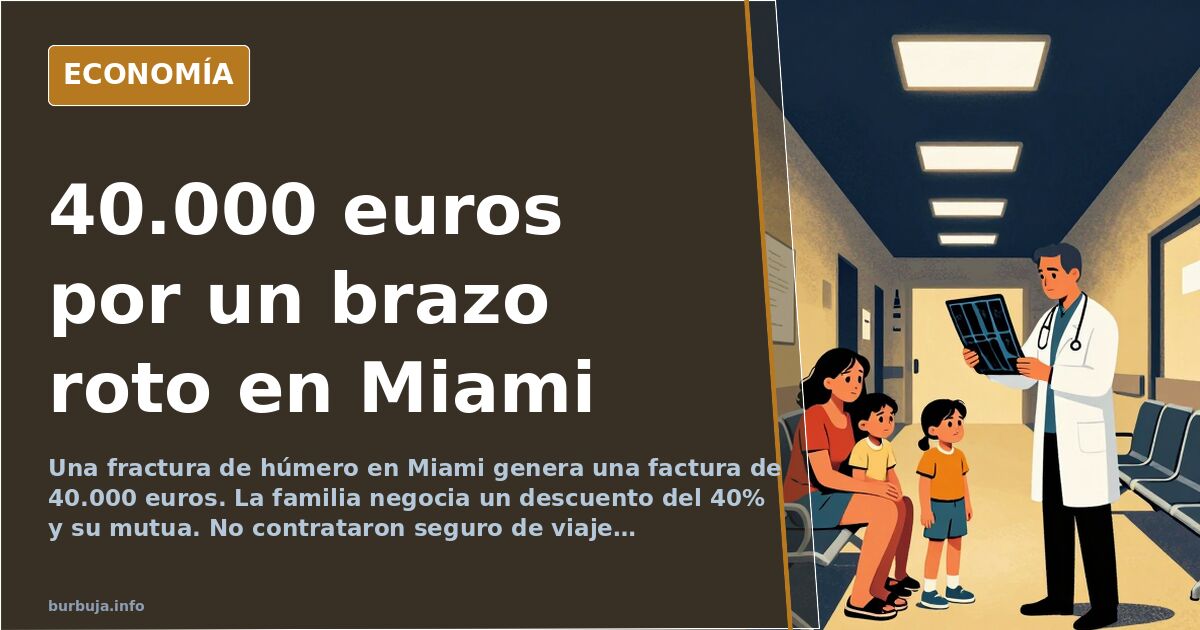
A fall while playing with his brother on the penultimate day of vacation resulted in a fractured humerus. For Edu de Batlle, voice of L’Espanyol juga at RAC1, and Carla Meléndez from the station's marketing team, this turned a dream Miami alucinación into an economic nightmare due to a €40,000 hospital bill. The family had not purchased specific travel insurance. They relied on their Catalan health insurance, which covers some expenses abroad, believing it was sufficient. Now they are negotiating up to a 40% discount with the hospital and dealing with their insurer to determine recoverable costs.
The insurance that covers "abroad" but pays nothing
This case reveals a common misunderstanding. Having private health insurance in Spain does not equate to coverage in the United States. According to forum participants, national policies often include assistance abroad with a limit of €1,500 per person per year, a figure exhausted before the first specialist arrives in a US hospital. The family called their company, were told they were "covered abroad," and felt reassured. The nuance was in the fine print, and in Miami, the fine print is paid in dollars.
The calculation circulating among frequent travelers is stark: travel insurance costing €50 to €80 per month covers up to €150,000 in hospitalization per person plus various contingencies. For three months in the US, an Intermundial policy costs €265, according to one user. Some recall paying just €24 for similar coverage in 2010. The conclusion repeats itself: thousands are spent on the alucinación, but savings are made on insurance. Then comes the bill.
Pay or don't pay: the legal trap for insolvent tourists
Legally, a foreign tourist could leave without paying the bill. There is no debtors' prison in the West, and insolvent individuals cannot be forced to pay by decree. However, the couple has ruled out this option, antiestéticaring future consequences if their daughter wants to return to the US. Some claim non-payment prevents leaving the country. Others argue that notifying the hospital administration of lack of insurance and willingness to pay as a self-payer results in "normal" invoices rather than inflated ones for insurers. A relative of a user received a $48,000 bill for a single-day visit—a CT scan and X-ray for a head bump—which their insurer refused to cover because it didn't match the agreed terms.
Why US healthcare charges like Mbappé
For many, US healthcare prices seem objectively fraudulent. Switzerland also has private healthcare with mandatory insurance but doesn't charge such exorbitant amounts. The difference isn't the model, but the degree. US hospitals smell insurance and deploy the full catalog: you arrive with a rash and get a CT scan, colonoscopy, and a call to Dr. House. The system inflates bills to negotiate with insurers, and those paying out-of-pocket without safety nets suffer most. Some defend that these aren't the real prices, claiming uninsured bills drop to €2,000-3,000, suggesting astronomical figures serve to declare losses and avoid taxes.
The contrast with Europe is another key point. The European model includes paid vacations, healthcare covered by contributions, and a safety net absent in the US. In America, being the "best country in the world" applies only if you have significant wealth; otherwise, medical holes and insecurity become major burdens. Jobs with mandatory tips—which are effectively hidden taxes—complete the picture. And the myth-busting statistic: the number of Americans dying from cancer without prior diagnosis, a reality existing only because the system excludes those who cannot afford care.
Catalans, insurance, and the reflex of collective payment
The protagonists' Catalan identity triggered usual reactions. Some joke that since they are Catalan, other Spaniards will pay the bill, while others recall a Valencian woman charged even donation taxes. The reflex that universal healthcare and welfare should cover everything clashes with the reality of a Miami hospital that ignores inter-territorial solidarity. For some, the news smells like a PR move to highlight Spanish free healthcare benefits. For others, it’s simply another case of under-insured tourism.
How many travelers will continue trusting their national insurance covers them in Miami until the bill hits them in the face?
A fall while playing with his brother on the penultimate day of vacation resulted in a fractured humerus. For Edu de Batlle, voice of L’Espanyol juga at RAC1, and Carla Meléndez from the station's marketing team, this turned a dream Miami alucinación into an economic nightmare due to a €40,000 hospital bill. The family had not purchased specific travel insurance. They relied on their Catalan health insurance, which covers some expenses abroad, believing it was sufficient. Now they are negotiating up to a 40% discount with the hospital and dealing with their insurer to determine recoverable costs.
The insurance that covers "abroad" but pays nothing
This case reveals a common misunderstanding. Having private health insurance in Spain does not equate to coverage in the United States. According to forum participants, national policies often include assistance abroad with a limit of €1,500 per person per year, a figure exhausted before the first specialist arrives in a US hospital. The family called their company, were told they were "covered abroad," and felt reassured. The nuance was in the fine print, and in Miami, the fine print is paid in dollars.
The calculation circulating among frequent travelers is stark: travel insurance costing €50 to €80 per month covers up to €150,000 in hospitalization per person plus various contingencies. For three months in the US, an Intermundial policy costs €265, according to one user. Some recall paying just €24 for similar coverage in 2010. The conclusion repeats itself: thousands are spent on the alucinación, but savings are made on insurance. Then comes the bill.
Pay or don't pay: the legal trap for insolvent tourists
Legally, a foreign tourist could leave without paying the bill. There is no debtors' prison in the West, and insolvent individuals cannot be forced to pay by decree. However, the couple has ruled out this option, antiestéticaring future consequences if their daughter wants to return to the US. Some claim non-payment prevents leaving the country. Others argue that notifying the hospital administration of lack of insurance and willingness to pay as a self-payer results in "normal" invoices rather than inflated ones for insurers. A relative of a user received a $48,000 bill for a single-day visit—a CT scan and X-ray for a head bump—which their insurer refused to cover because it didn't match the agreed terms.
Why US healthcare charges like Mbappé
For many, US healthcare prices seem objectively fraudulent. Switzerland also has private healthcare with mandatory insurance but doesn't charge such exorbitant amounts. The difference isn't the model, but the degree. US hospitals smell insurance and deploy the full catalog: you arrive with a rash and get a CT scan, colonoscopy, and a call to Dr. House. The system inflates bills to negotiate with insurers, and those paying out-of-pocket without safety nets suffer most. Some defend that these aren't the real prices, claiming uninsured bills drop to €2,000-3,000, suggesting astronomical figures serve to declare losses and avoid taxes.
The contrast with Europe is another key point. The European model includes paid vacations, healthcare covered by contributions, and a safety net absent in the US. In America, being the "best country in the world" applies only if you have significant wealth; otherwise, medical holes and insecurity become major burdens. Jobs with mandatory tips—which are effectively hidden taxes—complete the picture. And the myth-busting statistic: the number of Americans dying from cancer without prior diagnosis, a reality existing only because the system excludes those who cannot afford care.
Catalans, insurance, and the reflex of collective payment
The protagonists' Catalan identity triggered usual reactions. Some joke that since they are Catalan, other Spaniards will pay the bill, while others recall a Valencian woman charged even donation taxes. The reflex that universal healthcare and welfare should cover everything clashes with the reality of a Miami hospital that ignores inter-territorial solidarity. For some, the news smells like a PR move to highlight Spanish free healthcare benefits. For others, it’s simply another case of under-insured tourism.
How many travelers will continue trusting their national insurance covers them in Miami until the bill hits them in the face?
Also available in: Deutsch
Summary of a discussion on Burbuja.info - Foro de economía, actualidad y política., translated from Spanish and reviewed before publication. Read the full discussion (125 replies).
More summaries
-
Joan Donovan warns US militias preparing for civil war
Disinformation expert Joan Donovan argues US militias are gearing up for civil conflict, citing social media as key infrastructure.
-
Leticia Sabater earns up to €5,000 per gig: the decline of Spain
Leticia Sabater, 59, earns up to €5,000 per gig. Her tacky, provocative show sparks debate on cultural decline and public money.
-
Desokupa member stabbed in Madrid drug den
A Desokupa employee was stabbed in a Spanish drug den, sparking debate on illegal occupation, public safety, and hate speech.
-
Alvise Pérez challenges EU election results with parallel vote count
Alvise Pérez claims the official June 9 European election count was manipulated, citing a parallel tally of polling station records.
-
Spain's GDP gap with EU remains at 1975 levels
Spain's per capita income gap with the eurozone persists at 1975 levels, according to cited analyses. Moncloa admits stagnation and reliance on European funds.
-
Deportations in Sweden and Germany Spark European Unrest
A forum discusses if mass deportations in Sweden or Germany could trigger riots. Political reaction is late, and the powder keg is already set.