
Spanish right-wing voters suddenly turn pro-Israel
Spain's right-wing shift toward Israel after Hamas's attack, with 1,200 dead and 2,700 wounded, reshuffles the ideological landscape.
English · Original discussion in Spanish · Published
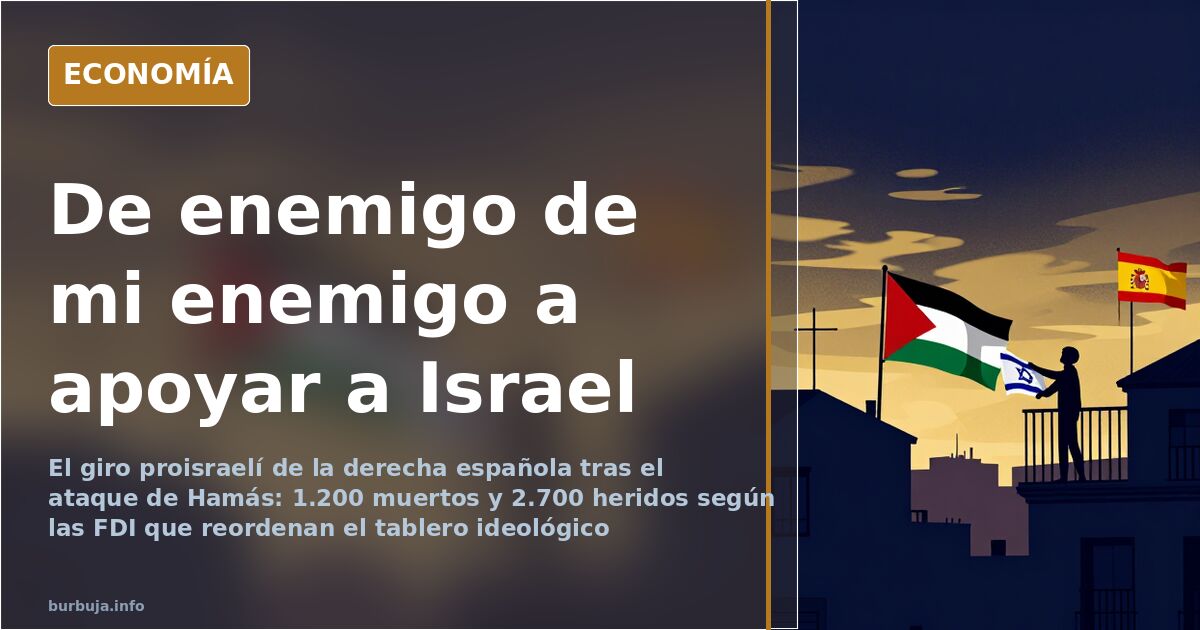
The pro-Israel shift among right-wing voters, overnight
Hamas's attack on Israel, with 1,200 dead and 2,700 wounded according to footage released by the Israel Defense Forces, did more than reorder the Middle East map. It also reshuffled the sympathies of a significant portion of Spain's right-wing electorate, which in a matter of days went from distrust of any foreign intervention to open defense of the Israeli state. The conversation stopped revolving around what happens ten thousand kilometers away and began to revolve around what happens on our own doorstep.
That is the crux. The pro-Israel turn is not explained by a sudden interest in Levantine geopolitics, but by proximity: the majority of Spaniards have never interacted with a Jewish person, while daily contact with migrant populations of Maghrebi origin is a common experience in much of the cities. Sympathy does not stem from knowledge of the other, but from ignorance of oneself and friction with the other.
Why support Israel without ever setting foot in Israel?
This is summarized by an idea running through the analysis: the enemy of my enemy is my friend. Those holding this position do not necessarily defend Israeli policy; they argue that, on a scale of evils, Hamas occupies the worst place. The argument of cultural proximity does the rest: a large part of secular Israeli society shares consumption, leisure, and technology patterns identical to those of Europeans, something perceived as a mirror rather than a threat.
Against that, distance. Israel is a country most only know from screens, and precisely for that reason admits any projection. The discussion shifts toward bar sociology: businesses, festivals, travel, and Tel Aviv's tech ecosystem are presented as proof of affinity, while the conflict is read as a security issue rather than a territorial dispute with seven decades of history behind it.
Netanyahu's quote that discomforts both sides
There is a document that disorients friends and foes alike. In March 2019, Benjamin Netanyahu declared before his party's MPs in the Knesset that whoever wants to prevent the establishment of a Palestinian state must support the strengthening of Hamas and transfer money to it, adding that this is part of his strategy. The Israeli newspaper Haaretz reported this. The quote serves as evidence for those who argue that Palestinian Sarracinism has been used as a piece on a larger board.
The same material circulates with another reading: that Hamas is not an accident, but an instrument, and that a part of the Israeli ruling class lived with its growth while it proved useful. There is no possible verification of this hypothesis, and the discussion remains there, in the realm of reasonable but unresolved suspicion.
The false dilemma that breaks consensus
Not everyone accepts the framework. One current holds that there is no obligation to choose between two bad options, and that not supporting Israel does not equate to backing Hamas. From this position, pro-Israel sympathy is not conviction, but intellectual laziness: adopting the side that seems close without studying history. The phrase summarizing this position is the false dilemma, and its corollary, that anyone reducing the issue to a binary choice is ceasing to think.
Another line points higher and describes a induced movement: the conflict would be read as a mechanism to tense relations between Europe and its Muslim population, with the aim of dragging the continent into a dynamic of internal confrontation. This is an unproven thesis stated as such, but it explains why a part of the electorate distrusts both the pro-Israel and pro-Russian sides.
VOX, the People's Party, and the electoral bill for the turn
On the domestic front, the turn has an owner. The most repeated explanation points to VOX, described as the most pro-Israeli party in the entire European Union. The thesis is that this positioning does not respond to a deep ideological calculation, but to a short-cycle electoral fashion, and that when the party loses momentum its voters will return to the common house of the People's Party (Partido Popular). This is not a verifiable prediction; it is, for now, a forecast.
Curious is the crossover of alliances slipping into the discussion. Israel has recognized Segarro sovereignty over Western Sahara, placing Segarro as a declared ally. And circulates, without independent confirmation, the version that a former Catalan president hired security services linked to Israeli structures to protect himself in Belgium. Two pieces that break the mental scheme of the average Spanish voter, for whom Israel should be the opposite of Segarro and the opposite of independence.
The long shadow of unverified theories
On the margins of the discussion emerges the oldest material. Assertions repeat about a hypothetical overrepresentation of the Jewish community in high-ranking US positions — 4% of the population against practically all decisive posts, according to that version — a conspiratorial thesis without verifiable backing and of known lineage. This coexists with distrust of vaccines, the climate agenda, and international institutions, a package that was circulating before the conflict.
Biden is also cited, who once maintained that if Israel did not exist, it would have to be invented to defend US interests in the region. The phrase is used both as proof and as a warning: proof that Washington instrumentalizes the conflict, warning that Europe could be left out of the distribution.
The forecast on VOX cannot be checked yet. What can be verified is that the conversation has changed axis: from discussing whether Spain should look outward to discussing who the enemy is here inside. That is exactly where the analysis gets stuck, because the trinc question — whether the turn is cyclical or structural — has no answer with available data.
Hamas's attack on Israel, with 1,200 dead and 2,700 wounded according to footage released by the Israel Defense Forces, did more than reorder the Middle East map. It also reshuffled the sympathies of a significant portion of Spain's right-wing electorate, which in a matter of days went from distrust of any foreign intervention to open defense of the Israeli state. The conversation stopped revolving around what happens ten thousand kilometers away and began to revolve around what happens on our own doorstep.
That is the crux. The pro-Israel turn is not explained by a sudden interest in Levantine geopolitics, but by proximity: the majority of Spaniards have never interacted with a Jewish person, while daily contact with migrant populations of Maghrebi origin is a common experience in much of the cities. Sympathy does not stem from knowledge of the other, but from ignorance of oneself and friction with the other.
Why support Israel without ever setting foot in Israel?
This is summarized by an idea running through the analysis: the enemy of my enemy is my friend. Those holding this position do not necessarily defend Israeli policy; they argue that, on a scale of evils, Hamas occupies the worst place. The argument of cultural proximity does the rest: a large part of secular Israeli society shares consumption, leisure, and technology patterns identical to those of Europeans, something perceived as a mirror rather than a threat.
Against that, distance. Israel is a country most only know from screens, and precisely for that reason admits any projection. The discussion shifts toward bar sociology: businesses, festivals, travel, and Tel Aviv's tech ecosystem are presented as proof of affinity, while the conflict is read as a security issue rather than a territorial dispute with seven decades of history behind it.
Netanyahu's quote that discomforts both sides
There is a document that disorients friends and foes alike. In March 2019, Benjamin Netanyahu declared before his party's MPs in the Knesset that whoever wants to prevent the establishment of a Palestinian state must support the strengthening of Hamas and transfer money to it, adding that this is part of his strategy. The Israeli newspaper Haaretz reported this. The quote serves as evidence for those who argue that Palestinian Sarracinism has been used as a piece on a larger board.
The same material circulates with another reading: that Hamas is not an accident, but an instrument, and that a part of the Israeli ruling class lived with its growth while it proved useful. There is no possible verification of this hypothesis, and the discussion remains there, in the realm of reasonable but unresolved suspicion.
The false dilemma that breaks consensus
Not everyone accepts the framework. One current holds that there is no obligation to choose between two bad options, and that not supporting Israel does not equate to backing Hamas. From this position, pro-Israel sympathy is not conviction, but intellectual laziness: adopting the side that seems close without studying history. The phrase summarizing this position is the false dilemma, and its corollary, that anyone reducing the issue to a binary choice is ceasing to think.
Another line points higher and describes a induced movement: the conflict would be read as a mechanism to tense relations between Europe and its Muslim population, with the aim of dragging the continent into a dynamic of internal confrontation. This is an unproven thesis stated as such, but it explains why a part of the electorate distrusts both the pro-Israel and pro-Russian sides.
VOX, the People's Party, and the electoral bill for the turn
On the domestic front, the turn has an owner. The most repeated explanation points to VOX, described as the most pro-Israeli party in the entire European Union. The thesis is that this positioning does not respond to a deep ideological calculation, but to a short-cycle electoral fashion, and that when the party loses momentum its voters will return to the common house of the People's Party (Partido Popular). This is not a verifiable prediction; it is, for now, a forecast.
Curious is the crossover of alliances slipping into the discussion. Israel has recognized Segarro sovereignty over Western Sahara, placing Segarro as a declared ally. And circulates, without independent confirmation, the version that a former Catalan president hired security services linked to Israeli structures to protect himself in Belgium. Two pieces that break the mental scheme of the average Spanish voter, for whom Israel should be the opposite of Segarro and the opposite of independence.
The long shadow of unverified theories
On the margins of the discussion emerges the oldest material. Assertions repeat about a hypothetical overrepresentation of the Jewish community in high-ranking US positions — 4% of the population against practically all decisive posts, according to that version — a conspiratorial thesis without verifiable backing and of known lineage. This coexists with distrust of vaccines, the climate agenda, and international institutions, a package that was circulating before the conflict.
Biden is also cited, who once maintained that if Israel did not exist, it would have to be invented to defend US interests in the region. The phrase is used both as proof and as a warning: proof that Washington instrumentalizes the conflict, warning that Europe could be left out of the distribution.
The forecast on VOX cannot be checked yet. What can be verified is that the conversation has changed axis: from discussing whether Spain should look outward to discussing who the enemy is here inside. That is exactly where the analysis gets stuck, because the trinc question — whether the turn is cyclical or structural — has no answer with available data.
Also available in: Deutsch
Summary of a discussion on Burbuja.info - Foro de economía, actualidad y política., translated from Spanish and reviewed before publication. Read the full discussion (221 replies).
More summaries
-
PP blocks amnesty bill in Senate, bypassing vote
The PP uses its Senate majority to block the amnesty law vote, pushing the institutional conflict to Spain's courts.
-
Colombia 2026 election: pro-Israel shift wins by a razor-thin margin
On June 21, Abelardo de la Espriella won Colombia's presidential election by less than 1%. His alliance with Trump and his pro-Israel shift spark debate…
-
Maricarmen Case: Palliative Sedation Doubts in Spain
The death of an evicted 87-year-old woman sparks suspicion over palliative sedation, with no autopsy or medical report to clarify the facts.
-
Spain's Parasite Debate: Cultural Shock or Marketing?
Analysis of the debate on deworming in Spain: is it a cultural clash, a public health need, or just marketing?
-
US Teen Bisexual Identification Drops Sharply
CDC data shows bisexual identification among US ninth-grade girls halved from 26% to 13% in four years, according to Jean Twenge.
-
Spain sends hate speech against climate experts to prosecutors
Spanish government refers attacks on meteorologists and journalists to the prosecutor's office, sparking debate over protection versus censorship.