
Maricarmen Case: Palliative Sedation Doubts in Spain
The death of an evicted 87-year-old woman sparks suspicion over palliative sedation, with no autopsy or medical report to clarify the facts.
English · Original discussion in Spanish · Published
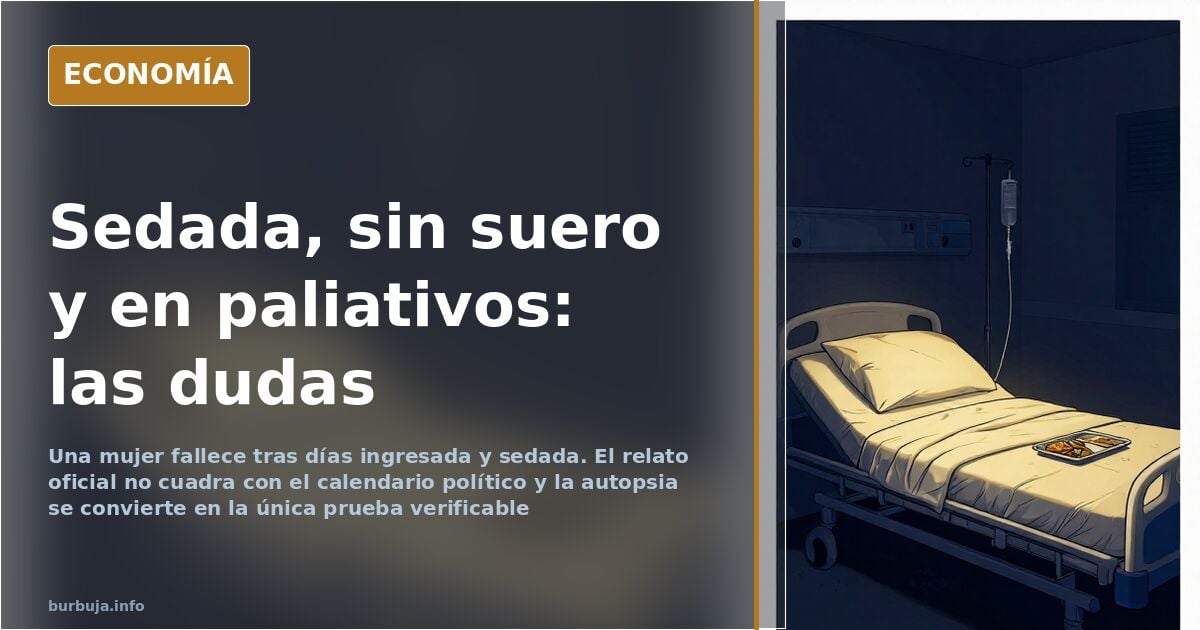
Maricarmen "Sedated": Questions Surrounding Palliative Care at Age 87
The death of an 87-year-old woman who had been evicted from her home has ignited a firestorm of suspicion. The official account describes palliative sedation in a hospital; skeptics allege death by dehydration while under sedation. The timing coinciding with the Sol encampment and upcoming elections has fueled speculation, leading many to interpret each detail as part of a scripted narrative. The result is a debate where data is scarce and hypotheses multiply.
What Is Known About Maricarmen's Death
The starting point is an 87-year-old woman evicted from her housing who, according to circulating accounts, was hospitalized and sedated. The official version, as reproduced in discussions, states this was palliative sedation during the dying process. The critical version argues that sedation involved withdrawing food serum and water, causing death by dehydration. No one provides the medical report, specific diagnosis, or pathology justifying the sedation. This absence fuels all theories.
A key detail acted as a trigger: the woman said goodbye to her family before dying. For some, this confirms she was in agony and the sedation was proportionate medical care. For others, it proves a deliberate decision to end her life. The same fact supports two opposing narratives.
Why Link the Case to Elections and the Encampment?
Because the death occurred while the encampment remained on the streets, days before an electoral event. This temporal alignment led some analysts to claim the death came earlier than planned and was intended for three days before the elections. The hypothesis, formulated without evidence, suggests the woman was chosen for her profile—elderly, evicted, with open conflict—to become a symbol. Accusations of murder are made conditionally, without presenting a single document.
On the opposite side, the reading is more prosaic: an 87-year-old woman, evicted and facing conflict, dies. The coincidence with the encampment is merely chance. Proponents argue mortality at that age needs no political explanation, and turning every death into a crime requires more than intuition.
Palliative Sedation: What It Is and Why It Is Debated
Palliative sedation involves administering drugs to reduce consciousness in the final stage of illness to relieve suffering. In this case, the debate isn't about the definition but the requirements: what pathology did the woman have, was she truly dying, and who authorized the sedation. The most repeated criticism is that one cannot sedate someone solely due to old age and distress. The most common defense is that sedation applies when nothing else can be done and morphine prevents suffering.
The technical argument circulating is that sedation combined with withdrawing serum and water leads to death by dehydration if the patient cannot drink independently. Supporters claim if the serum had been maintained, she would not have died. Opponents recall that in palliative care, withdrawing support measures is accepted when they offer no benefit, and sedation aims precisely to avoid the sensation of thirst.
Context: Eviction, Encampment, and Public Narrative
The woman had been evicted from her home. This fact places her at the center of the public narrative. Street encampments, housing protests, and proximity to elections turn her figure into a narrative asset. Some analysts argue it suited someone perfectly that she died at that moment, and using her name as a symbol is part of a strategy. Others respond that using the death of an evicted person to attack protesters is, at minimum, reckless.
The detail that drew most attention in the discussion is the woman's biography: a cousin who was actually a brother, memories of Venezuela, a chalet in Aravaca, €250,000 in the bank. These are unverified, scattered details circulating as if forming a pattern. The lingering question is whether that life fits the victim profile assigned to her.
What Can Be Verified and What Cannot
As of this discussion, there is no public autopsy, no medical report, and no confirmed diagnosis. According to comments, the autopsy would be performed on the dog on the 29th. Everything else is hypothesis. Murder accusations are made without proof; defenses of sedation lack reports. The case remains open and without data.
What can be stated is that the case has functioned as a mirror: everyone sees confirmation of what they already believed. Those distrustful of the official account see a crime; those skeptical of conspiracy theories see a natural death turned into a political weapon. The only certainty is that the woman died and no one has shown the paper explaining why.
The death of an 87-year-old woman who had been evicted from her home has ignited a firestorm of suspicion. The official account describes palliative sedation in a hospital; skeptics allege death by dehydration while under sedation. The timing coinciding with the Sol encampment and upcoming elections has fueled speculation, leading many to interpret each detail as part of a scripted narrative. The result is a debate where data is scarce and hypotheses multiply.
What Is Known About Maricarmen's Death
The starting point is an 87-year-old woman evicted from her housing who, according to circulating accounts, was hospitalized and sedated. The official version, as reproduced in discussions, states this was palliative sedation during the dying process. The critical version argues that sedation involved withdrawing food serum and water, causing death by dehydration. No one provides the medical report, specific diagnosis, or pathology justifying the sedation. This absence fuels all theories.
A key detail acted as a trigger: the woman said goodbye to her family before dying. For some, this confirms she was in agony and the sedation was proportionate medical care. For others, it proves a deliberate decision to end her life. The same fact supports two opposing narratives.
Why Link the Case to Elections and the Encampment?
Because the death occurred while the encampment remained on the streets, days before an electoral event. This temporal alignment led some analysts to claim the death came earlier than planned and was intended for three days before the elections. The hypothesis, formulated without evidence, suggests the woman was chosen for her profile—elderly, evicted, with open conflict—to become a symbol. Accusations of murder are made conditionally, without presenting a single document.
On the opposite side, the reading is more prosaic: an 87-year-old woman, evicted and facing conflict, dies. The coincidence with the encampment is merely chance. Proponents argue mortality at that age needs no political explanation, and turning every death into a crime requires more than intuition.
Palliative Sedation: What It Is and Why It Is Debated
Palliative sedation involves administering drugs to reduce consciousness in the final stage of illness to relieve suffering. In this case, the debate isn't about the definition but the requirements: what pathology did the woman have, was she truly dying, and who authorized the sedation. The most repeated criticism is that one cannot sedate someone solely due to old age and distress. The most common defense is that sedation applies when nothing else can be done and morphine prevents suffering.
The technical argument circulating is that sedation combined with withdrawing serum and water leads to death by dehydration if the patient cannot drink independently. Supporters claim if the serum had been maintained, she would not have died. Opponents recall that in palliative care, withdrawing support measures is accepted when they offer no benefit, and sedation aims precisely to avoid the sensation of thirst.
Context: Eviction, Encampment, and Public Narrative
The woman had been evicted from her home. This fact places her at the center of the public narrative. Street encampments, housing protests, and proximity to elections turn her figure into a narrative asset. Some analysts argue it suited someone perfectly that she died at that moment, and using her name as a symbol is part of a strategy. Others respond that using the death of an evicted person to attack protesters is, at minimum, reckless.
The detail that drew most attention in the discussion is the woman's biography: a cousin who was actually a brother, memories of Venezuela, a chalet in Aravaca, €250,000 in the bank. These are unverified, scattered details circulating as if forming a pattern. The lingering question is whether that life fits the victim profile assigned to her.
What Can Be Verified and What Cannot
As of this discussion, there is no public autopsy, no medical report, and no confirmed diagnosis. According to comments, the autopsy would be performed on the dog on the 29th. Everything else is hypothesis. Murder accusations are made without proof; defenses of sedation lack reports. The case remains open and without data.
What can be stated is that the case has functioned as a mirror: everyone sees confirmation of what they already believed. Those distrustful of the official account see a crime; those skeptical of conspiracy theories see a natural death turned into a political weapon. The only certainty is that the woman died and no one has shown the paper explaining why.
Also available in: Deutsch
Summary of a discussion on Burbuja.info - Foro de economía, actualidad y política., translated from Spanish and reviewed before publication. Read the full discussion (186 replies).
More summaries
-
Poll puts Aliança Catalana as leading force in Catalonia
A poll places Aliança Catalana as the leading force in Catalonia. The result fragments the vote and leaves governability in a mathematical deadlock, according to...
-
Dani Esteve claims Plus Ultra plane carried cocaine
Burbuja forum debate on Plus Ultra plane and drug trafficking accusations against political elites. Narco-state or firewall?
-
Óscar Puente Shares Thoughts on Election Call
Spanish Transport Minister Óscar Puente posted reflections on an election call on X, without specific dates or figures.
-
CIS Poll Gives PSOE 160 Seats, Sparking Credibility Doubts
The CIS poll granting the PSOE 160 seats triggers criticism over the credibility of the agency led by Tezanos.
-
Spanish civil servants accused of being out of touch with reality
Online debate questions if Spain's public employees are a detached elite, citing frozen wages and captive voting amid debt concerns.
-
Viral tweet names public figures in Maricarmen eviction case
A viral tweet links Pepa Bueno, Ana Belén and Álvaro García Ortiz to the death of an evicted woman in Spain without providing evidence.