
Spanish Retail Staff Often Lack Product Knowledge
In Spain, tech store employees frequently lack technical expertise. With online access, customers now know more than the sales staff.
English · Original discussion in Spanish · Published
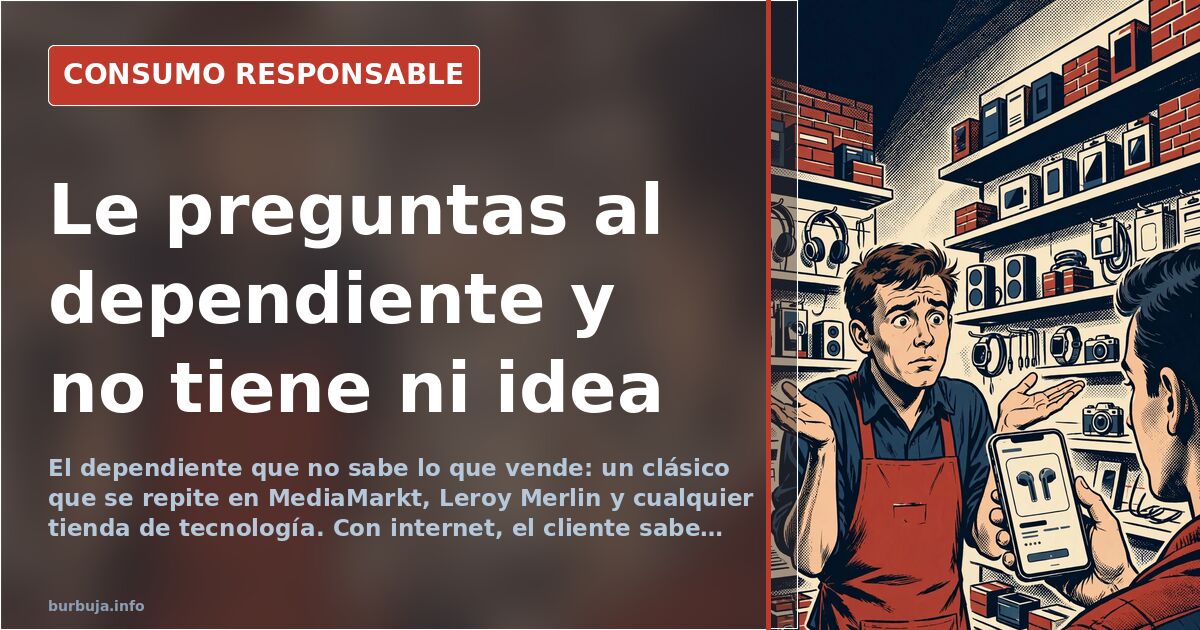
The Salesperson Who Doesn't Know What They Sell
You walk into a big-box store to buy a phone. You find the section attendant, ask about the difference between two processors, and get two short sentences and a look that says "don't bother me." Minutes later, another employee appears, friendlier, who actually helps you. This scene repeats at MediaMarkt, Leroy Merlin, and any tech store in this country. It’s not new: it has been happening for decades.
What has changed is the customer. With the internet in their pocket, anyone arrives at the store knowing more than the person serving them. That breaks the old balance: previously, the seller had more information than you and could afford the expert role. Not anymore. And when the buyer discovers they know more than the assistant, the relationship becomes tense.
A Stopgap Job, Not a Technical Vocation
The first argument that comes up again and again is the most obvious: they are retail assistants, not engineers. A young person earning a thousand euros a month, on a temporary contract with rotating shifts, isn’t going to come home after struggling to study the technical specs of the entire catalog. Training, if it exists, should be provided by the company during working hours. And it isn’t.
Some go further and point to the hiring process: they prioritize the smooth-talking extrovert over the knowledgeable one. The goal isn’t for you to solve technical doubts, but to move product and close sales. A salesman, not a technician. That is the real function of the job, and anyone who doesn’t understand it will be frustrated every time they enter a store.
The Customer Who Asks Too Much
The other side of the issue is less pleasant. There are customers who go to the store to annoy the assistant with questions they don’t even need to answer themselves. Differences between processors that only matter in specialized forums, engineering details that don’t change the user experience. The assistant detects this and responds with reluctance. It’s not just ignorance: it’s calculated disinterest.
Some say the ultimate expression of this problem is in large DIY stores. There, the staff’s level of knowledge is nonexistent. And it doesn’t matter, because the customer isn’t going to ask how to calculate the load-bearing capacity of a beam either.
It Was Always Like This, But Now It’s More Noticeable
The most repeated argument is that this has always peine. Thirty years ago, an appliance salesperson didn’t know how many pistons were in a fridge compressor. An El Corte Inglés assistant in a suit seemed to know everything, but was actually repeating manufacturer antiestéticatures and selling the most expensive item within the customer’s budget. The difference is that back then there was no way to verify it.
Today, the customer arrives with their phone, compares prices and specs in real time, and spots the deception. The physical showroom loses its main advantage: information. All it has left is the tactile feel of the product and personal service. And if that service is bad, the business makes no sense.
The Solution Isn’t Blaming the Worker
The underlying problem is structural. If the company wants its staff to know what they sell, it has to train and pay them. You can’t expect a low-wage worker to become an expert out of vocation. Nor can you expect the customer to pay brick-and-mortar prices to receive information they already have for free online.
Some argue the assistant only needs to know the basics: guide those who don’t know, recommend within a budget, and not waste time with those who already arrive informed. Others believe that is settling for mediocre service. The gap between these positions remains wide.
In the end, the anecdote that best summarizes the issue is the customer who asks something technical and the assistant replies, "you got me." Admitting ignorance is more honest than making things up. But it also confirms that physical retail has given up being anything more than a warehouse with a display window.
Also available in: Deutsch
Summary of a discussion on Burbuja.info - Foro de economía, actualidad y política., translated from Spanish and reviewed before publication. Read the full discussion (105 replies).
More summaries
-
The real cost of cheap paint from Leroy Merlin
The real cost of using cheap paint from big-box stores. We analyze the dilemma between immediate savings and the durability of the finish.
-
Leroy Merlin's one-cent charge per item: the plastic tax
The waste management fee that Leroy Merlin adds to receipts comes from Law 7/2022: €0.45 per kilo of non-reusable plastic in packaging.
-
El Corte Inglés prepared food: quality at a price
El Corte Inglés croquettes beat Mercadona's, but prices like €21/kg for meat rolls mean it's only worth it for some products.
-
Total Renting: Is car leasing for individuals a financial trap?
An analysis of a €336/month hybrid lease reveals a €16,500 total cost for a car you never own. Is leasing worthwhile for private individuals in Spain?
-
Metalcore vs reggaeton lyrics: why the comparison is misleading
An analysis compares metalcore and reggaeton verses to discuss whether all popular music deserves the same intellectual respect. Read it and decide for yourself.
-
Kodi for watching movies: the setup that drives half of Spain away
Kodi plays movies from USB without a hitch, but setting up artwork, add-ons and debrid takes hours. Most people give up before finishing.