
Spanish prison staff assaulted at Topas; union blames overcrowding
A female officer at Topas Prison in Salamanca is on sick leave after being beaten by an inmate during a cell check, prompting ACAIP-UGT to highlight severe overcrowding.
English · Original discussion in Spanish · Published
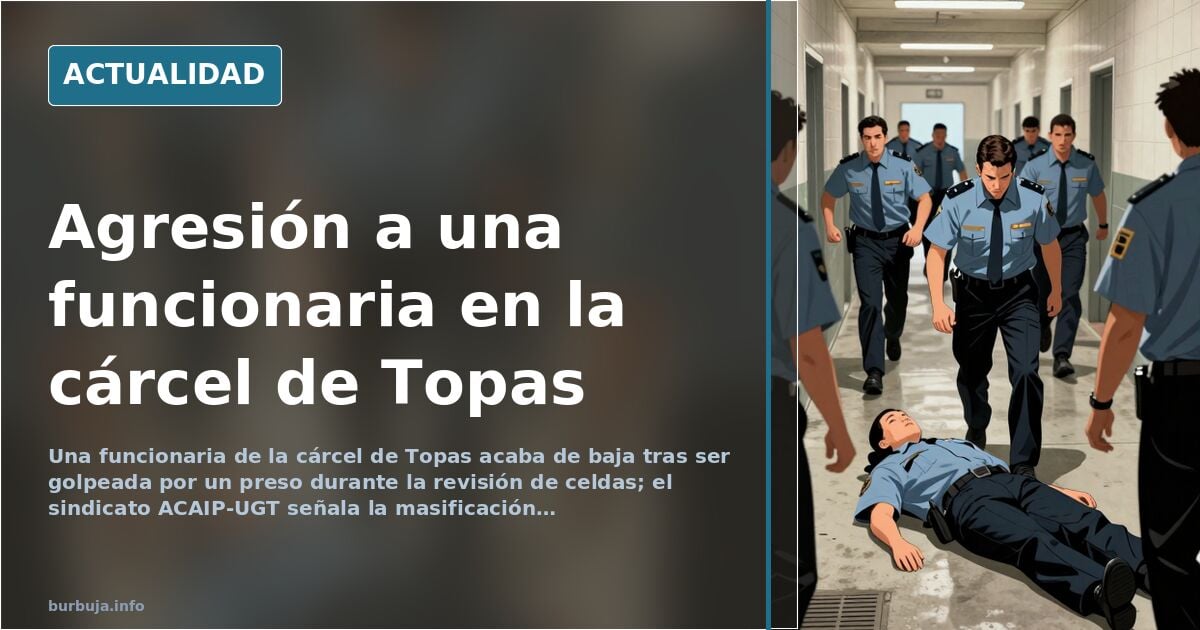
Assault at Topas Prison: Female officer hospitalized after inmate attack
A surveillance officer at Topas Prison in Salamanca was medically treated and placed on sick leave after an inmate punched and kicked her during a routine cell inspection. The prisoner, who reportedly had prior convictions for assault, burglary, theft, and disobedience, reacted violently when the worker informed him he would have to share his cell with another detainee. According to reports, spontaneous intervention by other inmates and the subsequent arrival of colleagues prevented a worse outcome.
The ACAIP-UGT union, cited by La Gaceta de Salamanca, used the incident to point out two underlying problems: the facility's overcrowding and the influx of highly conflictive profiles amidst what they consider an insufficient staffing level. This episode, occurring during a standard task, has peine the debate on work organization in men's prisons and the real protection afforded to frontline staff.
What exactly peine during the cell check
The incident occurred while cells were being inspected. The officer informed the inmate that he would be sharing a cell with another prisoner, a routine administrative notice. The reaction was immediate: according to the circulated account, the man began shouting and leaning his face within inches of hers.
The worker ordered him to stop his aggressive and defiant behavior. Instead of backing down, the prisoner lunged at her, grabbed her forcefully, pushed her against the booth's glass, and started kicking her. The victim required medical attention and was placed on sick leave.
It was then that several prisoners intervened on their own to assist her until other officers arrived and managed to restrain the aggressor. During the transfer to the isolation module, the inmate struggled against the workers and continued issuing death threats against the woman, according to the same journalistic report.
Staffing and overcrowding: The union's argument
ACAIP-UGT did not limit itself to condemning this specific case. The union lamented the overcrowding of the Salamanca prison, the arrival of highly conflictive profiles, and a deficit in workforce numbers. Essentially, it shifts the focus from the individual prisoner's conduct to the structural conditions of the center.
This argument holds weight: if the ratio of officers per inmate drops and incoming profiles accumulate sentences for assault or disobedience, the likelihood of a routine task escalating into an attack increases. Cell checks, module transfers, or notifying inmates of a roommate change are daily tasks often performed alone or with minimal support.
Some argue the problem is not just numerical but procedural: checking cells of dangerous prisoners without a partner turns any notice into a moment of risk. Counterarguments suggest that doubling personnel for every task is unfeasible with current staffing levels, and that the solution lies in redesigning procedures rather than just hiring more staff.
The role of other inmates and the chain of command
One of the most commented aspects of the case is that other prisoners intervened first. The scene reverses the usual script: inmates providing containment while staff arrive. This raises an uncomfortable question about response times within the facility.
The complete sequence — notification, assault, spontaneous aid, officer arrival, restraint, transfer to isolation, and further threats — suggests that staff intervention came after the initial blow. There is no data in the available reports regarding how many minutes passed between the start of the assault and the arrival of colleagues.
The transfer to the isolation module was also not smooth: the inmate struggled again and had to be restrained once more using, according to the newspaper, the necessary physical force. The final threat against the officer was recorded in the journalistic account.
The debate on women in surveillance roles
The incident has reignited a recurring discussion: whether women should hold surveillance positions in men's modules. One line of analysis argues that the issue is not the worker's gender, but the lack of protocols and support; another stream directly advocates that these posts should be reserved for men due to physical safety concerns.
The unsettling fact is that the assault did not occur during a struggle with a violent prisoner in the midst of a riot, but while communicating a cell change. An administrative task. If that suffices to end up in the hospital, the debate over who should perform these duties falls short: the problem is how they are done.
The union demands more staff and less overcrowding. The officer is on sick leave. The prisoner is in isolation. And the question of how many routine notices turn into assaults each year remains unanswered by public figures.
A surveillance officer at Topas Prison in Salamanca was medically treated and placed on sick leave after an inmate punched and kicked her during a routine cell inspection. The prisoner, who reportedly had prior convictions for assault, burglary, theft, and disobedience, reacted violently when the worker informed him he would have to share his cell with another detainee. According to reports, spontaneous intervention by other inmates and the subsequent arrival of colleagues prevented a worse outcome.
The ACAIP-UGT union, cited by La Gaceta de Salamanca, used the incident to point out two underlying problems: the facility's overcrowding and the influx of highly conflictive profiles amidst what they consider an insufficient staffing level. This episode, occurring during a standard task, has peine the debate on work organization in men's prisons and the real protection afforded to frontline staff.
What exactly peine during the cell check
The incident occurred while cells were being inspected. The officer informed the inmate that he would be sharing a cell with another prisoner, a routine administrative notice. The reaction was immediate: according to the circulated account, the man began shouting and leaning his face within inches of hers.
The worker ordered him to stop his aggressive and defiant behavior. Instead of backing down, the prisoner lunged at her, grabbed her forcefully, pushed her against the booth's glass, and started kicking her. The victim required medical attention and was placed on sick leave.
It was then that several prisoners intervened on their own to assist her until other officers arrived and managed to restrain the aggressor. During the transfer to the isolation module, the inmate struggled against the workers and continued issuing death threats against the woman, according to the same journalistic report.
Staffing and overcrowding: The union's argument
ACAIP-UGT did not limit itself to condemning this specific case. The union lamented the overcrowding of the Salamanca prison, the arrival of highly conflictive profiles, and a deficit in workforce numbers. Essentially, it shifts the focus from the individual prisoner's conduct to the structural conditions of the center.
This argument holds weight: if the ratio of officers per inmate drops and incoming profiles accumulate sentences for assault or disobedience, the likelihood of a routine task escalating into an attack increases. Cell checks, module transfers, or notifying inmates of a roommate change are daily tasks often performed alone or with minimal support.
Some argue the problem is not just numerical but procedural: checking cells of dangerous prisoners without a partner turns any notice into a moment of risk. Counterarguments suggest that doubling personnel for every task is unfeasible with current staffing levels, and that the solution lies in redesigning procedures rather than just hiring more staff.
The role of other inmates and the chain of command
One of the most commented aspects of the case is that other prisoners intervened first. The scene reverses the usual script: inmates providing containment while staff arrive. This raises an uncomfortable question about response times within the facility.
The complete sequence — notification, assault, spontaneous aid, officer arrival, restraint, transfer to isolation, and further threats — suggests that staff intervention came after the initial blow. There is no data in the available reports regarding how many minutes passed between the start of the assault and the arrival of colleagues.
The transfer to the isolation module was also not smooth: the inmate struggled again and had to be restrained once more using, according to the newspaper, the necessary physical force. The final threat against the officer was recorded in the journalistic account.
The debate on women in surveillance roles
The incident has reignited a recurring discussion: whether women should hold surveillance positions in men's modules. One line of analysis argues that the issue is not the worker's gender, but the lack of protocols and support; another stream directly advocates that these posts should be reserved for men due to physical safety concerns.
The unsettling fact is that the assault did not occur during a struggle with a violent prisoner in the midst of a riot, but while communicating a cell change. An administrative task. If that suffices to end up in the hospital, the debate over who should perform these duties falls short: the problem is how they are done.
The union demands more staff and less overcrowding. The officer is on sick leave. The prisoner is in isolation. And the question of how many routine notices turn into assaults each year remains unanswered by public figures.
Also available in: Deutsch
Summary of a discussion on Burbuja.info - Foro de economía, actualidad y política., translated from Spanish and reviewed before publication. Read the full discussion (119 replies).
More summaries
-
José Mota stops hair treatment due to side effects
José Mota quits hair loss medication due to side effects: 'I prefer to have a receding hairline and thinning hair'
-
Two Years of Depersonalization After Hallucinogenic Mushroom Use
A young man reports two years of depersonalization and panic after taking hallucinogenic mushrooms, reigniting debate on dosage, context, and predisposition.
-
Dogs at Weddings: A New Social Protocol Debate
Guests report dogs attending weddings, sparking debate on animal humanization and etiquette.
-
Spanish men recognize divorce as a predictable life cycle
A café reunion reveals a pattern some Spanish men acknowledge: marrying, having children, and divorcing without making informed choices.
-
Catalan independence video reignites language debate
A promotional spot featuring a child highlights that only one-third of Catalans use Catalan daily, challenging the official narrative.
-
Gloria Álvarez calls Ganges 'crystal clear', sparking backlash
Liberal commentator Gloria Álvarez describes the Ganges as crystal clear, triggering scrutiny of her private life and ideological consistency.