
Two Years of Depersonalization After Hallucinogenic Mushroom Use
A young man reports two years of depersonalization and panic after taking hallucinogenic mushrooms, reigniting debate on dosage, context, and predisposition.
English · Original discussion in Spanish · Published
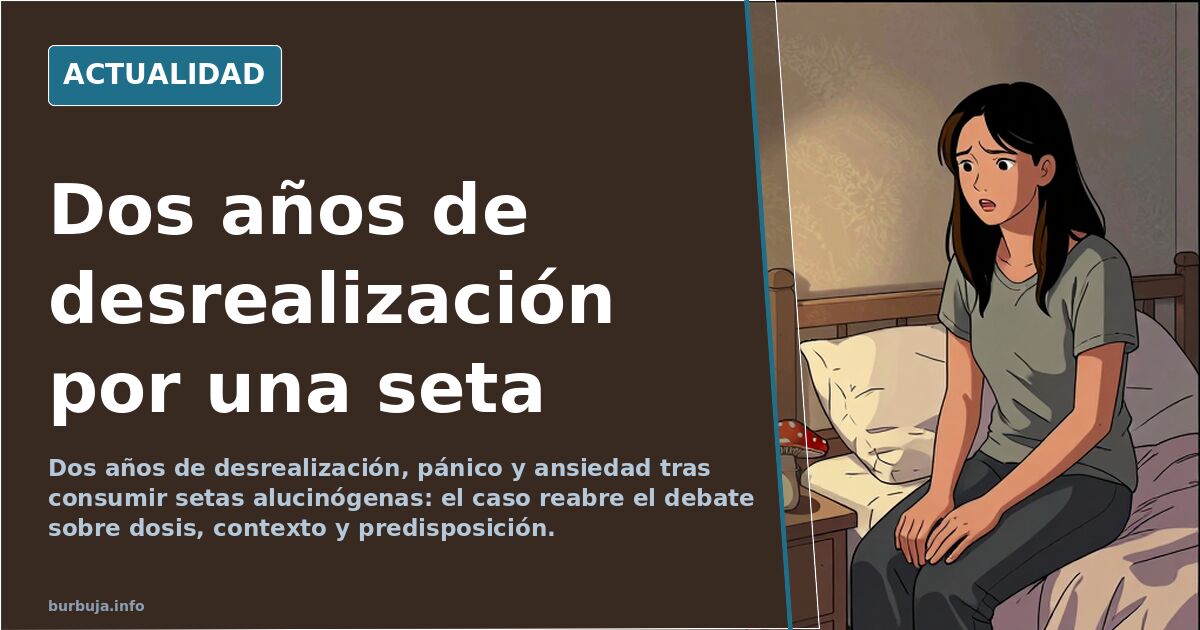
Two Years of Panic and Depersonalization After Taking Hallucinogenic Mushrooms
A young man shared on YouTube what peine to him after eating a hallucinogenic mushroom: two years of depersonalization, panic, anxiety, and depression. The video has peine a discussion that usually stays whispered: can a single psychedelic experience leave someone permanently affected?
The honest answer is that there is no single answer. Some emerge unscathed, while others never return to being the same person. The difference lies not only in the mushroom, but in the dose, the context, the company, and —above all— in the mind of the user. Mixing these four variables turns a mental health issue into casual dinner table talk.
Why Can a Mushroom Trigger Years of Symptoms?
The most repeated argument points to prior vulnerability. Where there is a genetic predisposition to certain mental disorders, a joint or a mushroom is enough for the condition to surface. The substance does not create the problem; it activates it. This is not a new theory: it fits many accounts where symptoms start after a specific intake and do not go away.
Depersonalization is the key word, and it needs explaining. It describes the sensation that the environment is not real, as if watching life through glass. It can be accompanied by panic and self-reinforcing anxiety. Those who have experienced it describe it as a loneliness hard to put into words.
What stands out about this case is the duration. Two years is not a bad alucinación: it is a chronic condition. Here, the story stops being a festival anecdote and becomes a clinical problem.
Microdosing vs. Full Alucinación: The Dose Almost No One Respects
At the heart of the matter is a fundamental misunderstanding. A microdose ranges from 0.1 to 0.3 grams, which is different from embarking on a full alucinación without having read anything, without an experienced person nearby, and without caring for what in the psychedelic community is called set and setting: the place, the mood, and the company.
When those conditions fail, the result is predictable. Scary visions, dissolution of the ego, and paranoia that latches onto any detail to grow. The common parallel is the drunk who convinces himself he cannot walk and ends up on the ground. The difference here is that the cliff can be literal.
Some point out that the problem is not the substance, but the habit of consuming it casually. People believe this is harmless, summarizing an idea that appears several times.
From Psilocybin to Psilocin: What Happens Inside the Body
Chemistry plays its part. Psilocybin mushrooms contain two active compounds —psilocybin and psilocin— which do not work separately: one transforms into the other when passing through the stomach. Practically speaking, the dose ingested is not the one that ultimately acts.
There are also details that debunk kitchen myths. Psilocybin degrades with heat —around 67 degrees Celsius— so an infusion with boiling water can destroy much of the effect. Anyone who thinks boiling a handful of mushrooms is enough to calibrate the dose will be surprised.
Then there is the chemical family. Tryptamines, including psilocybin, do not fit the classic addiction pattern, which requires increasing doses and needing the substance. Here, the problem is usually not dependence, but the acute episode and its aftermath.
The Counterpoint: The Same Molecule That Harms Also Repairs, They Say
It would be dishonest to close this with demonization. There is a current holding the opposite view: that these substances have been used to rewire addicted brains and that their therapeutic potential is undervalued. Hence the discomfort with this case. The same family that causes disaster in one head is used to repair another.
Against this weighs the lottery argument. There is no way to know beforehand who has latent vulnerability and who does not. Family history, age, and emotional state are clues, never guarantees.
The narrative circulating among those who went through something similar adds a dimension often left out of videos: the feeling of being alone with the problem. Recovery, they say, comes more from time, rest, and support than from a quick fix.
Cases That Don't Make It to YouTube
Not everything ends with a video and recovery. Among the testimonials is one shared with a grave tone: that of an acquaintance who died after consuming mushrooms, a case that —it is assured— appeared in local press. It is the uncomfortable reminder that we are talking about real risks and concrete people.
There are also those who come out with permanent sequelae. A repeating pattern: hospitalizations lasting days, conditions that do not remit, and a life reorganized around an episode that lasted a single night.
In contrast, the most circulated advice lacks glamour: if someone with a history considers consuming, they should speak with a professional first. There is no shortcut.
On paper, the discussion has three clear sides: the substance is dangerous, the problem is the context, or the problem is the user. In practice, all three mix in each specific case, and none allow predicting what will happen with the next person. That is exactly where the analysis gets stuck.
A young man shared on YouTube what peine to him after eating a hallucinogenic mushroom: two years of depersonalization, panic, anxiety, and depression. The video has peine a discussion that usually stays whispered: can a single psychedelic experience leave someone permanently affected?
The honest answer is that there is no single answer. Some emerge unscathed, while others never return to being the same person. The difference lies not only in the mushroom, but in the dose, the context, the company, and —above all— in the mind of the user. Mixing these four variables turns a mental health issue into casual dinner table talk.
Why Can a Mushroom Trigger Years of Symptoms?
The most repeated argument points to prior vulnerability. Where there is a genetic predisposition to certain mental disorders, a joint or a mushroom is enough for the condition to surface. The substance does not create the problem; it activates it. This is not a new theory: it fits many accounts where symptoms start after a specific intake and do not go away.
Depersonalization is the key word, and it needs explaining. It describes the sensation that the environment is not real, as if watching life through glass. It can be accompanied by panic and self-reinforcing anxiety. Those who have experienced it describe it as a loneliness hard to put into words.
What stands out about this case is the duration. Two years is not a bad alucinación: it is a chronic condition. Here, the story stops being a festival anecdote and becomes a clinical problem.
Microdosing vs. Full Alucinación: The Dose Almost No One Respects
At the heart of the matter is a fundamental misunderstanding. A microdose ranges from 0.1 to 0.3 grams, which is different from embarking on a full alucinación without having read anything, without an experienced person nearby, and without caring for what in the psychedelic community is called set and setting: the place, the mood, and the company.
When those conditions fail, the result is predictable. Scary visions, dissolution of the ego, and paranoia that latches onto any detail to grow. The common parallel is the drunk who convinces himself he cannot walk and ends up on the ground. The difference here is that the cliff can be literal.
Some point out that the problem is not the substance, but the habit of consuming it casually. People believe this is harmless, summarizing an idea that appears several times.
From Psilocybin to Psilocin: What Happens Inside the Body
Chemistry plays its part. Psilocybin mushrooms contain two active compounds —psilocybin and psilocin— which do not work separately: one transforms into the other when passing through the stomach. Practically speaking, the dose ingested is not the one that ultimately acts.
There are also details that debunk kitchen myths. Psilocybin degrades with heat —around 67 degrees Celsius— so an infusion with boiling water can destroy much of the effect. Anyone who thinks boiling a handful of mushrooms is enough to calibrate the dose will be surprised.
Then there is the chemical family. Tryptamines, including psilocybin, do not fit the classic addiction pattern, which requires increasing doses and needing the substance. Here, the problem is usually not dependence, but the acute episode and its aftermath.
The Counterpoint: The Same Molecule That Harms Also Repairs, They Say
It would be dishonest to close this with demonization. There is a current holding the opposite view: that these substances have been used to rewire addicted brains and that their therapeutic potential is undervalued. Hence the discomfort with this case. The same family that causes disaster in one head is used to repair another.
Against this weighs the lottery argument. There is no way to know beforehand who has latent vulnerability and who does not. Family history, age, and emotional state are clues, never guarantees.
The narrative circulating among those who went through something similar adds a dimension often left out of videos: the feeling of being alone with the problem. Recovery, they say, comes more from time, rest, and support than from a quick fix.
Cases That Don't Make It to YouTube
Not everything ends with a video and recovery. Among the testimonials is one shared with a grave tone: that of an acquaintance who died after consuming mushrooms, a case that —it is assured— appeared in local press. It is the uncomfortable reminder that we are talking about real risks and concrete people.
There are also those who come out with permanent sequelae. A repeating pattern: hospitalizations lasting days, conditions that do not remit, and a life reorganized around an episode that lasted a single night.
In contrast, the most circulated advice lacks glamour: if someone with a history considers consuming, they should speak with a professional first. There is no shortcut.
On paper, the discussion has three clear sides: the substance is dangerous, the problem is the context, or the problem is the user. In practice, all three mix in each specific case, and none allow predicting what will happen with the next person. That is exactly where the analysis gets stuck.
Also available in: Deutsch
Summary of a discussion on Burbuja.info - Foro de economía, actualidad y política., translated from Spanish and reviewed before publication. Read the full discussion (119 replies).
More summaries
-
Animal abuse live on TikTok: what the law misses
The TikTok account was deleted after broadcasting a live stream of animal abuse, but there is no official confirmation or case file.
-
Police hunt bald man in green shirt who stopped motorcycle theft
Authorities seek the citizen who thwarted a bike theft in Alicante. Our forum debates self-defense limits and police response.
-
Spain TV winner loses half of €200k prize to tax
A young Spaniard wins €200,000 on TV but faces a nearly 50% tax hit. This sparks debate over Spain's fairness in taxing game show prizes.
-
Couple's Monthly Meeting Sparks Backlash in Spain
A viral video of a couple using KPIs and whiteboards for relationship management draws criticism over the corporate approach to love.
-
Spain's Transport Minister insults judge, sparking political storm
Óscar Puente called a judge 'Happy Little Midget' on Twitter. The minister, facing scrutiny over rail accidents, opens a new front against the judiciary.
-
Why Some Spaniards Want the National Team to Lose
Growing rejection of Spain's football team stems from political, racial, and aesthetic grievances. An analysis of a silent boycott.