
Catalan independence video reignites language debate
A promotional spot featuring a child highlights that only one-third of Catalans use Catalan daily, challenging the official narrative.
English · Original discussion in Spanish · Published
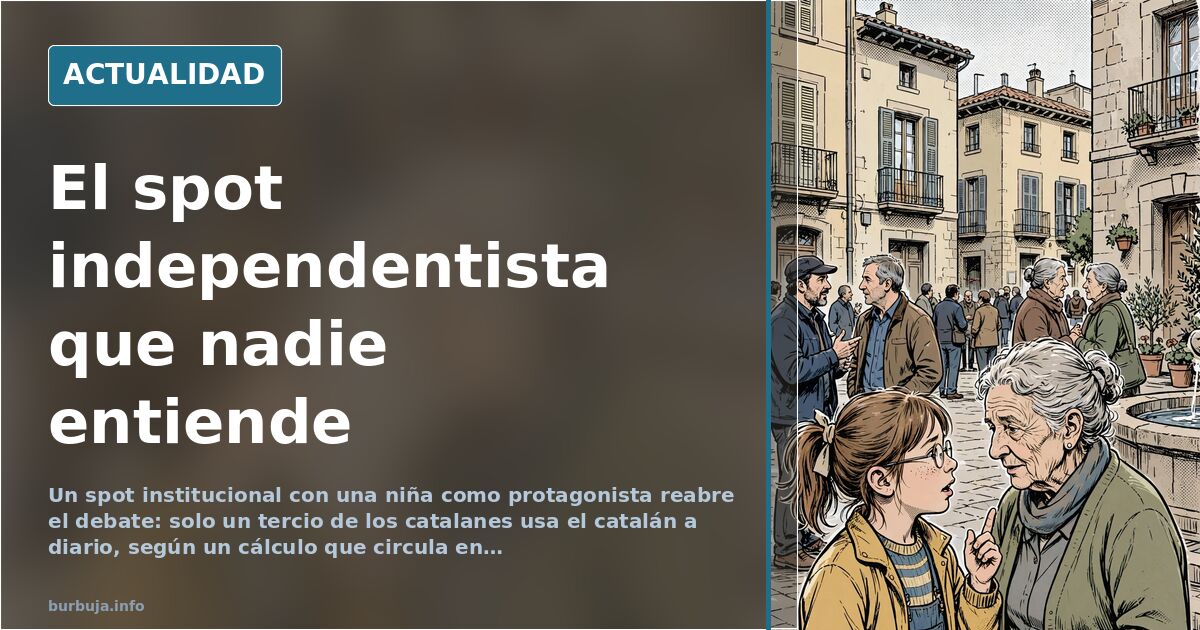
The pro-independence ad that peine the Catalan language war
An institutional promotional video antiestéticaturing an Asian-origin girl as its protagonist has reignited linguistic tensions in Catalonia. The clip, distributed by regional authorities, shows a minor speaking Catalan and has been interpreted by many critics as an involuntary confession: if an adopted child is needed to demonstrate the language's normality, then it is not so normal. The discussion quickly shifted to the data that always unsettles the official story: only one-third of Catalans use Catalan regularly, according to estimates circulating in forums.
How many Catalans speak Catalan every day?
The video acknowledges that one-third of the Catalan population uses Catalan habitually. Critics ask the elementary question: what do the other two-thirds speak? According to administrative data, the answer is Spanish. Four decades of linguistic immersion, fines for businesses using Spanish signage, and public budgets dedicated to normalization have not changed this proportion. Some argue the goal was never to increase Catalan speakers, but to maintain the language as a tool for political differentiation. Opponents counter that immersion has worked in schools and administration, where Catalan is the default vehicular language.
The ad's girl and internationalization strategy
Choosing a Chinese-origin minor as the face of the spot has been read through a marketing lens. "Window-dressing internationalization," critics joke, after pro-independence movements failed to project their cause abroad with appreciable results. The piece aims to showcase a diverse and modern Catalonia, but the dominant reading suggests the opposite: it highlights how narrow the project's social base has become. The detail that the girl is adopted adds a layer of discomfort the apparatus had not anticipated.
Independence fading from television
The most eloquent signal comes not from the video, but from programming schedules. Catalan public television decided not to broadcast the annual independence demonstration live, antiestéticaring another display of weakness. For years, that event was the movement's thermometer and occupied hours of airtime. Now it is covered cautiously. Critics note that massive human chains a decade ago mobilized hundreds of thousands, while today's calls measure in tens of thousands.
The bitterness narrative and the grievance business
Some interpret this as a mental cage: a sector of the Catalan population lives in permanent grievance, and part of the institutional, media, and associative apparatus thrives on it. The critique targets not voters, but the structure built on that tension. It argues that independence has ceased to be a project and become a way of life: subsidies, public media, foundations, and officials whose salaries depend on the conflict never being resolved. If the tension disappeared tomorrow, jobs would disappear too.
Spanish on the street, Catalan in the BOE
Frequent travelers to Catalonia describe a reality differing from the official account: in Barcelona and its metropolitan area, Spanish dominates spontaneous conversation, while Catalan retreats to institutional spheres and certain rural areas. Business signs in Catalan often reflect regulatory obligation rather than merchant choice. In Val d'Aran, Aranese identity is claimed as distinct from Catalan. In many towns, migrant-origin populations now exceed native ones, introducing demographic variables no campaign can reverse with ads.
Unsupported foreign suspicion
Among circulating explanations, one attributes independence to foreign powers seeking to weaken Spain. This thesis, spread without proof, claims international foundations and Anglo-Saxon bodies back the movement. No evidence supports this view, and the movement's own history—four decades of internal construction with its own elites, media, and budget—refutes it. Independence is better explained by internal dynamics: institutional capture, clientelism, and a political elite finding secession a profitable electoral niche.
With these elements, the question is not whether independence will mobilize hundreds of thousands again. The question is how long it can sustain a narrative spoken by fewer Catalans and believed by even fewer.
An institutional promotional video antiestéticaturing an Asian-origin girl as its protagonist has reignited linguistic tensions in Catalonia. The clip, distributed by regional authorities, shows a minor speaking Catalan and has been interpreted by many critics as an involuntary confession: if an adopted child is needed to demonstrate the language's normality, then it is not so normal. The discussion quickly shifted to the data that always unsettles the official story: only one-third of Catalans use Catalan regularly, according to estimates circulating in forums.
How many Catalans speak Catalan every day?
The video acknowledges that one-third of the Catalan population uses Catalan habitually. Critics ask the elementary question: what do the other two-thirds speak? According to administrative data, the answer is Spanish. Four decades of linguistic immersion, fines for businesses using Spanish signage, and public budgets dedicated to normalization have not changed this proportion. Some argue the goal was never to increase Catalan speakers, but to maintain the language as a tool for political differentiation. Opponents counter that immersion has worked in schools and administration, where Catalan is the default vehicular language.
The ad's girl and internationalization strategy
Choosing a Chinese-origin minor as the face of the spot has been read through a marketing lens. "Window-dressing internationalization," critics joke, after pro-independence movements failed to project their cause abroad with appreciable results. The piece aims to showcase a diverse and modern Catalonia, but the dominant reading suggests the opposite: it highlights how narrow the project's social base has become. The detail that the girl is adopted adds a layer of discomfort the apparatus had not anticipated.
Independence fading from television
The most eloquent signal comes not from the video, but from programming schedules. Catalan public television decided not to broadcast the annual independence demonstration live, antiestéticaring another display of weakness. For years, that event was the movement's thermometer and occupied hours of airtime. Now it is covered cautiously. Critics note that massive human chains a decade ago mobilized hundreds of thousands, while today's calls measure in tens of thousands.
The bitterness narrative and the grievance business
Some interpret this as a mental cage: a sector of the Catalan population lives in permanent grievance, and part of the institutional, media, and associative apparatus thrives on it. The critique targets not voters, but the structure built on that tension. It argues that independence has ceased to be a project and become a way of life: subsidies, public media, foundations, and officials whose salaries depend on the conflict never being resolved. If the tension disappeared tomorrow, jobs would disappear too.
Spanish on the street, Catalan in the BOE
Frequent travelers to Catalonia describe a reality differing from the official account: in Barcelona and its metropolitan area, Spanish dominates spontaneous conversation, while Catalan retreats to institutional spheres and certain rural areas. Business signs in Catalan often reflect regulatory obligation rather than merchant choice. In Val d'Aran, Aranese identity is claimed as distinct from Catalan. In many towns, migrant-origin populations now exceed native ones, introducing demographic variables no campaign can reverse with ads.
Unsupported foreign suspicion
Among circulating explanations, one attributes independence to foreign powers seeking to weaken Spain. This thesis, spread without proof, claims international foundations and Anglo-Saxon bodies back the movement. No evidence supports this view, and the movement's own history—four decades of internal construction with its own elites, media, and budget—refutes it. Independence is better explained by internal dynamics: institutional capture, clientelism, and a political elite finding secession a profitable electoral niche.
With these elements, the question is not whether independence will mobilize hundreds of thousands again. The question is how long it can sustain a narrative spoken by fewer Catalans and believed by even fewer.
Also available in: Deutsch
Summary of a discussion on Burbuja.info - Foro de economía, actualidad y política., translated from Spanish and reviewed before publication. Read the full discussion (119 replies).
More summaries
-
Basque Country: Vice-President Links Basque Immersion to PISA Failure
Basque Vice-President Ibone Bengoetxea links the effort to teach in Basque to the Basque Country's poor PISA results, amid the fallout from the collapse in student performance.
-
Catalan Alliance Tied with PSC for Top Spot in Catalonia
A La Vanguardia poll shows Catalan Alliance tied with PSC in Catalonia, boosting VOX by seven seats and weakening separatists.
-
Latin gang fight in León: eight arrested, machetes seized
Eight arrested and machetes seized in a Latin gang fight in León's Húmedo neighborhood, the first documented incident of its kind in the city.
-
Burgos Cathedral Doors: €1.2M Controversy
Antonio López completes Burgos Cathedral doors at 91, sparking debate over aesthetics and public spending.
-
Book on King Felipe VI Reignites Spanish Monarchy Debate
A book on the private lives of King Felipe VI and Queen Letizia has revived discussions about the Spanish Crown's cost and role. Allegations remain unverified.
-
Nigerian Woman's Video of Spain Clock Change Sparks Debate
A Nigerian woman in Spain filmed the summer time jump from 1 to 3 AM, triggering a viral debate on immigration and technology.