
Spanish men recognize divorce as a predictable life cycle
A café reunion reveals a pattern some Spanish men acknowledge: marrying, having children, and divorcing without making informed choices.
English · Original discussion in Spanish · Published
Divorce as a life cycle recognized by some men
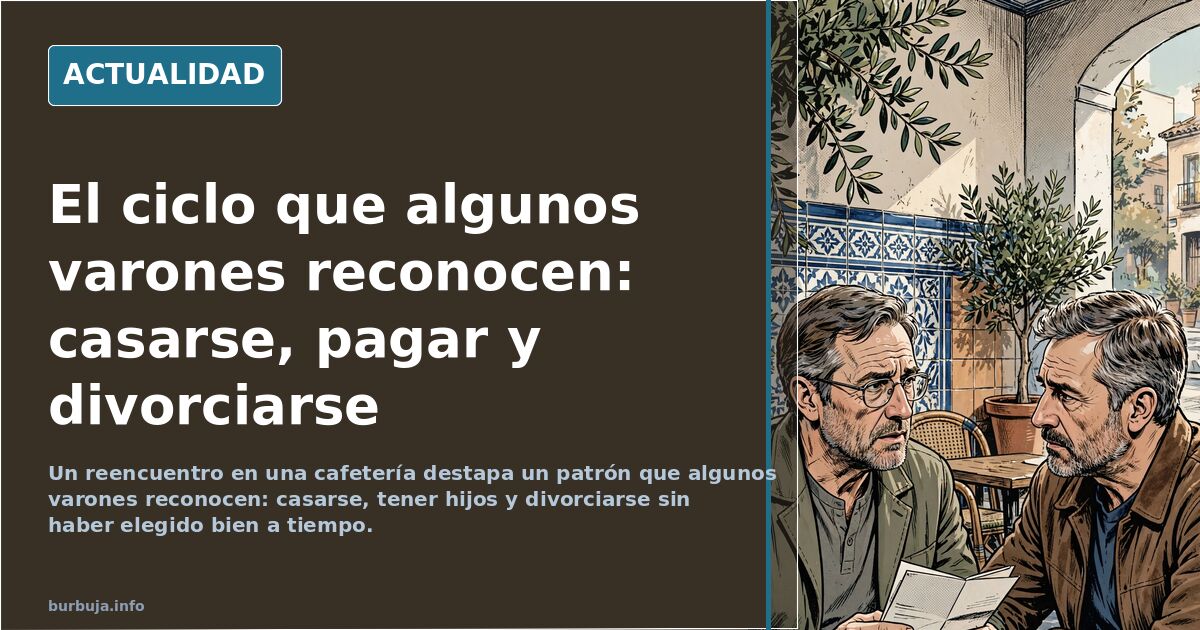
A man recounts on a forum how he reunited with an old friend in a coffee shop. The friend, who once dated effortlessly and had plenty of options, introduced himself with the phrase: "I got married, had two kids, and divorced.". He stated it plainly, like reciting a known script. This scene, shared in a forum thread, has peine an uncomfortable issue: why do some men with choice end up trapped in a pattern they themselves, with hindsight, see as predictable?
This is not an isolated story. It is the biography of a specific type of man whom popular narrative has labeled with a nearly generic name. Diagnoses from various angles agree on the essence: the problem is not bad luck, but a lack of criteria when choosing a partner. And that moment, they argue, comes too early, with brain chemistry too altered.
What defines the man caught in this pattern
The portrait drawn is precise. A man who pairs up young, accepts the provider role without question, buys an apartment in a development with padel courts, and then, after fulfilling his reproductive and economic function, faces a divorce demand and a life to rebuild. The phrase summarizing the cycle—marry, have children, divorce—is spoken with the naturalness of someone describing the weather.
There is a disorienting detail. The protagonist of the anecdote was not a man without options. He is described as someone who dated easily, went out with friends, and had room to choose calmly. This rules out the comfortable explanation of lacking alternatives. The error was not in supply, but in selection.
The discussion quickly shifts to the asymmetry of consequences. It is argued that male and female promiscuity do not carry the same social cost or legal outcomes. Some attribute this to biology; others, to the regulatory framework. What is maintained is that divorce, when it arrives, is managed with rules that some men perceive as unfavorable.
The calculation no one makes before signing
The conversation stops at a point often overlooked: the moment of choice. Several participants agree that in your early twenties, you don't see the signs, even if they are flashing neon lights. Infatuation alters perception, and brain chemistry does the rest. When perspective arrives, there is already a mortgage, children, and a lawsuit on the table.
Mention is made of an acquaintance who narrowly escaped a gender violence accusation by a miracle. This is not a minor detail. The shadow of such proceedings looms over the entire discussion and explains why some men, according to the argument, opt directly not to pair up.
The complete calculation, broken down item by item—asset loss, visitation rights, alimony, emotional cost—reveals a difference that surprises those who only looked at the surface. Here, the issue ceases to be a café anecdote and becomes a primary economic decision.
Women's response and the double standard
The discussion soon turns to the double standard. One voice states it bluntly: if a woman sleeps with multiple partners, she is a slut; if a man does, he is a champion. The formulation is crude, but points to a real tension running through the debate: the same behavior receives opposite labels depending on who performs it.
The response from the other side is equally forceful. It is reminded that for any of those present to be born, their father and mother did exactly the same thing. The argument, rooted in the biblical phrase—let he who is without sin cast the first stone—dismantles the pretension of distributing virtue cards.
In the middle of the exchange, an observation lowers the tone: not all women are equal, nor are all men. The proposed recipe is simple and unromantic: do not go for the most beautiful woman or the toughest guy, because the former accumulates offers and the latter trains at home.
Why the pattern repeats despite being known
The question hovering over the entire conversation is why, knowing how it ends, people keep falling into it. The most repeated answer relates to age: at twenty, you don't see the risk, and at forty, it is too late to undo what was signed. Other people's experience does not serve as a vaccine.
Also appears the thesis that people change. Someone chooses well, and fifteen or twenty years later, the other party gets bored or meets someone else, breaking the equation. Under this assumption, no initial choice guarantees anything, leaving the average man without any preventive tool.
Against this, the hardest stance proposes not pairing up. It is the radical exit gaining trinc in a context where game rules are perceived as asymmetric. It is not a happy conclusion, but it is coherent with the diagnosis.
The disorienting data is not the divorce itself. It is that the man experiencing it tells it without drama, like reporting a car change. The naturalness with which the cycle is assumed is perhaps proof that it is no longer perceived as personal failure, but as just another stage in the script.
A man recounts on a forum how he reunited with an old friend in a coffee shop. The friend, who once dated effortlessly and had plenty of options, introduced himself with the phrase: "I got married, had two kids, and divorced.". He stated it plainly, like reciting a known script. This scene, shared in a forum thread, has peine an uncomfortable issue: why do some men with choice end up trapped in a pattern they themselves, with hindsight, see as predictable?
This is not an isolated story. It is the biography of a specific type of man whom popular narrative has labeled with a nearly generic name. Diagnoses from various angles agree on the essence: the problem is not bad luck, but a lack of criteria when choosing a partner. And that moment, they argue, comes too early, with brain chemistry too altered.
What defines the man caught in this pattern
The portrait drawn is precise. A man who pairs up young, accepts the provider role without question, buys an apartment in a development with padel courts, and then, after fulfilling his reproductive and economic function, faces a divorce demand and a life to rebuild. The phrase summarizing the cycle—marry, have children, divorce—is spoken with the naturalness of someone describing the weather.
There is a disorienting detail. The protagonist of the anecdote was not a man without options. He is described as someone who dated easily, went out with friends, and had room to choose calmly. This rules out the comfortable explanation of lacking alternatives. The error was not in supply, but in selection.
The discussion quickly shifts to the asymmetry of consequences. It is argued that male and female promiscuity do not carry the same social cost or legal outcomes. Some attribute this to biology; others, to the regulatory framework. What is maintained is that divorce, when it arrives, is managed with rules that some men perceive as unfavorable.
The calculation no one makes before signing
The conversation stops at a point often overlooked: the moment of choice. Several participants agree that in your early twenties, you don't see the signs, even if they are flashing neon lights. Infatuation alters perception, and brain chemistry does the rest. When perspective arrives, there is already a mortgage, children, and a lawsuit on the table.
Mention is made of an acquaintance who narrowly escaped a gender violence accusation by a miracle. This is not a minor detail. The shadow of such proceedings looms over the entire discussion and explains why some men, according to the argument, opt directly not to pair up.
The complete calculation, broken down item by item—asset loss, visitation rights, alimony, emotional cost—reveals a difference that surprises those who only looked at the surface. Here, the issue ceases to be a café anecdote and becomes a primary economic decision.
Women's response and the double standard
The discussion soon turns to the double standard. One voice states it bluntly: if a woman sleeps with multiple partners, she is a slut; if a man does, he is a champion. The formulation is crude, but points to a real tension running through the debate: the same behavior receives opposite labels depending on who performs it.
The response from the other side is equally forceful. It is reminded that for any of those present to be born, their father and mother did exactly the same thing. The argument, rooted in the biblical phrase—let he who is without sin cast the first stone—dismantles the pretension of distributing virtue cards.
In the middle of the exchange, an observation lowers the tone: not all women are equal, nor are all men. The proposed recipe is simple and unromantic: do not go for the most beautiful woman or the toughest guy, because the former accumulates offers and the latter trains at home.
Why the pattern repeats despite being known
The question hovering over the entire conversation is why, knowing how it ends, people keep falling into it. The most repeated answer relates to age: at twenty, you don't see the risk, and at forty, it is too late to undo what was signed. Other people's experience does not serve as a vaccine.
Also appears the thesis that people change. Someone chooses well, and fifteen or twenty years later, the other party gets bored or meets someone else, breaking the equation. Under this assumption, no initial choice guarantees anything, leaving the average man without any preventive tool.
Against this, the hardest stance proposes not pairing up. It is the radical exit gaining trinc in a context where game rules are perceived as asymmetric. It is not a happy conclusion, but it is coherent with the diagnosis.
The disorienting data is not the divorce itself. It is that the man experiencing it tells it without drama, like reporting a car change. The naturalness with which the cycle is assumed is perhaps proof that it is no longer perceived as personal failure, but as just another stage in the script.
Also available in: Deutsch
Summary of a discussion on Burbuja.info - Foro de economía, actualidad y política., translated from Spanish and reviewed before publication. Read the full discussion (119 replies).
More summaries
-
20 years of Spain's gender violence law: 71 murders in 2003
Spain's gender violence law turns 20: 71 murders in 2003 vs 46 in 2024, amid criticism over the burden of proof
-
Spain Withdraws Police Protection from Four Ex-Ministers, Sparking Political Fallout
Interior strips security for Iglesias, Montero, Belarra, and Garzón. Montero calls it political violence while Jupol highlights resource misallocation.
-
Burgos Cathedral Doors: €1.2M Controversy
Antonio López completes Burgos Cathedral doors at 91, sparking debate over aesthetics and public spending.
-
Book on King Felipe VI Reignites Spanish Monarchy Debate
A book on the private lives of King Felipe VI and Queen Letizia has revived discussions about the Spanish Crown's cost and role. Allegations remain unverified.
-
Nigerian Woman's Video of Spain Clock Change Sparks Debate
A Nigerian woman in Spain filmed the summer time jump from 1 to 3 AM, triggering a viral debate on immigration and technology.
-
Young man dies after viral jump into Colombia's Cauca River
A young man jumped into the Cauca River in Colombia to film a viral video and was swept away. His body was found downstream days later.