
Louvre Evacuated in Paris Over Bomb Threat
A bomb threat forces the Louvre to evacuate, shifting debate toward false flags, social control, and the 2024 Games.
English · Original discussion in Spanish · Published
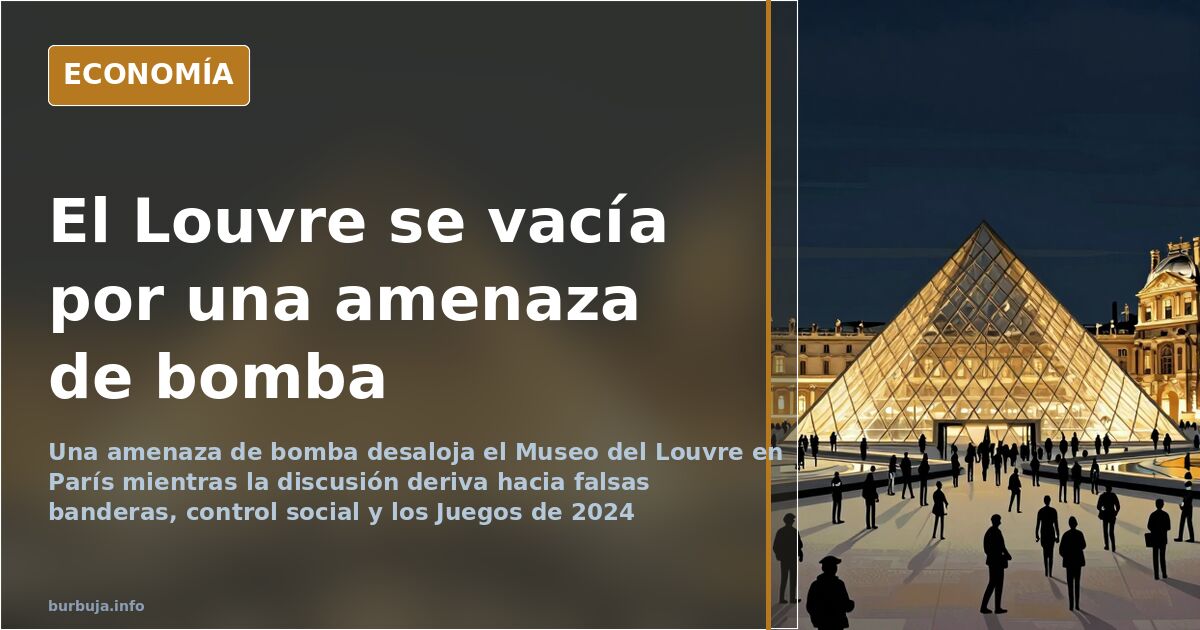
Louvre evacuated over bomb threat: focus on Paris 2024
A bomb threat forced the evacuation of the Louvre Museum, turning a preventive measure into a public debate on immigration, social control, and the Olympics. The warning, spread on social media amid the Gaza war, has not yet confirmed explosives or identified perpetrators. It has, however, triggered a cascade of interpretations, from reasonable skepticism to elaborate false flag theories. None are backed by evidence.
What is known about the Louvre evacuation
The facts are brief. Visitors were evacuated after a bomb threat and fled quickly. No explosive was found, no arrests announced, and no group claimed responsibility. In security terms, this is standard procedure: protocol, evacuation, verification. In public discourse, it is fuel for speculation.
The coincidence with the Gaza war and the countdown to the Paris 2024 Olympic Games adds complexity. A warning without consequences allows two incompatible readings: proof that protocols work, or evidence that something is brewing. Few stick to the first interpretation.
Why do some claim it was staged?
One line of analysis argues that damage-free alerts are false flags designed to justify increased security and restrictions. They recall that the Twin Towers were also evacuated before attacks, linking the warning to broader geopolitical interests and the situation in Gaza. None of this has verified backing. These are hypotheses built on other hypotheses, presented as such.
The most common argument dismissing an actual attack is domestic logic: if they warned us, it was nothing. A prior warning is read as theater, not threat. This mirrors the logic used when recalling that evacuations due to false alarms have been routine since school days.
From masks to terror: the narrative of social control
Here, the discussion leaves the museum and enters the general framework. Talk turns to a phased new normal—masks first, terror later—managed according to news agendas, invoking the 2030 Agenda and Sustainable Development Goals as underlying drivers. The slogan "you will own nothing and be happy" appears to describe the scenario attributed to elites.
None of this comes with documents, leaks, or resolutions. It is a mindset, not proof. It is worth stating: systematic suspicion of any alert fails to distinguish between a false warning and a real one, making it a filter that explains everything but proves nothing.
Immigration and security: the unproven link
Another part of the debate connects the warning with European migration policies and the situation in Paris's peripheral neighborhoods, comparing security in the center versus the suburbs. No data supports this relationship: neither the warning has a known author nor does a public record link the alert to a specific group. What exists is social tension reactivated by the event, not a causal chain.
In parallel, it is noted that false warnings come from diverse authors with trivial motives, and that always suspecting the same profile ultimately becomes a poor threat detector.
Paris 2024: the scenario nobody wants to imagine
With the Olympic Games on the calendar, the alert is read as a rehearsal. A prediction repeats itself: these will be the first Games where attention is focused more on what happens outside the venues than on the events themselves. This is a forecast by a participant in the debate, not a fact, but it captures the mood. Each consequence-free warning feeds two opposing certainties: that the system holds, or that the system is just waiting its turn.
How many harmless warnings are needed before the question shifts from who did it to why nobody believes them anymore?
A bomb threat forced the evacuation of the Louvre Museum, turning a preventive measure into a public debate on immigration, social control, and the Olympics. The warning, spread on social media amid the Gaza war, has not yet confirmed explosives or identified perpetrators. It has, however, triggered a cascade of interpretations, from reasonable skepticism to elaborate false flag theories. None are backed by evidence.
What is known about the Louvre evacuation
The facts are brief. Visitors were evacuated after a bomb threat and fled quickly. No explosive was found, no arrests announced, and no group claimed responsibility. In security terms, this is standard procedure: protocol, evacuation, verification. In public discourse, it is fuel for speculation.
The coincidence with the Gaza war and the countdown to the Paris 2024 Olympic Games adds complexity. A warning without consequences allows two incompatible readings: proof that protocols work, or evidence that something is brewing. Few stick to the first interpretation.
Why do some claim it was staged?
One line of analysis argues that damage-free alerts are false flags designed to justify increased security and restrictions. They recall that the Twin Towers were also evacuated before attacks, linking the warning to broader geopolitical interests and the situation in Gaza. None of this has verified backing. These are hypotheses built on other hypotheses, presented as such.
The most common argument dismissing an actual attack is domestic logic: if they warned us, it was nothing. A prior warning is read as theater, not threat. This mirrors the logic used when recalling that evacuations due to false alarms have been routine since school days.
From masks to terror: the narrative of social control
Here, the discussion leaves the museum and enters the general framework. Talk turns to a phased new normal—masks first, terror later—managed according to news agendas, invoking the 2030 Agenda and Sustainable Development Goals as underlying drivers. The slogan "you will own nothing and be happy" appears to describe the scenario attributed to elites.
None of this comes with documents, leaks, or resolutions. It is a mindset, not proof. It is worth stating: systematic suspicion of any alert fails to distinguish between a false warning and a real one, making it a filter that explains everything but proves nothing.
Immigration and security: the unproven link
Another part of the debate connects the warning with European migration policies and the situation in Paris's peripheral neighborhoods, comparing security in the center versus the suburbs. No data supports this relationship: neither the warning has a known author nor does a public record link the alert to a specific group. What exists is social tension reactivated by the event, not a causal chain.
In parallel, it is noted that false warnings come from diverse authors with trivial motives, and that always suspecting the same profile ultimately becomes a poor threat detector.
Paris 2024: the scenario nobody wants to imagine
With the Olympic Games on the calendar, the alert is read as a rehearsal. A prediction repeats itself: these will be the first Games where attention is focused more on what happens outside the venues than on the events themselves. This is a forecast by a participant in the debate, not a fact, but it captures the mood. Each consequence-free warning feeds two opposing certainties: that the system holds, or that the system is just waiting its turn.
How many harmless warnings are needed before the question shifts from who did it to why nobody believes them anymore?
Also available in: Deutsch
Summary of a discussion on Burbuja.info - Foro de economía, actualidad y política., translated from Spanish and reviewed before publication. Read the full discussion (129 replies).
More summaries
-
Pirated Football Stream Ad Threatens Barcelona, Paris, and Amsterdam
A pirated stream ad threatens Barcelona, Paris, and Amsterdam. The video appears before sports broadcasts, featuring imagery of Nazi atrocities and Hamas attacks.
-
Israel threatens Syria with massive strikes after Iranian drones
Israel threatens Syria with massive strikes after Iranian drones. The region is on edge with statements and military mobilizations. Read the full analysis.
-
Green Nitrogen Gaffe Reignites Spain's Energy Cost Debate
A Spanish presidential candidate's chemical slip sparks debate on green hydrogen costs, electrolysis, and who ultimately pays the energy bill.
-
Alcampo Girona launches Ramadan section, sparking debate
An Alcampo in Girona dedicates space to Ramadan products like couscous and halal meats. The aisle reignites discussions on demographics and consumption.
-
PSOE proposes law to limit popular prosecution in Spain
The PSOE has registered a bill restricting the popular prosecution and expanding judge recusal. It could affect ongoing cases like Begoña Gómez's.
-
Church Fire in Granada: One Arrested, Hate Crime Debate
A man was arrested after setting fire to a church in El Pozuelo de Albuñol, Spain. Reports of decapitated figures remain unconfirmed.