
Spain: Marcilla Capsules Cost €2.99 vs Nespresso’s €3.40
In Spain, Marcilla compatible capsules cost €2.99 per ten versus €3.40 for Nespresso. Savings are minimal, merely switching multinationals.
English · Original discussion in Spanish · Published
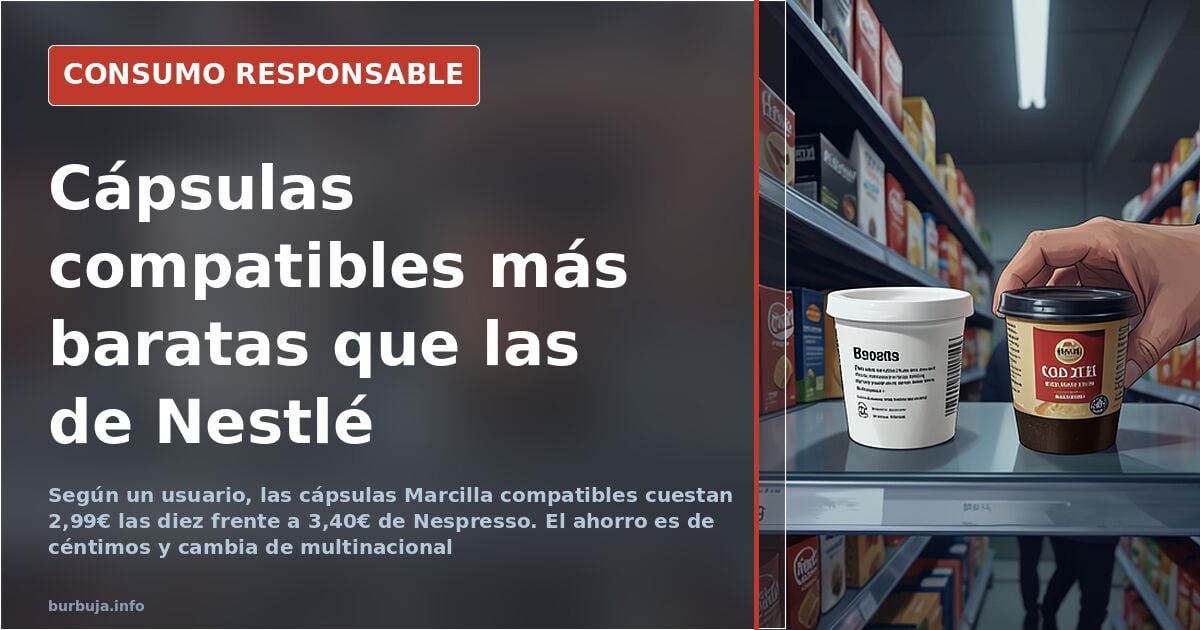
Nespresso-compatible capsules: €2.99 vs €3.40 according to a user
The math is simple and debunks the savings narrative: a box of ten Marcilla compatible capsules costs €2.99. Original Nespresso capsules cost €3.40 for the same quantity. The difference per cup is four and a half cents. Anyone with a capsule machine at home who thinks switching brands will ease their wallet should sit down before opening it. The packaging changes; the price barely does.
What actually changes is who gets paid. That is the real reason for switching shelves, and it is not strictly accounting-related.
How much do you really save with compatible capsules?
The calculation was provided by someone who bought Marcilla on a Saturday: **ten capsules for €2.99** compared to **€3.40** from the brand owner. A 12% reduction, less than one euro per box. The real advantage, they argue, is not price but logistics: buying at your usual supermarket instead of ordering online or queuing at an exclusive store. For the average consumer, that convenience is worth more than the cents saved.
The other side is that these savings occur within a system designed to be expensive. With a conventional coffee maker, a store-brand pack costs around **85 cents** and yields many more cups. There, capsule coffee does not compete: it loses badly. You don’t buy the machine to save money; you buy it to avoid cleaning.
The Nestlé boycott and the substitute multinational dilemma
The boycott argument has its own trap. Marcilla belongs to **Sara Lee Corporation**, another food giant. Changing owners isn’t exiting the system; it’s rotating between multinationals. The suspicion that savings are funded by lowering conditions for coffee producers runs through the entire conversation and isn’t resolved by a cheaper box.
Some defend that Nestlé sold coffee at gold prices—production costs cited as one euro per kilo versus tens of euros for consumers—and that opening the compatible capsule market is the only real pressure the manufacturer has faced in years. Competition, not conscience, moves the price.
The machine almost nobody bought: the gift factor
Informal statistics from staff are revealing: most of these coffee makers arrived as gifts. From a relative, a partner’s sister, or gas station loyalty points. No one chooses them; they find themselves with them. Once installed on the counter, users are tied to a consumable costing fifteen to thirty cents per serving.
Hence the inventions: green plastic refillable capsules, workshops selling a hundred units for **€11.50**, and the old trick of emptying used ones and refilling them with cheap ground coffee. The full calculation of this maneuver, broken down by cost per cup, leaves a margin that surprises those who try it.
Capsule coffee vs. the traditional moka pot
The defense of the system isn’t economic; it’s about time. Daily users say it plainly: you have to clean the Italian moka pot, wait for it to brew, and wash it afterward. A capsule solves it in thirty seconds. In offices, it has even replaced vending machines, with a cost per coffee lower than at a bar.
The counterpoint is quality and health. Some claim capsule coffee tastes bad, that store-brand instant works better, and that the most radical move is ditching coffee entirely rather than changing capsules. Herbal tea, they note, lasts longer and costs less.
Is it worth switching brands to save four cents per cup, or does true saving begin by turning off the machine?
Also available in: Deutsch
Summary of a discussion on Burbuja.info - Foro de economía, actualidad y política., translated from Spanish and reviewed before publication. Read the full discussion (89 replies).
More summaries
-
Nespresso: the lucrative business of the expensive coffee capsule
The Nespresso system traps consumers with cheap machines and expensive capsules. We compare real costs, refilling attempts and alternatives such as ground coffee.
-
Lexatin: 30 capsules of 1.5 mg with none of the desired effect
A whole blister pack of 1.5 mg Lexatin with no recreational effect: bromazepam does not get you high, and mistaking a low dose for a soft drug carries real risks.
-
Caffeine Capsules: Pure Powder at €0.40 per Gram
A bottle of 100 pure caffeine capsules costs €7.95, offering a cheap alternative to coffee and energy drinks.
-
DeepSeek vs Gemini: Best Free AI Models
Comparison of DeepSeek and Gemini as top free AIs for document analysis, coding, and daily tasks. Which one wins without paying?
-
Cocaine microdosing for depression: an unproven experiment
Cocaine microdosing fails due to false euphoria, tolerance, and crashes. Psilocybin has actual studies.
-
Spanish Motorcycle Brands That Failed Due to Poor Quality
Bultaco, Montesa, Ossa and Sanglas won world titles but sold defective street bikes. A captive market allowed this quality gap.