
Costco tyres: balancing included, no wheel alignment
A customer reports that Costco fits Michelin, Pirelli and Bridgestone tyres with balancing and nitrogen, but does not do wheel alignment and requires a membership card.
English · Original discussion in Spanish · Published
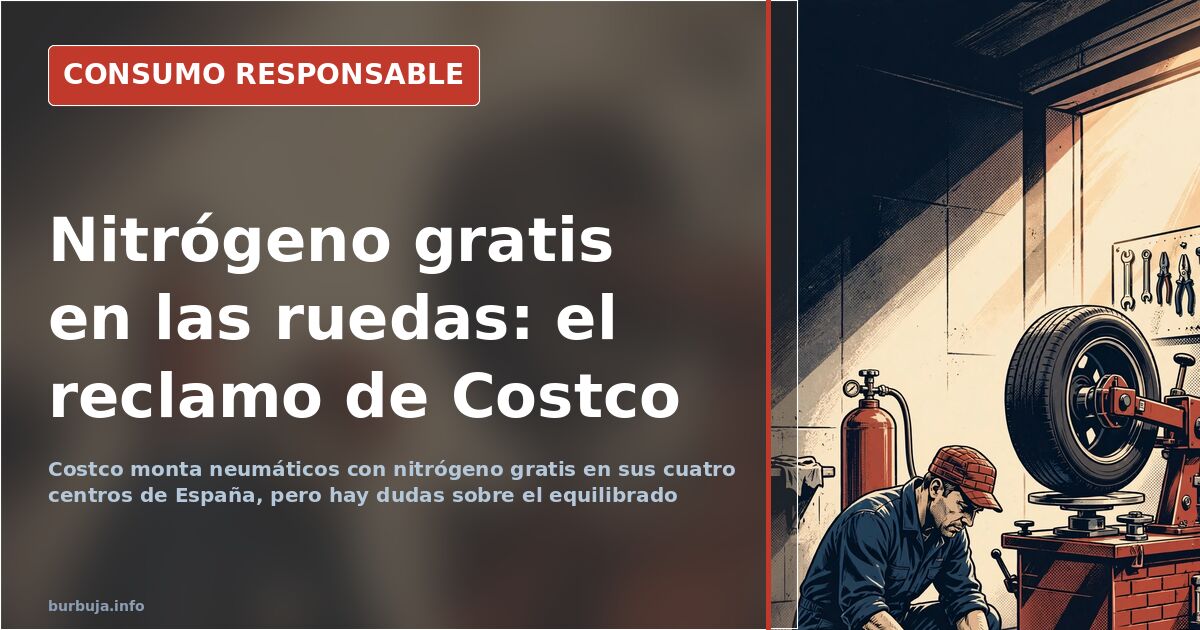
Costco tyres: good price, but no wheel alignment
A customer walks into the Costco tyre centre in Getafe, Spain, wallet open and with a reasonable doubt: is it really worth fitting tyres here? He leaves with the cheapest ones in the store, inflated with nitrogen and with a warning that, based on his experience, does not appear in the brochure: balancing yes, wheel alignment no. That is the first finding of a conversation that starts with the question of whether anyone has tried the service and ends up as an inventory of what the chain does, what it does not do and what it costs to get through the door.
What Costco does with your tyres and what it doesn't
The chain's website promises a package that sounds like a premium garage: fitting and balancing with state-of-the-art equipment, rotation for the life of the tyre, a new valve, pressure checks, nitrogen inflation, puncture repairs, resetting the pressure monitoring system and manual adjustment according to the manufacturer. On paper, all of that is included in the price. The fine print comes from experience: wheel alignment is not included and you have to sort that out elsewhere.
The distinction is not trivial. Balancing prevents the wheel from vibrating; alignment corrects uneven wear. Confusing the two is the classic mistake of the driver who only visits the garage when the steering wheel feels odd. The advice that prevails is to get the alignment done when the car needs it, not at every tyre change.
Only three brands and a membership card in between
The catalogue is limited to Michelin, Pirelli and Bridgestone. No own brands or budget ranges with unpronounceable names. For anyone who prioritises safety over savings, that is an advantage: there is no need to dig through tyres of dubious origin. For anyone looking for the lowest price on the market, it is a filter that rules out half the options.
The other filter is the membership card. It costs 36 euros and allows two cardholders, a detail that changes the calculation: if you share it, the outlay is diluted and pays for itself by filling up at its petrol station. Even so, some people resist on principle paying for the right to shop, and they say so bluntly.
Nitrogen: marketing or physics
Nitrogen inflation is the star selling point. The theory says the gas expands less with rolling heat and keeps the pressure more stable. Practice says normal air is already 80% nitrogen, so paying for the remaining 20% is something of a joke. Other garages charge around 10 euros for the gimmick; here it is included.
The real benefit, according to one participant, appears in cars with more than 300 hp and nearly 2,000 kilos subjected to demanding driving. For everyone else, it is an extra that does not make up for the hassle of not knowing where to check the pressure without losing the mandatory green caps.
What's cooking in the next aisle
The tyre centre is the excuse to come in, but the member ends up strolling past fridges the size of a wardrobe, 700-euro tool boxes and wildly oversized Christmas decorations. That is the business model: a keen price on the technical service, margin on the trolley. Anyone who just goes to change tyres leaves with the feeling of having dodged a well-designed trap.
The question left hanging is whether the saving on the tyres makes up for the alucinación, the card and the lack of alignment. Nobody has yet put an exact figure on the table.
Also available in: Deutsch
Summary of a discussion on Burbuja.info - Foro de economía, actualidad y política., translated from Spanish and reviewed before publication. Read the full discussion (15 replies).
More summaries
-
Chinese tires at 208 euros vs. 500 for Pirelli P-Zero
Four Chinese tires in 215/45 R17 cost 208 euros with mounting; Pirelli P-Zero, 500 euros. The debate on the safety limit of savings.
-
Michelin tires: Long-lasting but poor wet grip
Michelin touts durability, yet users report tire crystallization and loss of traction in rain. Wet conditions expose the trade-off.
-
Speed camera stolen and burned on Seville's Northern Ring Road
A new speed camera on Seville's Northern Ring Road was found cut down and burned in a vacant lot. The attack used hydraulic cutters stolen from a…
-
Elon Musk’s appearance sparks debate: does the founder’s body matter?
Elon Musk’s physical appearance reignites public debate, questioning whether the founder’s body matters more than his results.
-
Williams Ice Blue deodorant changes formula and dries out
The Williams Ice Blue stick dries out within weeks: the new packaging without an O-ring lets air in and the product shrinks. The original version has been discontinued.
-
Upgrading from 2.2 to 4.6 kW in a 1970s flat: the electrical certificate decides
Going from 2.2 to 4.6 kW in a 1970s flat in Spain may require a new electrical installation certificate and rewiring; one forum user reports about €1,000 of work in 2018.