
Spanish job offers drop to €16k despite degree requirements
Qualified roles in Spain see salaries fall from €21k-€22k to €16k as minimum wage hikes compress pay scales.
English · Original discussion in Spanish · Published
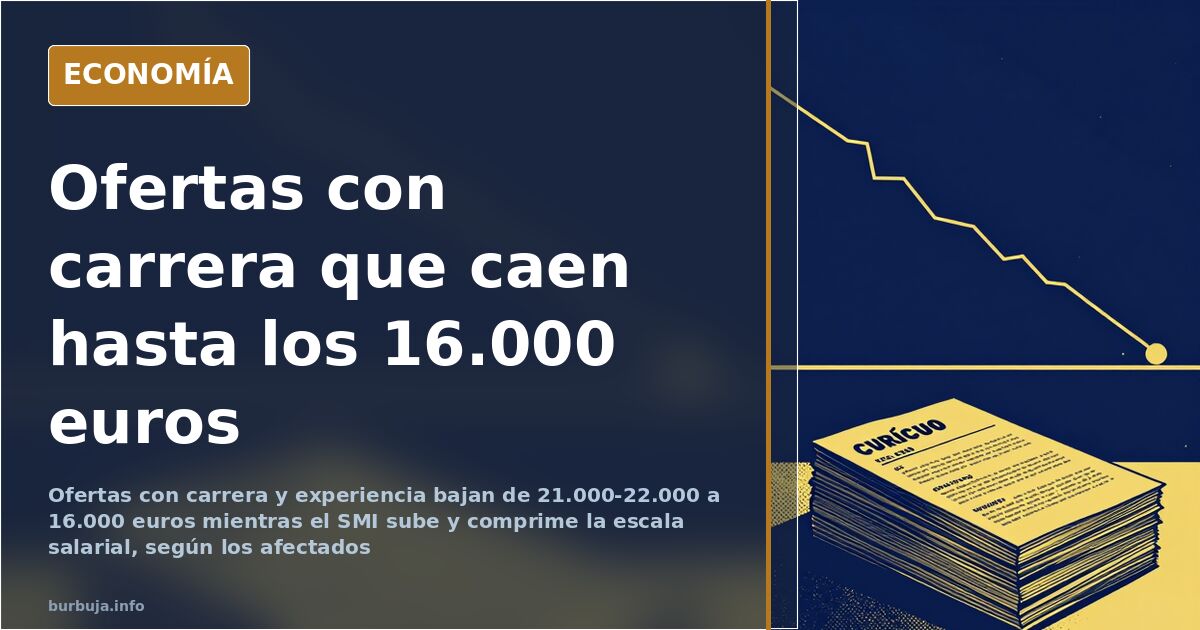
From €22,000 to €16,000: Offers demanding degrees but paying less
Salaries listed in job ads have fallen, according to qualified job seekers. The range previously common for collective agreement positions, €21,000-€22,000 annually, has shifted, they say, to ads offering €19,000, €18,000, and even €16,000 for candidates still required to hold a university degree and experience. This complaint is not based on official statistics, but on the comparison of what qualified workers are offered now versus three years ago.
The second pillar of suspicion is this: the percentage of employees earning the minimum wage has ceased to be a market residual, say those closely monitoring payslips. The floor rises. The middle bands do not.
Why are job offers paying less?
The first repeated explanation is the oversupply of candidates per vacancy. When dozens of equivalent profiles apply for one role, the one accepting the lowest bracket gets the job. And that bracket is set by the collective agreement. The consequence, according to this view, is uncomfortable: a tool designed to prevent new hires from earning below a minimum has become the de facto standard of the market. It does not matter if you bring more value. If someone is willing to sign at the agreement rate, they get the position.
The second angle points to costs. Some argue companies reserve a growing portion of their budget to cover social security contributions and tax burdens, money taken from the gross offer. The third relates to cooling demand: fewer published vacancies, processes stopping abruptly, and companies withdrawing offers as soon as they hear the candidate's salary expectation.
SMI as ceiling instead of floor
The minimum wage (SMI) remains around €900 net per month, and some argue its repeated increases have had an unintended side effect: pushing up the bottom earners while leaving the middle almost unchanged. According to this view, the closer the floor gets to higher categories, the less it compensates to have studies, responsibility, and extra hours, narrowing the difference between a degree-holding role and a non-degree role until it becomes practically irrelevant.
There are two opposing readings on why it is updated. One argues that without these hikes, people would still work for €600. Another claims the SMI rises to bolster IRPF (income tax) collection, since tax brackets are not indexed for inflation and more taxpayers move into higher brackets. From this second reading comes an uncomfortable warning, in the words of another participant: if almost everyone earns low wages, almost everyone will contribute to low pensions, making a €800 pension no longer a rarity but a likely horizon.
The employee who costs two salaries
The argument most repeated from the employer side is arithmetic. A low-value-added business, requiring no degree, pays €1,200 net and cannot afford more, because the real cost of the position doubles the amount reaching the worker's account. Meanwhile, that same salary was earned by a bank employee five years ago, with €200 monthly fuel, car wear, and unpaid highway hours. The result: studying for a degree and master's can leave someone earning the same, or less, than a role with no requirements.
Even IT cools down: from €55,000 to €40,000
The tech sector was the exception that proved the rule. No longer. Senior profiles who closed contracts of €50,000-€55,000 five years ago now receive proposals of €40,000-€45,000, say observers. One case summarizes the shift: a professional earning €53,000 received offers of €40,000 for an identical role to the one they already hold. It is not just about price. Recruiter contacts have cut off suddenly, with fewer vacancies published, contradicting the supply and demand law that should push salaries up when talent is scarce.
It is worth specifying where this occurs. Much of those high figures concentrate in product companies in Madrid or Barcelona; outside there, many tech profiles earn significantly less for the same work.
12.8% unemployment and 29.5% among youth
Macro data do not explain the brackets, but they provide context. Spain records an unemployment rate of 12.8%, the highest in the EU, compared to 6.0% across Europe and 2.8% in Germany. Among those under 25, unemployment reaches 29.5%. Unemployed people over 45 make up more than 57% of the total. On this basis, downward pressure on entry-level salaries is not an accident: it is the expected behavior of a market with too much labor competing for few vacancies.
Another hypothesis appears, unquantified: that part of this pressure comes from the arrival of workers willing to accept less, with relocation firms assisting newcomers even in housing searches. It is raised as suspicion, not measured fact.
Become a civil servant: the advice gaining ground
The conclusion reached by many affected is not to negotiate better, but to switch sides. The recommendation to study for civil service exams (oposiciones) is repeated, half-jokingly. It relies on cited data: there may already be more Spaniards on public payroll than private, with 16 million payslips per month and a fiscal structure where over 90% of revenue comes from a specific base of taxpayers, out of 21 million IRPF filers in a country of 48 million inhabitants.
Whether that balance is sustainable is another discussion, but it sets the tone: when the private sector offers €16,000 for a university degree, public employment stops looking like a conservative choice and starts looking like the only rational move.
With the scale compressed from below and the collective agreement as the sole reference, forecasts suggest offers will remain anchored in these bands while the cost of life gives no respite. With a nuance that could change everything: if the cooling of demand for qualified labor spreads, the €16,000 bracket that today seems a floor may end up functioning as a ceiling.
Salaries listed in job ads have fallen, according to qualified job seekers. The range previously common for collective agreement positions, €21,000-€22,000 annually, has shifted, they say, to ads offering €19,000, €18,000, and even €16,000 for candidates still required to hold a university degree and experience. This complaint is not based on official statistics, but on the comparison of what qualified workers are offered now versus three years ago.
The second pillar of suspicion is this: the percentage of employees earning the minimum wage has ceased to be a market residual, say those closely monitoring payslips. The floor rises. The middle bands do not.
Why are job offers paying less?
The first repeated explanation is the oversupply of candidates per vacancy. When dozens of equivalent profiles apply for one role, the one accepting the lowest bracket gets the job. And that bracket is set by the collective agreement. The consequence, according to this view, is uncomfortable: a tool designed to prevent new hires from earning below a minimum has become the de facto standard of the market. It does not matter if you bring more value. If someone is willing to sign at the agreement rate, they get the position.
The second angle points to costs. Some argue companies reserve a growing portion of their budget to cover social security contributions and tax burdens, money taken from the gross offer. The third relates to cooling demand: fewer published vacancies, processes stopping abruptly, and companies withdrawing offers as soon as they hear the candidate's salary expectation.
SMI as ceiling instead of floor
The minimum wage (SMI) remains around €900 net per month, and some argue its repeated increases have had an unintended side effect: pushing up the bottom earners while leaving the middle almost unchanged. According to this view, the closer the floor gets to higher categories, the less it compensates to have studies, responsibility, and extra hours, narrowing the difference between a degree-holding role and a non-degree role until it becomes practically irrelevant.
There are two opposing readings on why it is updated. One argues that without these hikes, people would still work for €600. Another claims the SMI rises to bolster IRPF (income tax) collection, since tax brackets are not indexed for inflation and more taxpayers move into higher brackets. From this second reading comes an uncomfortable warning, in the words of another participant: if almost everyone earns low wages, almost everyone will contribute to low pensions, making a €800 pension no longer a rarity but a likely horizon.
The employee who costs two salaries
The argument most repeated from the employer side is arithmetic. A low-value-added business, requiring no degree, pays €1,200 net and cannot afford more, because the real cost of the position doubles the amount reaching the worker's account. Meanwhile, that same salary was earned by a bank employee five years ago, with €200 monthly fuel, car wear, and unpaid highway hours. The result: studying for a degree and master's can leave someone earning the same, or less, than a role with no requirements.
Even IT cools down: from €55,000 to €40,000
The tech sector was the exception that proved the rule. No longer. Senior profiles who closed contracts of €50,000-€55,000 five years ago now receive proposals of €40,000-€45,000, say observers. One case summarizes the shift: a professional earning €53,000 received offers of €40,000 for an identical role to the one they already hold. It is not just about price. Recruiter contacts have cut off suddenly, with fewer vacancies published, contradicting the supply and demand law that should push salaries up when talent is scarce.
It is worth specifying where this occurs. Much of those high figures concentrate in product companies in Madrid or Barcelona; outside there, many tech profiles earn significantly less for the same work.
12.8% unemployment and 29.5% among youth
Macro data do not explain the brackets, but they provide context. Spain records an unemployment rate of 12.8%, the highest in the EU, compared to 6.0% across Europe and 2.8% in Germany. Among those under 25, unemployment reaches 29.5%. Unemployed people over 45 make up more than 57% of the total. On this basis, downward pressure on entry-level salaries is not an accident: it is the expected behavior of a market with too much labor competing for few vacancies.
Another hypothesis appears, unquantified: that part of this pressure comes from the arrival of workers willing to accept less, with relocation firms assisting newcomers even in housing searches. It is raised as suspicion, not measured fact.
Become a civil servant: the advice gaining ground
The conclusion reached by many affected is not to negotiate better, but to switch sides. The recommendation to study for civil service exams (oposiciones) is repeated, half-jokingly. It relies on cited data: there may already be more Spaniards on public payroll than private, with 16 million payslips per month and a fiscal structure where over 90% of revenue comes from a specific base of taxpayers, out of 21 million IRPF filers in a country of 48 million inhabitants.
Whether that balance is sustainable is another discussion, but it sets the tone: when the private sector offers €16,000 for a university degree, public employment stops looking like a conservative choice and starts looking like the only rational move.
With the scale compressed from below and the collective agreement as the sole reference, forecasts suggest offers will remain anchored in these bands while the cost of life gives no respite. With a nuance that could change everything: if the cooling of demand for qualified labor spreads, the €16,000 bracket that today seems a floor may end up functioning as a ceiling.
Summary of a discussion on Burbuja.info - Foro de economía, actualidad y política., translated from Spanish and reviewed before publication. Read the full discussion (143 replies).
More summaries
-
EU OS: Europe tests a public Linux to phase out Microsoft
The EU has a draft, not a plan: EU OS, a Linux for European public administration. The cost, the Fedora origin, and the regional precedent are under review.
-
EU Wine Labeling: Health Concerns vs. Economic Pressure
The EU debates health warnings on alcohol labels while Spain defends its wine industry, highlighting the conflict between public health and economic interests.
-
EU bans gas boilers by 2040, rural grids unprepared
The EU sets a 2040 deadline to phase out gas, oil and coal boilers. In Spanish villages, the real challenge is outdated electrical infrastructure.
-
Call to prayer at 3 AM in Albacete: town still unidentified
A video without a specific town sparks alarm over a 3:00 AM call to prayer in Albacete. The timing doesn't add up and the controversy gets tangled between hoax, noise and…
-
Spain's welfare debate reignited by 'work is violence' slogan
A Madrid protester claiming work is violence while receiving Minimum Vital Income sparks debate on social aid costs.
-
Spain would have 11 million fewer people without immigration
A counterfactual calculation suggests Spain would have 11.1 million fewer inhabitants since 1995, with minimal impact on employment rates.