
Spanish house prices rise 12.2% in 49th straight quarter of gains
Spain's INE confirms a 12.2% year-on-year rise in house prices, the 49th consecutive quarter of increases. The price surge has spread across the entire country and...
English · Original discussion in Spanish · Published
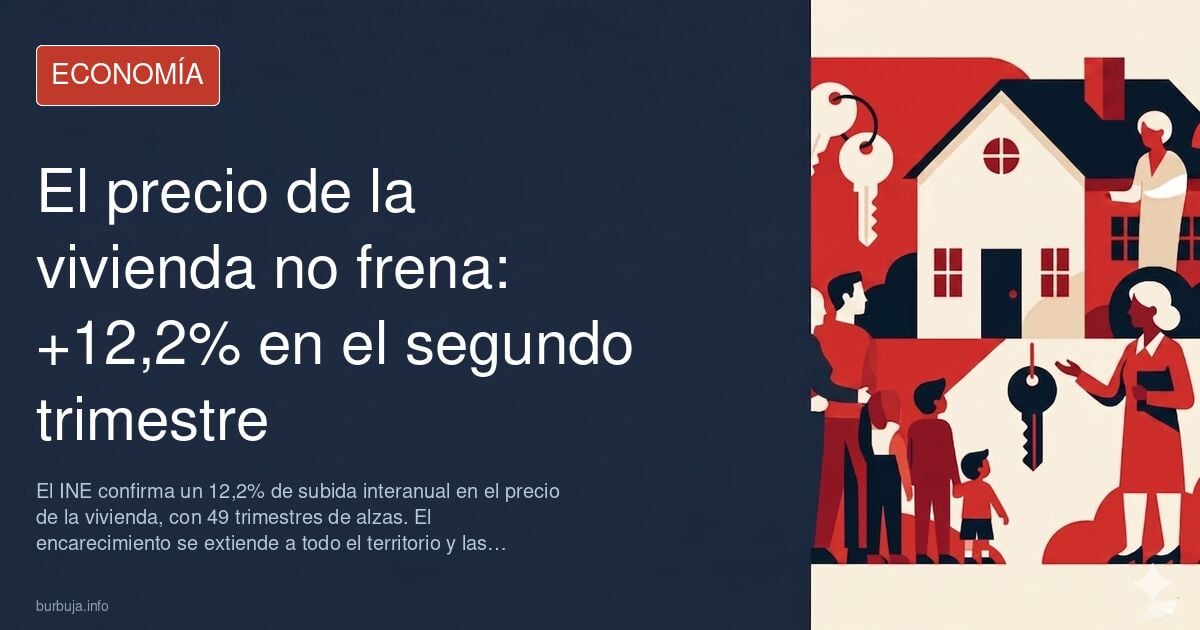
House prices rise 12.2% and notch up 49 straight quarters of gains: who is sustaining this climb?
How long will Spanish house prices keep rising? The data published by the INE (Spain's national statistics institute) on Monday offers no respite: the House Price Index recorded a 12.2% year-on-year increase in the second quarter. With this jump, the indicator has now logged 49 consecutive quarters of gains, a streak stretching over twelve years that shows no sign of running out of steam. The question is no longer whether prices are rising, but who is buying at these levels and how long the market can sustain this pace.
A price surge spreading across the whole country
The most revealing finding in the report is not the headline figure but its geographic spread. The tourist markets that led the increases after the pandemic, such as the Balearic and Canary Islands, have been caught up with and even overtaken by regions in the north and inland: Asturias, La Rioja, Castilla y León and Aragón. Rising prices are no longer concentrated in specific demand hotspots but have become generalised across practically the whole country. This debunks the narrative that the pressure comes only from big cities or tourism.
Clashing causes and interpretations
Explanations for this climb collide head-on. One school of thought points to demographic pressure: the arrival of millions of people in just a few years has created demand for housing that supply has failed to absorb, especially in small municipalities where prices have soared through a knock-on effect. A more sceptical reading holds that this is not a matter of supply and demand but a deliberate design of the system, in which house prices have become an instrument of economic policy. And some argue that weighted averages may be hiding weaknesses: in some areas prices are already falling sharply on property portals, and the third-quarter figure, due out in November, could reveal a less robust reality.
The figure that unsettles
Meanwhile, the average citizen watches their purchasing power fall short against prices that now rival Manhattan's, but with salaries that are a fraction of the kind earned there. The irony is that after more than a decade of uninterrupted increases, no one has found the brake. Perhaps the problem is not that prices cannot be stopped, but that no one wants to stop them.
Also available in: Deutsch
Summary of a discussion on Burbuja.info - Foro de economía, actualidad y política., translated from Spanish and reviewed before publication. Read the full discussion (23 replies).
More summaries
-
Bricks, scarcity and overcrowding: Spain's housing failure by design
Spanish housing prices are up 12.7% year on year while real wages barely grow. A million young people live in overcrowded conditions and the state collects record taxes.
-
Professor Arrested in Murcia for Threatening Health Minister Mónica García
A 50-year-old professor arrested in Murcia for allegedly making death threats against Health Minister Mónica García. No prior convictions.
-
Spain's growing impoverishment fuels generational and fiscal conflict
Spain's impoverishment reopens the clash between pensioners, tenants and taxpayers: private property, subsidies and institutional decay.
-
Married man in his forties: dodging nagging as a way of life
A forty-something describes his married routine: dodging complaints, bringing home his salary and pretending not to calculate what leaving would cost. The portrait dividing readers.
-
US tech visa debate: Microsoft accused of replacing 4,000 American engineers
A forum discusses claims that Microsoft replaced 4,000 US engineers with 4,300 foreign workers, and the staffing intermediaries charging to place and retain them.
-
Spain set to break summer hiring record as tourism drives job growth
A record 800,000 jobs this summer: real recovery or seasonal precarity? The forum debates whether this is economic optimism or just cosmetic employment figures.